
A Customer Asked for the Price and Disappeared. What Should You Do?
Learn how to follow up after a customer asks for the price and stops responding—without sounding pushy or losing a valuable sales opportunity.
On this page15 sections
- A Customer Asked for the Price and Disappeared. What Should You Do?
- 1. Do Not Follow Up Immediately
- 2. Check the Original Response
- 3. Send a Helpful First Follow-Up
- 4. Identify the Possible Barrier
- 5. Offer a Relevant Alternative
- 6. Reinforce Value Without Arguing
- 7. Use a Limited Follow-Up Sequence
- 8. Use Genuine Urgency Only
- 9. Record the Follow-Up in the CRM
- 10. Learn From Lost Enquiries
- Example Recovery Conversation
- Follow-Up Checklist
- How Voixt.ai Helps
- Final Thoughts
A Customer Asked for the Price and Disappeared. What Should You Do?
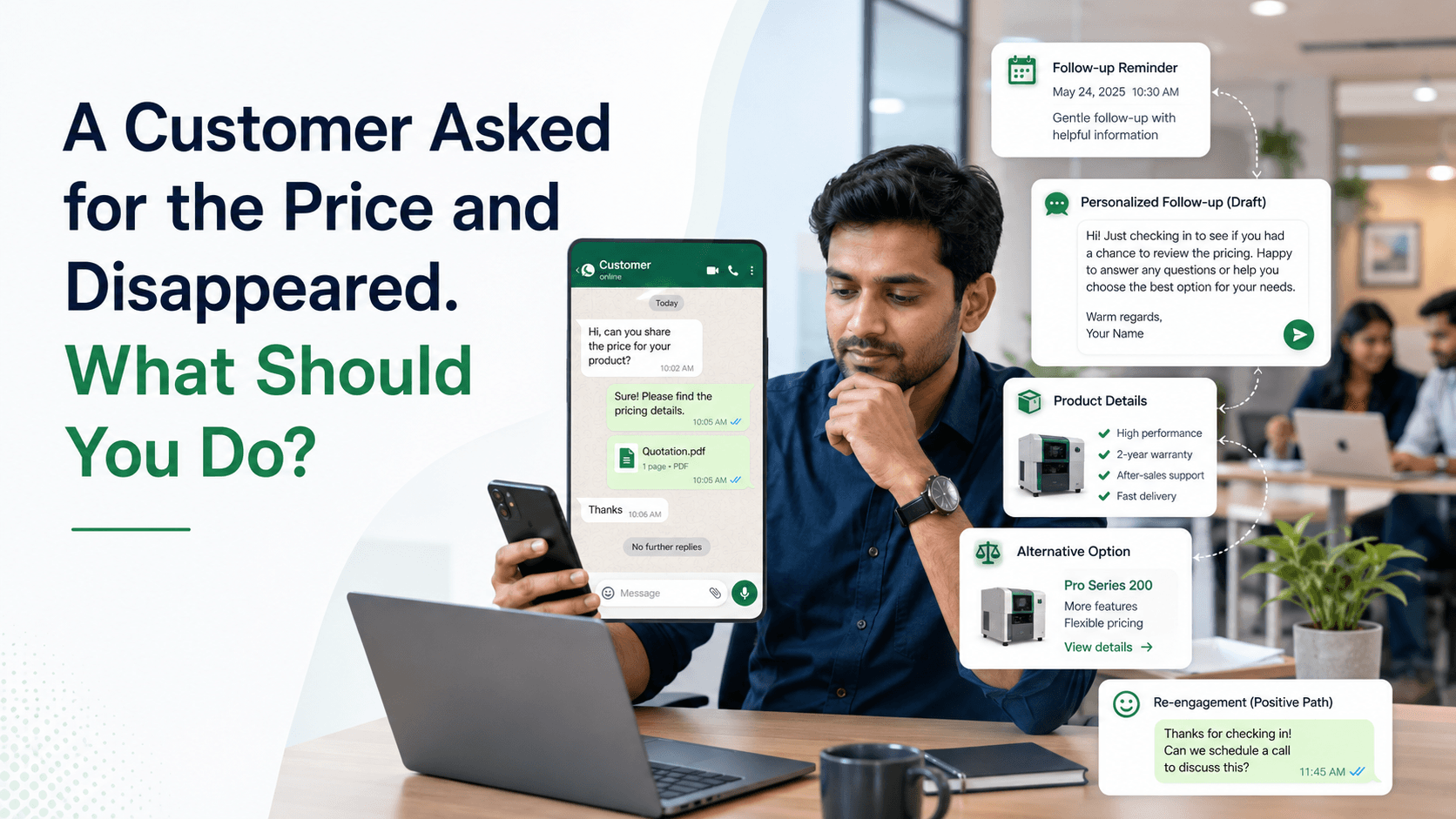
A customer asks for the price, receives your response, and then disappears.
This is common in WhatsApp sales conversations. It does not always mean the customer has rejected the offer. They may be comparing alternatives, waiting for approval, arranging payment, or simply distracted.
The right follow-up can restart the conversation. The wrong one can make the customer feel pressured.
Here is what businesses should do when a customer stops responding after receiving the price.
1. Do Not Follow Up Immediately
Give the customer enough time to consider the purchase.
For a simple product enquiry, waiting one or two days may be appropriate. For a quotation, customised service, or larger purchase, allow two or three business days.
If the customer mentioned a specific timeline, respect it.
For example, if they said they would discuss the quotation with their partner over the weekend, wait until the following week before contacting them.
2. Check the Original Response
Before following up, review how the price was communicated.
A reply containing only:
₹15,000.
may leave the customer uncertain about what is included.
A clearer response would be:
The package costs ₹15,000 and includes setup, delivery, staff training, and three months of support.
Customers may stop replying when they do not understand:
- What the price includes
- Whether taxes are included
- Delivery or installation charges
- Product availability
- Payment terms
- Warranty or support
- The difference between available options
- What they should do next
If the original response lacked important information, clarify it in the follow-up.
3. Send a Helpful First Follow-Up
Avoid sending a generic message such as:
Any update?
Instead, refer to the enquiry and offer useful assistance:
Hi Rahul, I’m following up on your enquiry about the office chairs. The ₹6,500 price includes delivery and a three-year warranty. Would you like me to share the available colours?
This message reminds the customer of the conversation, adds context, and asks one easy question.
4. Identify the Possible Barrier
Price may not be the only reason the customer disappeared.
They may be concerned about:
- Affordability
- Delivery time
- Product suitability
- Missing features
- Trust or quality
- Internal approval
- Payment timing
- Comparison with a competitor
- Changed requirements
Make it easy for the customer to explain:
Hi Neha, I wanted to check whether the quotation matches your requirements. If the scope, budget, or delivery timeline needs adjustment, I can prepare another option.
This creates space for an honest response without assuming that price is the problem.
5. Offer a Relevant Alternative
If the original option may be outside the customer’s budget, offer a suitable alternative instead of immediately discounting it.
We also have a standard package at ₹9,500 with the essential features you mentioned. Would you like a comparison of both options?
Alternatives may include:
- A smaller package
- A lower-cost model
- Fewer optional features
- A different payment plan
- Another delivery option
- Monthly instead of annual billing
- A phased implementation
Avoid sending an entire catalogue. Recommend one or two options based on the customer’s requirement.
6. Reinforce Value Without Arguing
If the customer says the price is too high, do not become defensive or repeatedly justify the amount.
Explain the value briefly:
I understand. The ₹25,000 package includes design, installation, delivery, and a one-year service warranty, so there are no separate setup charges. If you prefer, I can also suggest an option within a lower budget.
The goal is to help the customer evaluate the offer, not pressure them into accepting it.
7. Use a Limited Follow-Up Sequence
Do not continue messaging indefinitely.
A simple sequence can include three follow-ups.
First follow-up
Hi Aman, I’m following up on the quotation sent Tuesday. Would you like me to clarify what is included in the package?
Second follow-up
Hi Aman, we also have a smaller package that includes the main features you requested at a lower monthly cost. Would you like me to send the details?
Final follow-up
Hi Aman, I’ll close this enquiry for now so we do not keep messaging you. You can reply here anytime if you would like to continue.
Stop immediately if the customer declines, opts out, or asks not to receive further messages.
8. Use Genuine Urgency Only
Urgency can encourage action when it is accurate.
Valid reasons may include:
- A quotation expiry date
- Limited availability
- A scheduled price change
- A delivery deadline
- An expiring promotion
- A booking deadline
For example:
Hi Kavya, the quotation remains valid until Friday because supplier prices change next week. Would you like me to reserve the current price?
Never create false scarcity. Repeated claims that an offer is about to expire can damage trust.
9. Record the Follow-Up in the CRM
A price enquiry should not remain only inside a WhatsApp chat.
Record:
- Customer name and number
- Product or service
- Price shared
- Customer requirement
- Enquiry source
- Assigned employee
- Current lead stage
- Follow-up date
- Previous messages
- Next action
- Final outcome
This prevents leads from being forgotten and ensures that another employee can continue the conversation with the correct context.
Voixt.ai connects WhatsApp conversations with contact records, assignments, follow-up reminders, and visual CRM pipelines.
10. Learn From Lost Enquiries
If the customer does not respond after the final follow-up, close the enquiry and record the likely outcome.
Possible lost-lead reasons include:
- Price too high
- No response
- Chose a competitor
- Purchase postponed
- Product unavailable
- Delivery unavailable
- Requirement changed
- Not qualified
Reviewing this information helps businesses identify patterns.
If many customers disappear after receiving delivery charges, those costs may need to be communicated earlier. If customers frequently request cheaper options, the campaign may be attracting the wrong audience or promoting the wrong package.
Example Recovery Conversation
Customer
What is the price?
Business
The package costs ₹12,500 and includes delivery and installation.
First follow-up
Hi Priya, I’m following up on the package you viewed. It includes delivery, installation, and a one-year warranty. Would you like photos of the available finishes?
Customer
I like it, but it is above my budget.
Business
Thank you for letting me know. We have another option at ₹9,500 with the same design but a simpler finish. Would you like me to send a comparison?
The conversation continues because the follow-up identifies the barrier and provides a relevant solution.
Follow-Up Checklist
Before contacting the customer, confirm that:
- Enough time has passed.
- The original price response was clear.
- The message refers to the correct enquiry.
- The follow-up adds useful information.
- It asks only one clear question.
- The tone is respectful.
- Any urgency is genuine.
- The customer can decline easily.
- The CRM record is updated.
- Follow-ups stop after an opt-out.
How Voixt.ai Helps
Voixt.ai helps businesses manage price enquiries through:
- Shared multi-agent WhatsApp inboxes
- Automatic contact capture
- Visual CRM pipelines
- Conversation assignments
- Follow-up reminders
- Contact tags and filters
- No-code automation workflows
- Private internal notes
- AI-powered responses
- AI-to-human handovers
These capabilities help teams follow up at the right time, preserve customer context, and prevent valuable enquiries from disappearing inside busy WhatsApp inboxes.
Final Thoughts
When a customer asks for the price and disappears, do not assume the opportunity is lost.
Wait for an appropriate amount of time, review whether the price was explained clearly, send a helpful follow-up, and offer a relevant alternative when necessary.
Keep the sequence limited and respectful. If the customer remains unresponsive, close the enquiry professionally and record the outcome.
Start using Voixt.ai to track price enquiries, schedule follow-ups, and recover sales opportunities without sounding pushy.