
How Local Retailers Can Compete Online Using WhatsApp
Learn how local retailers can use WhatsApp to showcase products, manage enquiries, accept orders and provide the personal service that builds customer loyalty.
On this page14 sections
- Why Local Retailers Need a Digital Sales Channel
- Turn Conversations Into Organised Sales
- Create a Digital Product Catalogue
- Make Product Discovery Easier
- Offer Personal Recommendations
- Provide Local Convenience
- Simplify Orders and Payments
- Send Automatic Order Updates
- Use Targeted Campaigns
- Follow Up Without Pressuring Customers
- Combine Automation With Human Support
- Track What Generates Sales
- How Voixt.ai Helps Local Retailers
- Final Thoughts
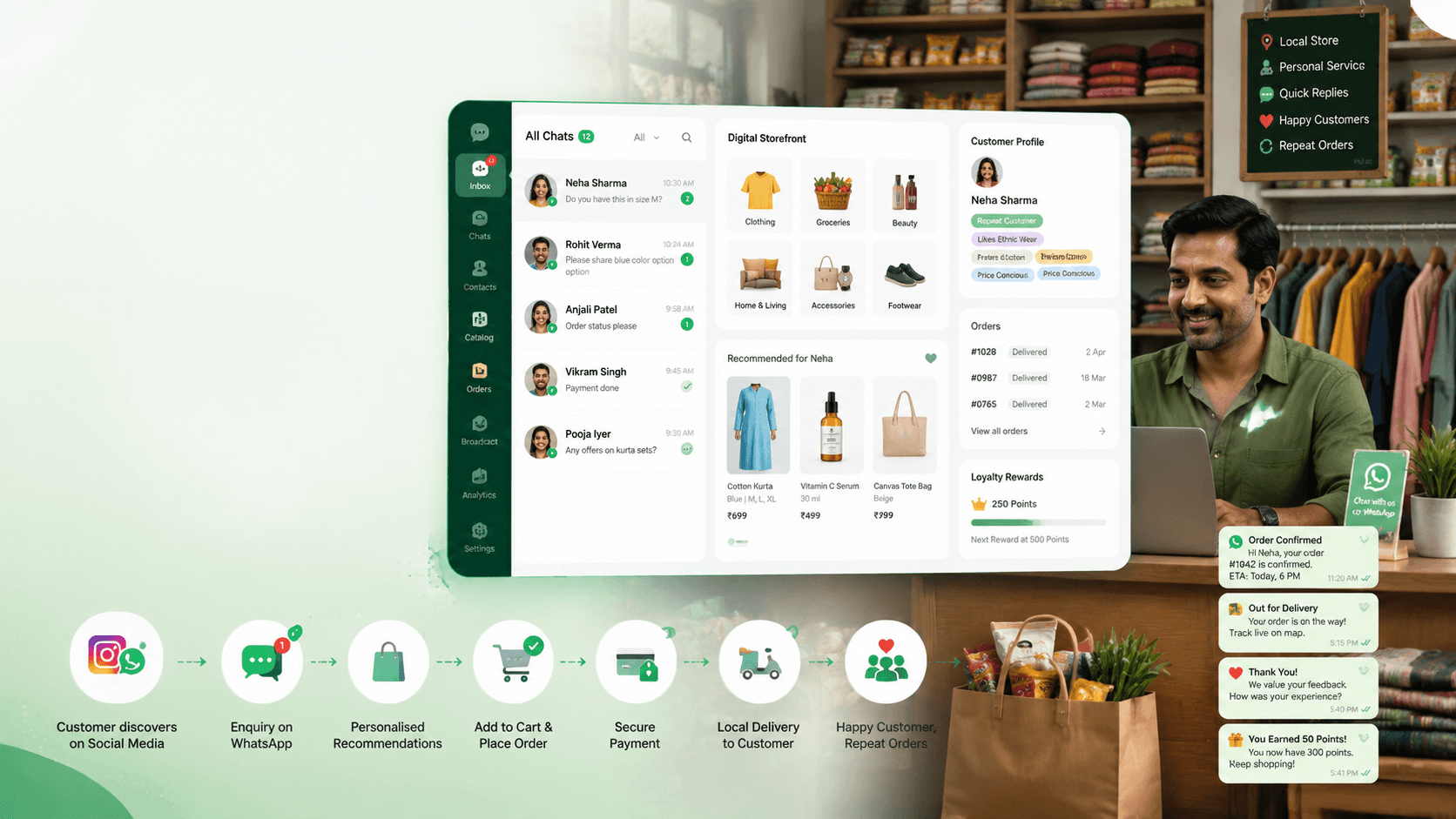
Large online marketplaces offer convenience, wide product selection and fast ordering. Local retailers may not have the same budgets or technology, but they have something equally valuable: trusted relationships with nearby customers.
WhatsApp helps local stores combine that personal connection with the convenience of online shopping.
Why Local Retailers Need a Digital Sales Channel
Customers increasingly expect to check availability, compare products, place orders and receive updates without visiting a store first.
Without a digital channel, local retailers may lose customers even when they offer better products, faster local delivery or more personalised assistance.
WhatsApp gives retailers a familiar way to serve customers online without forcing them to download another application or navigate a complicated website.
Turn Conversations Into Organised Sales
A customer may ask:
- Is this product available?
- What colours or sizes do you have?
- Can you deliver today?
- What is the final price?
- Can I pay online?
- Can you reserve this item?
These messages should not remain scattered across personal WhatsApp accounts. Each conversation should have a responsible employee, a clear status and a next action.
A shared WhatsApp inbox helps teams respond without sending duplicate replies or losing customer enquiries.
Create a Digital Product Catalogue
Local retailers can display products through a WhatsApp E-Shop where customers can:
- Browse categories
- View product images
- Check prices
- Select available variants
- Add items to their cart
- Confirm delivery details
- Choose a payment method
- Place an order
Keep product information accurate. If an item is unavailable, update its status rather than allowing customers to order something that cannot be delivered.
Make Product Discovery Easier
Customers should not have to search through hundreds of chat messages to find a product. Retailers can organise products by category, use clear images and share direct product links.
A clothing store might organise products by men, women, children and new arrivals. A grocery store might use categories such as household essentials, snacks, beverages and personal care.
Simple navigation makes the shopping experience faster.
Offer Personal Recommendations
Local retailers often understand their customers better than large marketplaces. Employees may know preferred sizes, favourite brands, previous purchases or usual budgets.
This knowledge can support helpful recommendations.
For example:
“Hi Riya, the kurta style you purchased last month is now available in two new colours. Would you like to see them?”
Personalisation should be relevant and respectful, not intrusive.
Provide Local Convenience
Local stores can compete through services that large marketplaces may not always provide, such as:
- Same-day local delivery
- Store pickup
- Product reservations
- Quick size exchanges
- Personal product demonstrations
- Local-language support
- Direct access to a known salesperson
WhatsApp makes it easy to coordinate these services through one conversation.
Simplify Orders and Payments
Once a customer selects a product, the checkout process should be clear and secure.
The customer should receive:
- Product summary
- Quantity and price
- Delivery charges
- Final payable amount
- Available payment options
- Order confirmation
Retailers can support online payments or cash on delivery based on their operational process. Payment status and order details should remain connected to the customer conversation.
Send Automatic Order Updates
Customers often ask, “Where is my order?” when they do not receive timely information.
Retailers can automatically send updates when an order is:
- Confirmed
- Being prepared
- Ready for pickup
- Dispatched
- Out for delivery
- Delivered
- Cancelled or refunded
Clear updates reduce repetitive enquiries and improve customer confidence.
Use Targeted Campaigns
Sending every offer to every customer can make messages feel like spam. Retailers should segment contacts using information such as:
- Product interest
- Purchase history
- Location
- Preferred category
- Customer type
- Order frequency
- New or returning customer
- Inactive customer
Relevant campaigns may include new arrivals, restocked products, festival collections, reorder reminders or offers based on previous interests.
Follow Up Without Pressuring Customers
A customer may ask about a product and then stop replying. Instead of sending repeated generic messages, create a follow-up reminder with clear context.
Useful follow-ups include:
- A requested product is back in stock
- A reserved item requires confirmation
- A preferred size or colour is available
- A payment remains incomplete
- The customer requested a later callback
- A relevant new collection has arrived
Every follow-up should provide value and respect the customer’s communication preferences.
Combine Automation With Human Support
Automation can handle routine tasks such as:
- Greeting new customers
- Sharing product categories
- Capturing basic requirements
- Assigning conversations
- Sending payment confirmations
- Providing order updates
- Creating follow-up reminders
Human support remains important for recommendations, complaints, returns, exchanges, custom requirements and high-value purchases.
Customers should always have a simple way to reach a team member.
Track What Generates Sales
Retailers should measure more than the number of messages received. Useful information includes:
- New enquiries
- Response time
- Product categories generating interest
- Orders completed
- Follow-ups due
- Repeat purchases
- Campaign performance
- Average order value
- Reasons for lost sales
These insights help retailers improve their product selection, service and marketing decisions.
How Voixt.ai Helps Local Retailers
Voixt.ai helps local retailers manage customer conversations and online sales through:
- Shared multi-agent WhatsApp inboxes
- Automatic contact capture
- Conversation assignments
- Customer tags and filters
- Visual CRM pipelines
- Follow-up reminders
- No-code automation workflows
- AI-powered responses
- AI-to-human handovers
- Targeted campaign management
- WhatsApp E-Shop
- Orders and payments
- Automated order updates
- Private internal notes
Retail teams can manage enquiries, products, customers, orders and follow-ups from one organised platform instead of depending on scattered chats and manual records.
Final Thoughts
Local retailers do not need to compete with large marketplaces on size. They can compete through trust, convenience, speed and personalised service.
By using WhatsApp for product discovery, customer support, ordering, payments and delivery updates, local stores can provide a simple digital shopping experience while preserving their personal connection with customers.
Voixt.ai brings WhatsApp conversations, CRM, automation, campaigns and E-Shop capabilities together so local retailers can sell online and grow more efficiently.