
Making Repeat Purchases Easier for Your Existing Customers
Learn how businesses can simplify repeat purchases with organised customer history, timely reorder reminders, personalised recommendations, faster checkout, and WhatsApp automation.
On this page21 sections
- Making Repeat Purchases Easier for Your Existing Customers
- Why Repeat Purchases Matter
- 1. Keep a Complete Customer Purchase History
- 2. Let Customers Reorder With a Simple Message
- 3. Create One-Tap Reorder Options
- 4. Send Reorder Reminders at the Right Time
- 5. Confirm Current Prices and Availability
- 6. Remember Preferences Without Becoming Intrusive
- 7. Recommend Complementary Products Carefully
- 8. Use Customer Segments
- 9. Keep Conversations in a Shared Inbox
- 10. Assign Ownership and Next Actions
- 11. Simplify Order Confirmation
- 12. Make Payment Convenient and Secure
- 13. Provide Proactive Fulfilment Updates
- 14. Automate Repetition, Not the Relationship
- 15. Make It Easy to Pause or Stop Messages
- Measure Repeat-Purchase Performance
- Common Mistakes to Avoid
- How Voixt.ai Helps Businesses Increase Repeat Purchases
- Final Thoughts
Making Repeat Purchases Easier for Your Existing Customers
An existing customer should not have to repeat the complete buying process every time they return.
The business may already know which product they purchased, their preferred variant, delivery location, usual quantity, and how they prefer to pay. Yet many returning customers are treated like new enquiries because their information is scattered across chats, spreadsheets, invoices, and employee phones.
A smoother repeat-purchase experience saves customers time and helps businesses build lasting relationships.
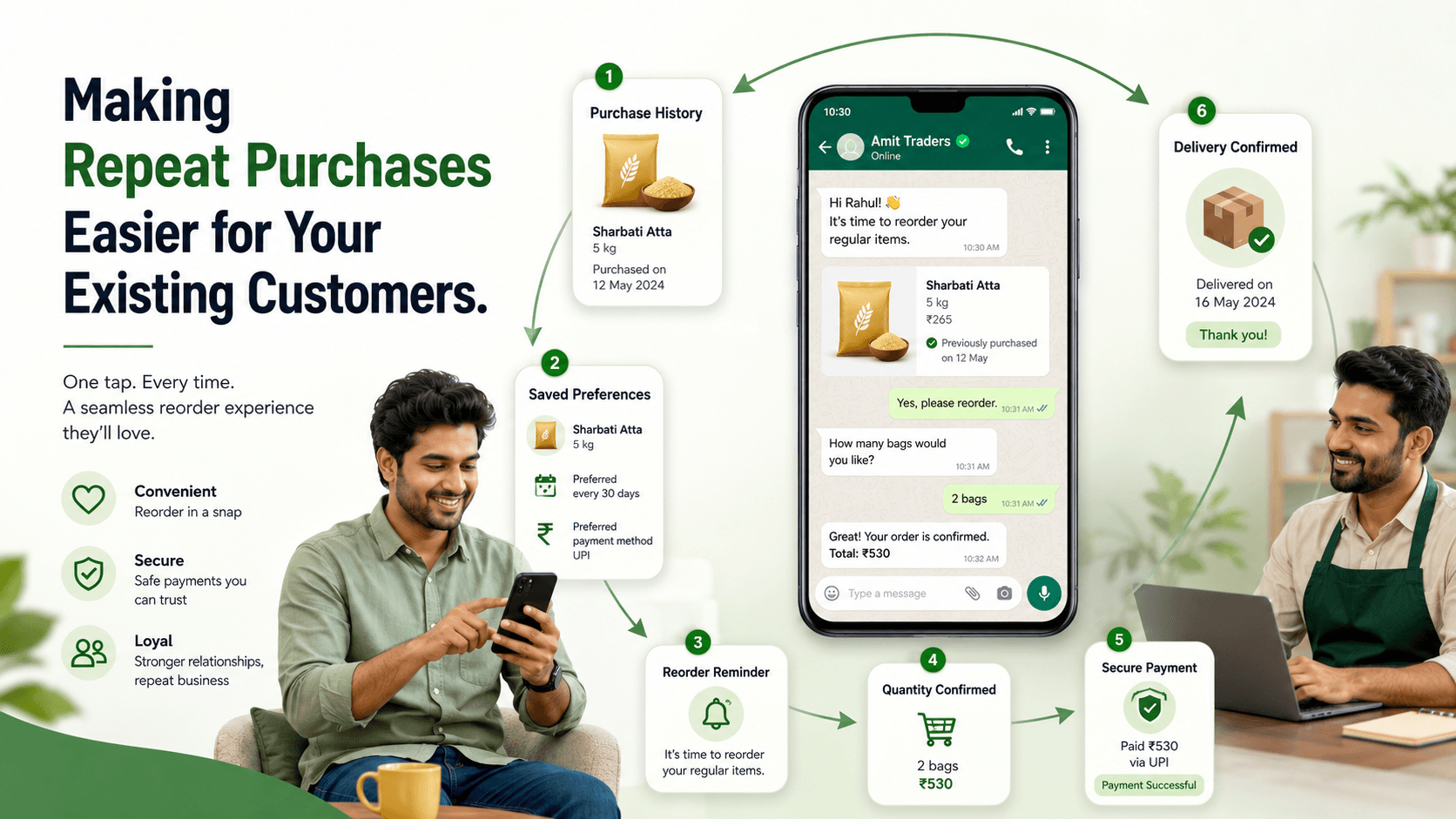
WhatsApp can make reordering convenient because customers can return to an existing conversation, ask for the same product, confirm any changes, and receive payment and fulfilment updates in one place.
Here is how businesses can make repeat purchases easier without making communication feel intrusive or automated.
Why Repeat Purchases Matter
Existing customers already know the business and have experienced its products or services. The business does not need to rebuild trust from the beginning.
However, customers may still leave if reordering is inconvenient.
Common problems include:
- Having to explain the previous order again
- Being asked for information the business already has
- Receiving irrelevant recommendations
- Waiting for an employee to find the old invoice
- Learning too late that a product is unavailable
- Repeating delivery and payment details
- Receiving too many reminders
- Getting messages from different employees without context
Removing these problems can make the business the easiest option to choose again.
1. Keep a Complete Customer Purchase History
Employees should be able to see relevant information from previous purchases, including:
- Products or services purchased
- Variants
- Quantity
- Purchase date
- Price paid
- Delivery or pickup method
- Previous questions
- Special requirements
- Assigned employee
- Follow-up history
This allows an employee to respond naturally:
Hi Meera, welcome back. Would you like the same 5 kg pack of coffee beans you ordered last month, or would you prefer to see the new medium-roast option?
The customer receives continuity instead of having to start again.
Only store information that is relevant, appropriate, and permitted. Protect customer data and follow applicable privacy requirements.
2. Let Customers Reorder With a Simple Message
Repeat purchasing should require as few steps as reasonably possible.
A customer might send:
Please send my usual order.
The business should be able to identify the previous product, confirm current availability and price, and provide an order summary.
For example:
Your previous order was two 1 kg packs of medium-roast coffee. The current total is ₹1,800, including delivery. Would you like the same quantity delivered to your saved address on Saturday?
The customer can then confirm or request a change.
Do not process an order based only on assumptions. Always confirm the current product, quantity, price, and fulfilment details before payment.
3. Create One-Tap Reorder Options
Businesses can make frequent purchases easier with simple reply actions or direct reorder links.
A message might say:
Hi Arjun, would you like to reorder your usual printer supplies for this month? Reply REORDER for the same items or CHANGE to update the quantity.
A useful reorder flow can:
- Identify the previous purchase.
- Confirm current availability.
- Show the current price.
- Ask whether anything has changed.
- Present the complete order summary.
- Share an approved payment method.
- Send fulfilment updates.
The process should allow customers to reach an employee whenever they need assistance.
4. Send Reorder Reminders at the Right Time
Some products have a predictable replacement or replenishment cycle.
Examples include:
- Groceries
- Pet supplies
- Household products
- Beauty products
- Printer supplies
- Water deliveries
- Equipment maintenance
- Service renewals
- Regular business supplies
A well-timed reminder can be useful:
Hi Kavya, it may be time to reorder your usual pet food. The 10 kg pack is available for ₹1,850, with delivery on Thursday. Reply REORDER to confirm or LATER if you do not need it yet.
The timing should be based on the customer’s actual purchase pattern or stated preference—not a generic schedule applied to everyone.
Give customers control over reminder timing and frequency. If someone reorders less often, adjust the schedule rather than repeatedly messaging them.
5. Confirm Current Prices and Availability
A previous order is not a promise that the same product, price, or delivery timeline is still available.
Before accepting a repeat order, confirm:
- Current price
- Stock availability
- Product changes
- Delivery charge
- Fulfilment timeline
- Relevant terms
If the product is unavailable, recommend a suitable alternative and explain the difference clearly.
For example:
Your usual 500 ml bottle is temporarily unavailable. The same product is available in a 750 ml size for ₹420. Would you like that option, or should we notify you when the 500 ml size returns?
Honest availability information protects customer trust.
6. Remember Preferences Without Becoming Intrusive
Relevant preferences can make repeat shopping more convenient.
Depending on the business, useful information may include:
- Preferred product category
- Size or variant
- Typical quantity
- Delivery area
- Pickup preference
- Preferred language
- Usual purchase frequency
- Communication preference
Use this information to reduce effort, not to make uncomfortable assumptions.
For example:
Your previous order was the blue shirt in size L. Would you like to see the two new colours available in the same fit?
Avoid referencing sensitive details unnecessarily. Customers should be able to update or remove preferences.
7. Recommend Complementary Products Carefully
Relevant recommendations can improve the customer experience, but too many suggestions can make reordering feel like a sales pitch.
A complementary recommendation should be connected to the customer’s purchase.
For example:
We can add the replacement filter designed for the purifier you purchased. It costs ₹650. Would you like it included?
Avoid sending unrelated products or adding anything without explicit confirmation.
The main reorder should remain easy even if the customer declines the additional suggestion.
8. Use Customer Segments
Not every existing customer should receive the same message.
Useful segments may include:
- Product purchased
- Purchase date
- Typical reorder cycle
- Customer location
- Preferred variant
- Repeat buyer
- Membership level
- Inactive customer
- Waiting for restock
- Service renewal due
Segmentation makes reminders and recommendations more relevant.
Before sending a campaign, exclude customers who:
- Recently reordered
- Declined the product
- Requested fewer messages
- Asked to stop promotional communication
- Have an unresolved complaint
- Are outside the eligible location
Good exclusions prevent unnecessary messages.
9. Keep Conversations in a Shared Inbox
If customer history exists only on an employee’s personal phone, other team members cannot provide consistent service.
A shared inbox allows authorised employees to:
- View previous conversations
- See purchase context
- Assign returning customers
- Add private notes
- Check pending responses
- Continue conversations when someone is unavailable
Customers should not need to repeat their history whenever a different employee responds.
10. Assign Ownership and Next Actions
Every active repeat-purchase opportunity should have an owner and status.
A simple repeat-sales pipeline might include:
- Reorder opportunity identified
- Reminder scheduled
- Customer contacted
- Reorder confirmed
- Awaiting payment
- Paid
- Fulfilment in progress
- Completed
- Reminder postponed
- Declined
The assigned employee should know what action is due and when.
For example:
Follow up on 12 September because the customer requested a reminder after returning from travel.
This is more useful than sending repeated messages without context.
11. Simplify Order Confirmation
Before payment, send a complete summary:
Repeat order summary
Product: Medium-roast coffee beans Quantity: Two 1 kg packs Product total: ₹1,700 Delivery: ₹100 Final amount: ₹1,800 Delivery location: Koramangala, Bengaluru Expected delivery: Saturday
Please reply CONFIRM if these details are correct.
Allow the customer to update the quantity, address, delivery date, or variant before confirming.
Even when the same information was used previously, obtain confirmation for the current order.
12. Make Payment Convenient and Secure
After confirmation, provide an approved payment option supported by the business.
Possible options may include:
- Secure payment link
- Authorised UPI request
- Bank transfer instructions
- Cash on delivery
- Payment during pickup
Never request passwords, PINs, card credentials, or one-time passwords through chat.
Verify payment through the authorised payment system rather than relying only on a screenshot. After verification, send an order number, receipt, and fulfilment timeline.
13. Provide Proactive Fulfilment Updates
Repeat customers still need clear order communication.
Send updates when the order is:
- Confirmed
- Being prepared
- Ready for pickup
- Dispatched
- Out for delivery
- Delivered
- Delayed
A reliable fulfilment experience gives customers another reason to purchase again.
14. Automate Repetition, Not the Relationship
Automation can manage predictable tasks such as:
- Identifying an expected reorder date
- Creating reminders
- Sending approved reorder messages
- Assigning replies
- Confirming orders
- Updating CRM stages
- Sending fulfilment notifications
- Alerting an employee when assistance is needed
A person should handle conversations involving:
- Product changes
- Complaints
- Payment problems
- Custom requirements
- Uncertain preferences
- High-value purchases
- Exceptional delivery requests
Automation should make the customer’s experience easier, not remove access to human help.
15. Make It Easy to Pause or Stop Messages
Customers should control whether they receive reorder reminders and promotional communication.
A message can include:
Reply LATER to receive this reminder next month or STOP to discontinue reorder reminders.
Record the preference immediately and apply it across future campaigns.
Follow applicable consent, privacy, and messaging requirements. A repeat purchase does not automatically mean the customer wants unlimited promotional messages.
Measure Repeat-Purchase Performance
Useful metrics include:
- Number of reorder reminders sent
- Customer response rate
- Confirmed repeat orders
- Time between purchases
- Repeat-purchase conversion rate
- Average repeat-order value
- Products with the highest repeat rate
- Follow-ups due or overdue
- Opt-outs and complaints
- Reasons customers do not reorder
These metrics help businesses improve timing, relevance, and convenience.
Common Mistakes to Avoid
Treating returning customers like new leads
Use their previous purchase context when appropriate.
Reordering without confirmation
Verify the current product, quantity, price, and delivery details.
Sending reminders too frequently
Adjust timing according to customer behaviour and preferences.
Recommending unrelated products
Keep suggestions relevant to the customer’s known needs.
Ignoring price or stock changes
Confirm current information before accepting the order.
Keeping customer history on personal devices
Use an organised system accessible to authorised employees.
Making it difficult to stop reminders
Provide simple preference controls and respect them.
How Voixt.ai Helps Businesses Increase Repeat Purchases
Voixt.ai helps businesses organise customer history, reorder opportunities, reminders, and fulfilment conversations.
Teams can use:
- Shared multi-agent WhatsApp inboxes to manage returning customers together
- Automatic contact capture to maintain organised customer records
- Conversation assignments so every reorder has a responsible employee
- Visual CRM pipelines to track repeat purchases from reminder to fulfilment
- Contact tags and filters for products, purchase cycles, locations, and preferences
- Follow-up reminders so reorder opportunities are not forgotten
- No-code automation workflows for reminders, confirmations, assignments, and order updates
- AI-powered responses to help employees answer common reorder questions
- Private internal notes for sharing relevant customer context
- AI-to-human handovers when a customer needs personal assistance
- Campaign management for targeted replenishment, renewal, and restock messages
This allows businesses to make repeat purchasing convenient while keeping communication relevant and personal.
Final Thoughts
The easiest business to buy from often becomes the business customers choose again.
Repeat purchasing should not require customers to search for old invoices, explain previous orders, or wait while an employee reconstructs their history.
By maintaining organised customer records, sending timely reminders, confirming current details, simplifying payment, and providing reliable fulfilment updates, businesses can create a smoother experience for returning customers.
Voixt.ai helps teams manage these repeat-purchase journeys without losing the personal attention that keeps customers loyal.