
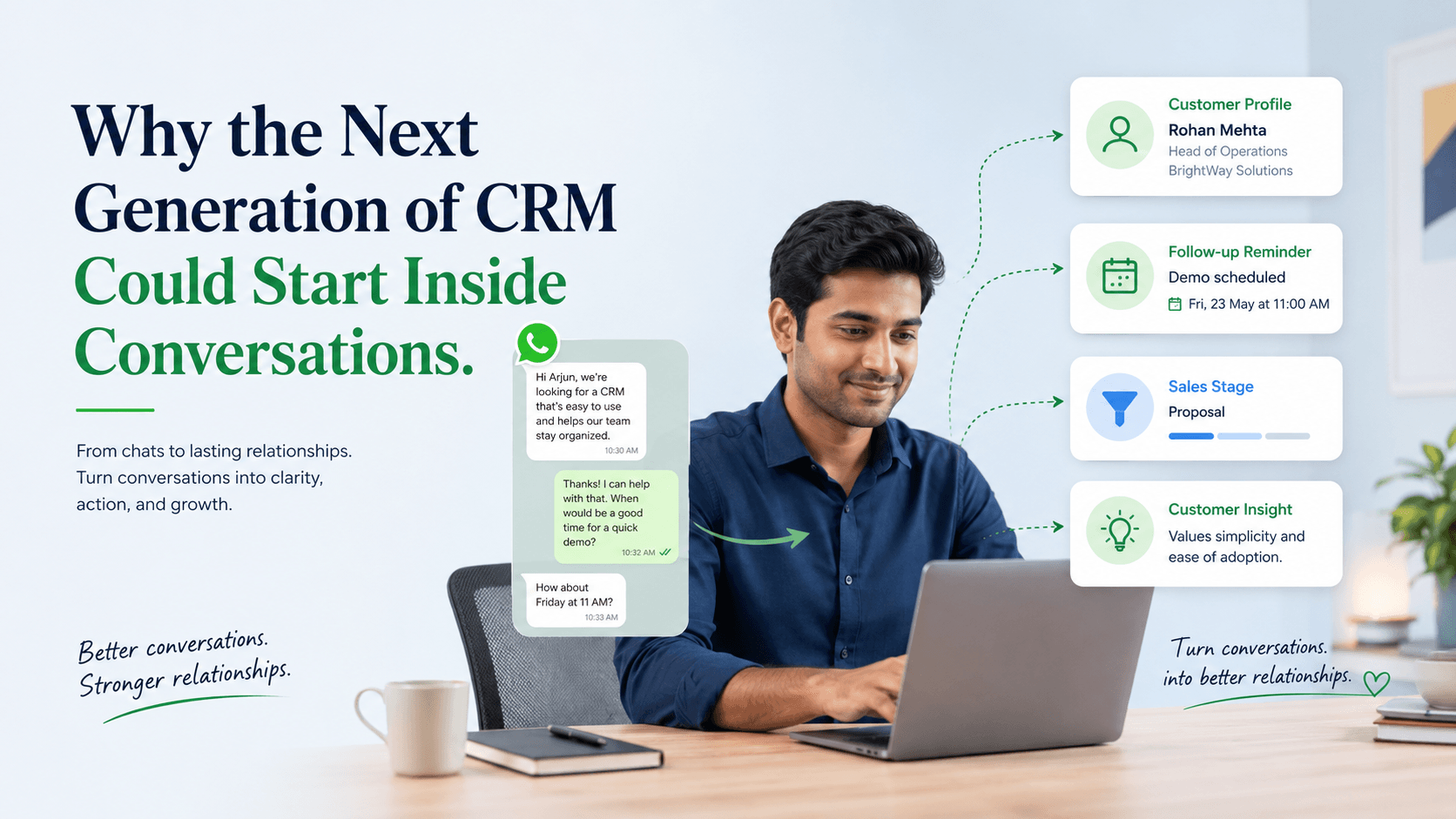
Why the Next Generation of CRM Could Start Inside Conversations
Discover how conversation-first CRM can capture customer context, organise leads, automate follow-ups and help teams manage sales directly from WhatsApp.
On this page15 sections
- The Problem With Disconnected CRM Systems
- Conversations Already Contain Valuable Customer Data
- Every Message Can Create Context
- A Shared Inbox Becomes the Starting Point
- Lead Stages Can Reflect Real Conversations
- Follow-Ups Become Connected to Context
- AI Can Assist Within the Customer Record
- Automation Can Update the CRM
- Internal Collaboration Stays Private
- Managers Gain Visibility Without Reading Every Chat
- CRM Becomes Easier for Employees to Use
- Customer Experience Becomes More Consistent
- Responsible Data Management Still Matters
- How Voixt.ai Connects CRM With Conversations
- Final Thoughts
Traditional CRM systems usually ask employees to update customer records after a conversation ends. They may need to create a contact, write notes, change the sales stage and schedule a follow-up manually.
This process creates a gap between where the customer conversation happens and where the business manages the relationship.
The next generation of CRM could close that gap by starting inside the conversation itself.
The Problem With Disconnected CRM Systems
Customers may communicate through WhatsApp while employees manage information in a separate CRM, spreadsheet or personal notes.
This can lead to:
- Missing customer details
- Incomplete conversation history
- Delayed CRM updates
- Forgotten follow-ups
- Duplicate data entry
- Unclear lead ownership
- Outdated sales stages
- Limited visibility for managers
When updating the CRM becomes additional work, important information is often recorded late or not recorded at all.
Conversations Already Contain Valuable Customer Data
A customer conversation may reveal:
- Product or service interest
- Budget range
- Preferred location
- Required timeline
- Previous concerns
- Purchase intent
- Appointment preference
- Payment status
- Follow-up requirement
Instead of asking employees to copy this information into another system, a conversation-first CRM can connect the data directly to the customer record.
Every Message Can Create Context
A new WhatsApp message can automatically:
- Capture the customer’s contact details
- Identify the enquiry source
- Create a lead
- Apply relevant tags
- Assign the conversation
- Start an automation workflow
- Place the lead in a CRM stage
- Create a follow-up reminder
The CRM becomes part of the conversation rather than a separate administrative task.
A Shared Inbox Becomes the Starting Point
A shared multi-agent inbox allows authorised team members to manage customer conversations from one organised workspace.
Teams can:
- Assign conversations
- See who is responding
- Review customer history
- Avoid duplicate replies
- Transfer ownership
- Add private internal notes
- Monitor pending conversations
The inbox becomes the operational centre for both communication and customer management.
Lead Stages Can Reflect Real Conversations
A visual pipeline can represent what is actually happening with each customer.
A lead may move through stages such as:
- New enquiry
- Contacted
- Requirement collected
- Qualified
- Demo or appointment scheduled
- Quotation shared
- Follow-up required
- Negotiation
- Payment pending
- Won or lost
Stage changes can happen manually or through defined automation rules based on customer actions.
Follow-Ups Become Connected to Context
Traditional reminders may only display a customer name and date. A conversation-first CRM can connect the reminder to the complete chat history.
For example:
“Follow up on Friday to confirm whether the customer wants the premium plan after reviewing the quotation.”
When the reminder appears, the employee can immediately see what was discussed and continue naturally.
AI Can Assist Within the Customer Record
AI-powered assistance can analyse the active conversation and help employees:
- Draft relevant responses
- Summarise customer requirements
- Identify potential intent
- Suggest the next action
- Retrieve approved information
- Prepare a human handover
AI should support employee judgement rather than make every customer decision automatically.
Automation Can Update the CRM
No-code workflows can connect customer actions with CRM activities.
For example:
- A new enquiry creates a contact
- A selected product adds a tag
- A demo booking changes the lead stage
- A completed payment marks the opportunity as won
- An unanswered quotation creates a follow-up reminder
- A support request transfers the conversation to a human
This reduces manual updates and keeps customer records more accurate.
Internal Collaboration Stays Private
Employees may need to discuss discounts, availability, technical questions or customer concerns.
Private internal notes can record information such as:
- “Manager approval required for the discount.”
- “Customer prefers communication after 6:00 p.m.”
- “Technical team is reviewing the requirement.”
- “Do not send another campaign until next month.”
The team receives the required context without exposing internal discussions to the customer.
Managers Gain Visibility Without Reading Every Chat
A conversation-first CRM can help managers monitor:
- New and unassigned leads
- First-response time
- Pending conversations
- Leads by pipeline stage
- Follow-ups due or overdue
- Sales by source
- Conversion rates
- Common customer questions
- Reasons for lost opportunities
Managers can understand performance through structured information rather than manually checking individual conversations.
CRM Becomes Easier for Employees to Use
CRM systems fail when employees see them only as reporting tools for management.
When CRM actions happen naturally inside the workspace where employees already communicate with customers, the system becomes useful for daily work.
Employees gain access to customer history, reminders, notes, assignments and sales stages without repeatedly switching tools.
Customer Experience Becomes More Consistent
Customers benefit when employees have complete context. They do not need to repeat the same information every time a conversation is transferred.
A connected CRM can help businesses provide:
- Faster responses
- Relevant recommendations
- Consistent information
- Timely follow-ups
- Smooth employee handovers
- Better post-purchase support
The customer experiences one continuous relationship rather than a series of disconnected interactions.
Responsible Data Management Still Matters
Conversation-first CRM systems should collect only necessary customer information and restrict access to authorised employees.
Businesses should obtain appropriate consent, protect customer records, respect opt-out requests and follow applicable privacy and messaging requirements.
Convenience should strengthen customer trust, not weaken it.
How Voixt.ai Connects CRM With Conversations
Voixt.ai helps businesses manage customer relationships directly from WhatsApp conversations through:
- Automatic contact capture
- Shared multi-agent WhatsApp inboxes
- Conversation assignments
- Visual CRM pipelines
- Contact tags and filters
- Follow-up reminders
- No-code automation workflows
- AI-powered responses
- AI-to-human handovers
- Private internal notes
- Targeted campaign management
- Orders and payments
- Automated order updates
Teams can manage communication, lead progress, sales activities and customer support from one connected platform.
Final Thoughts
The next generation of CRM may not begin with a form, dashboard or manual data entry. It may begin when a customer sends a message.
When conversations, customer records, pipeline stages, follow-ups and automation work together, CRM becomes a natural part of the customer journey.
Voixt.ai brings these capabilities into WhatsApp so businesses can manage relationships from the place where those relationships actually begin.