
How to Turn Repeat WhatsApp Enquiries Into Actual Sales
Learn how to identify buying intent, understand customer barriers, personalise responses, and convert repeat WhatsApp enquiries into actual sales.
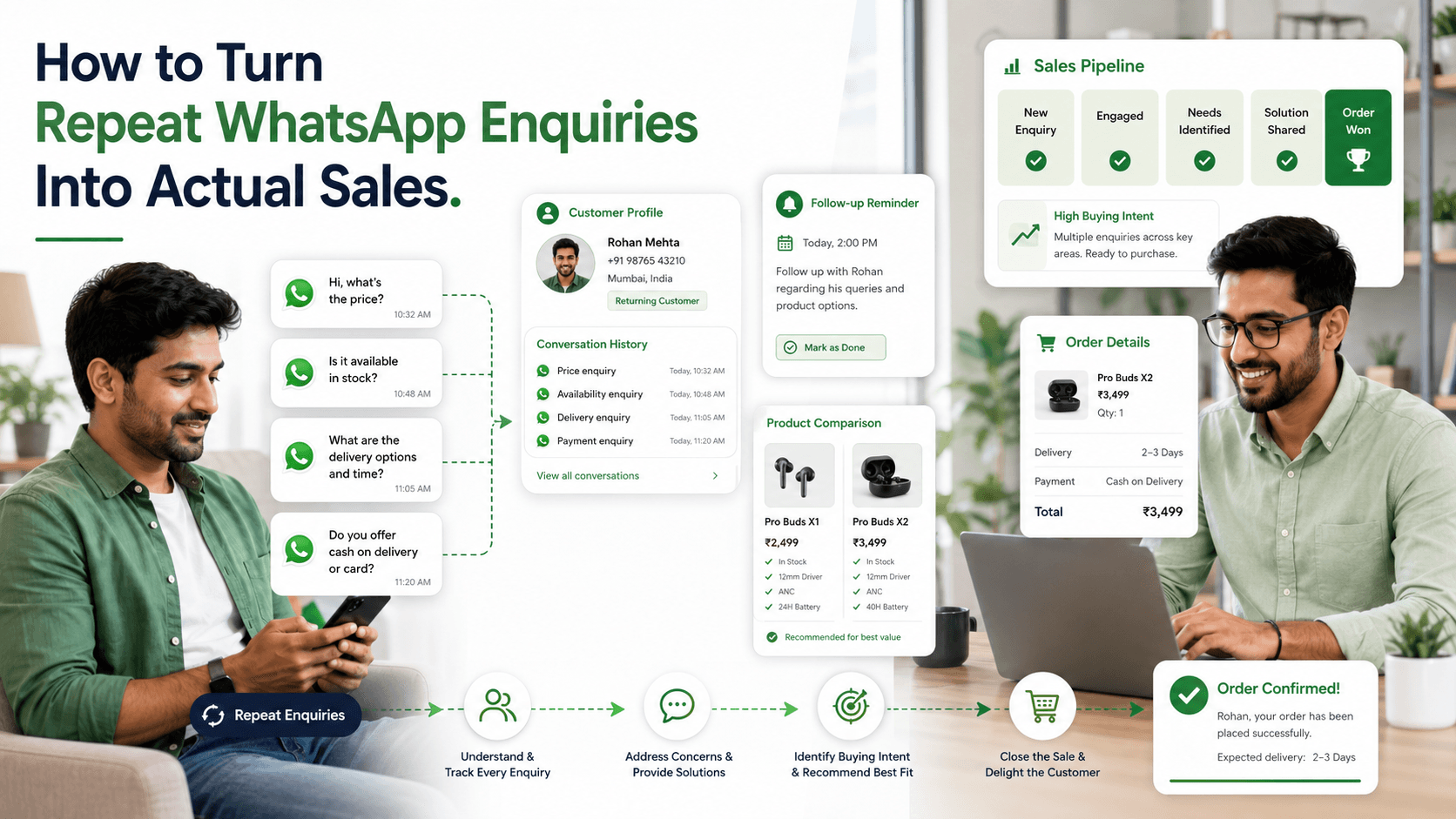
On this page17 sections
- How to Turn Repeat WhatsApp Enquiries Into Actual Sales
- 1. Recognise Repeat Enquiries as Buying Signals
- 2. Keep the Complete Conversation History
- 3. Identify What Is Preventing the Purchase
- 4. Personalise the Recommendation
- 5. Explain the Complete Value
- 6. Use Evidence to Build Confidence
- 7. Offer a Clear Next Step
- 8. Create Genuine Urgency
- 9. Assign One Employee
- 10. Follow Up With New Information
- 11. Use Automation Without Losing Context
- 12. Track Why Customers Do Not Purchase
- Example Repeat-Enquiry Workflow
- Repeat-Enquiry Checklist
- How Voixt.ai Helps
- Final Thoughts
How to Turn Repeat WhatsApp Enquiries Into Actual Sales
Some customers contact a business several times without purchasing.
They may repeatedly ask about prices, availability, delivery, features, or payment options. These conversations can appear unproductive, but repeated enquiries often indicate genuine interest combined with an unresolved concern.
The business must understand what is preventing the customer from deciding and guide them toward one clear next step.
Here is how to turn repeat WhatsApp enquiries into actual sales.
1. Recognise Repeat Enquiries as Buying Signals
A customer who returns to ask another question has not completely rejected the offer.
They may be:
- Comparing different options
- Waiting for approval
- Checking whether the product is still available
- Trying to understand the total cost
- Looking for reassurance
- Arranging payment
- Evaluating delivery timelines
- Unsure which option is suitable
Treat the returning customer as an active opportunity rather than a new enquiry.
Instead of replying:
Please check the details sent earlier.
Use the previous conversation:
Hi Meera, welcome back. You previously asked about the six-user plan with automation. Are you now comparing packages, or is there a particular feature you would like me to clarify?
This response acknowledges the earlier enquiry and makes continuing easier.
2. Keep the Complete Conversation History
Customers should not need to repeat their requirements every time they contact the business.
Employees should be able to see:
- Previous messages
- Products or services discussed
- Prices and quotations shared
- Customer requirements
- Budget
- Location
- Previous concerns
- Assigned employee
- Follow-up history
- Current CRM stage
Without this context, the business may ask the same questions repeatedly or provide inconsistent information.
A connected customer record allows the employee to respond more personally:
Hi Arjun, the black model you asked about last week is now available. The price remains ₹8,500, including delivery. Would you like me to reserve one?
Context turns a repeated enquiry into a continuous sales conversation.
3. Identify What Is Preventing the Purchase
If the customer keeps asking questions but does not proceed, an unresolved barrier probably remains.
Common barriers include:
- Price
- Delivery charges
- Product suitability
- Missing features
- Payment timing
- Lack of trust
- Internal approval
- Comparison with a competitor
- Unclear warranty or support
- Uncertainty about the next step
Ask one direct but helpful question:
You have reviewed both packages. Is there any particular concern preventing you from choosing one?
For a price-sensitive customer:
Would you prefer an option within a specific budget?
For a business purchase:
Does anyone else need to review the quotation before you proceed?
Understanding the barrier is more effective than repeating the same sales message.
4. Personalise the Recommendation
Do not send the full catalogue every time the customer returns.
Use the information already collected to recommend the most suitable option:
Based on your requirement for five employees, automated lead assignment, and CRM tracking, the Growth plan would be the best fit.
If alternatives are necessary, offer two clear choices:
We have two suitable options:
- Standard — ₹9,500 with the essential features
- Premium — ₹13,500 with automation, installation, and priority support
Would you like a short comparison?
A specific recommendation reduces decision fatigue and demonstrates that the business understands the customer.
5. Explain the Complete Value
Customers may repeatedly ask about price because the value is unclear.
Avoid sending only:
₹12,000.
Instead, explain what is included:
The package costs ₹12,000 and includes delivery, installation, employee training, and six months of support.
Depending on the offer, clarify:
- Product or service specifications
- Delivery and installation
- Taxes and additional charges
- Warranty
- Support
- Setup
- Training
- Payment terms
- Expected results
- Upgrade options
The purpose is not to overwhelm the customer. It is to remove uncertainty about what they will receive.
6. Use Evidence to Build Confidence
Some customers continue enquiring because they are interested but not fully confident.
Relevant evidence can include:
- Customer reviews
- Product photographs
- Demonstration videos
- Case studies
- Before-and-after examples
- Warranty details
- Certifications
- Return policies
- Sample work
- Client results
For example:
You mentioned that reliability was important. This model includes a three-year warranty, and I can also share a short customer review from a similar office installation. Would that help?
Send only evidence related to the customer’s concern. Large collections of unrelated files can make the decision more difficult.
7. Offer a Clear Next Step
A conversation can continue indefinitely when the customer does not know what to do next.
Each response should move toward one simple action:
- Confirm the quantity
- Receive a quotation
- View a demonstration
- Compare two options
- Check delivery availability
- Reserve the product
- Schedule a consultation
- Approve the proposal
- Receive a payment link
For example:
The model is available and can be delivered on Thursday. Would you like me to reserve it and send the payment link?
A clear question makes responding easier and creates momentum.
8. Create Genuine Urgency
Urgency can help a customer decide when it is accurate and relevant.
Valid reasons may include:
- Limited stock
- A quotation expiry date
- A scheduled price increase
- A booking deadline
- An expiring promotion
- A delivery cut-off
- Limited implementation availability
For example:
The current quotation remains valid until Friday because supplier pricing changes next week. Would you like me to reserve the current price?
Do not create false scarcity or repeatedly claim that an offer is ending. Artificial pressure can damage trust and reduce the chance of future sales.
9. Assign One Employee
Repeat customers should not receive different answers from different employees.
Every active lead should have one responsible owner who can:
- Review the complete history
- Maintain consistent information
- Understand the customer’s concerns
- Schedule follow-ups
- Update the CRM stage
- Coordinate internal approvals
- Record the final outcome
If another employee must take over, provide the complete context through internal notes.
A useful handover note might say:
Customer needs ten units before 20 August. Price and delivery are approved, but finance requires a formal tax invoice. Follow up Wednesday afternoon.
Clear ownership prevents duplicate messages and missed opportunities.
10. Follow Up With New Information
Do not send repeated messages that only ask:
Any update?
Every follow-up should add value.
For example:
Hi Neha, I’m following up on the package you reviewed. I’ve prepared a smaller option that keeps the main features within the budget you shared. Would you like me to send it?
Useful follow-up information may include:
- Revised pricing
- A lower-cost alternative
- New stock availability
- Updated delivery dates
- A relevant comparison
- An answered concern
- A demonstration
- A suitable payment option
- A genuine deadline
Limit the number of follow-ups and stop when the customer declines or opts out.
11. Use Automation Without Losing Context
Automation can help businesses manage repeat enquiries by:
- Recognising existing contacts
- Displaying previous conversations
- Identifying customer intent
- Applying tags
- Updating CRM stages
- Assigning conversations
- Scheduling follow-ups
- Sending reminders
- Notifying employees
- Stopping sequences after a response
However, repeat enquiries often require human judgement.
Transfer the conversation to an employee when the customer has complex requirements, requests a discount, raises an objection, needs approval, experiences a payment problem, or asks to speak with someone.
The employee should receive the complete conversation history so the customer does not need to begin again.
12. Track Why Customers Do Not Purchase
Not every repeat enquiry will convert.
Record the final outcome and, when possible, the reason:
- Price too high
- Chose a competitor
- Purchase postponed
- Product unavailable
- Delivery unavailable
- Requirement changed
- Approval declined
- No response
- Not qualified
Reviewing these reasons helps the business improve its pricing, campaigns, products, qualification process, and follow-up messages.
For example, if many customers repeatedly ask about delivery charges and then disappear, those charges may need to be communicated earlier.
Example Repeat-Enquiry Workflow
First enquiry
What is the price of the premium package?
Business
The premium package costs ₹15,000 and includes delivery, installation, and a two-year warranty. How many units do you require?
Customer
I need three, but I will decide later.
Repeat enquiry
Is it still available?
Business
Hi Rohan, yes, the three premium units you asked about are currently available. You previously mentioned that you needed time to decide. Is price, delivery timing, or product suitability the main concern?
Customer
The total cost is above my budget.
Business
Thank you for clarifying. We have a standard option at ₹11,500 per unit with the same core design and a one-year warranty. Would you like a comparison of both models?
The business converts a repeated availability question into a meaningful sales conversation by identifying the actual barrier.
Repeat-Enquiry Checklist
For every returning customer, confirm that:
- The previous conversation is available.
- The employee understands the original requirement.
- One person owns the lead.
- Earlier prices and promises are visible.
- The unresolved barrier has been identified.
- The recommendation is personalised.
- The value is explained clearly.
- One simple next step is proposed.
- Follow-ups add useful information.
- Automation stops after a response or opt-out.
- The CRM stage is accurate.
- The final outcome is recorded.
How Voixt.ai Helps
Voixt.ai helps businesses convert repeat WhatsApp enquiries through:
- Shared multi-agent inboxes
- Complete conversation histories
- Automatic contact capture
- Visual CRM pipelines
- Conversation assignments
- Contact tags and filters
- Follow-up reminders
- No-code automation workflows
- Private internal notes
- AI-powered responses
- AI-to-human handovers
These capabilities help employees recognise returning customers, understand previous conversations, address unresolved concerns, and guide each lead toward a clear next step.
Final Thoughts
Repeat WhatsApp enquiries are often signs of interest, not wasted conversations.
Businesses should preserve customer context, identify the unresolved barrier, recommend the right option, explain the value, and propose one simple action.
Start using Voixt.ai to track returning customers, personalise sales conversations, and turn repeated WhatsApp enquiries into actual sales.