
WhatsApp Is Becoming a Business Channel, Not Just a Messaging App
Discover how businesses can use WhatsApp for customer conversations, lead management, marketing, sales, payments and support from one connected channel.
On this page12 sections
- Why Customers Prefer WhatsApp
- Conversations Can Become Trackable Leads
- Teams Can Work From One Shared Inbox
- WhatsApp Can Support Marketing Campaigns
- Customers Can Shop Through Conversations
- Payments Can Be Connected to the Conversation
- Automation Can Save Time
- AI and Human Support Can Work Together
- WhatsApp Can Support the Entire Customer Journey
- Businesses Must Respect Customer Preferences
- How Voixt.ai Turns WhatsApp Into a Business Channel
- Final Thoughts
WhatsApp began as a simple way for people to exchange messages. Today, customers increasingly use it to contact businesses, ask questions, compare products, book appointments, place orders and request support.
For businesses, this means WhatsApp is no longer only a messaging app. It is becoming a complete customer engagement and sales channel.
Why Customers Prefer WhatsApp
Customers already understand how WhatsApp works. They do not need to download another application, create a new account or learn a complicated interface.
They can contact a business as naturally as they message someone they know.
Customers commonly use WhatsApp to:
- Ask about products or services
- Check prices and availability
- Request recommendations
- Book appointments
- Receive quotations
- Place orders
- Make payments
- Track deliveries
- Request support
- Receive useful reminders
This convenience gives businesses an opportunity to manage more of the customer journey inside one familiar channel.
Conversations Can Become Trackable Leads
A customer enquiry should not remain an isolated chat. It should become a trackable business opportunity with:
- Customer details
- Product or service interest
- Enquiry source
- Assigned employee
- Current sales stage
- Follow-up date
- Previous conversation history
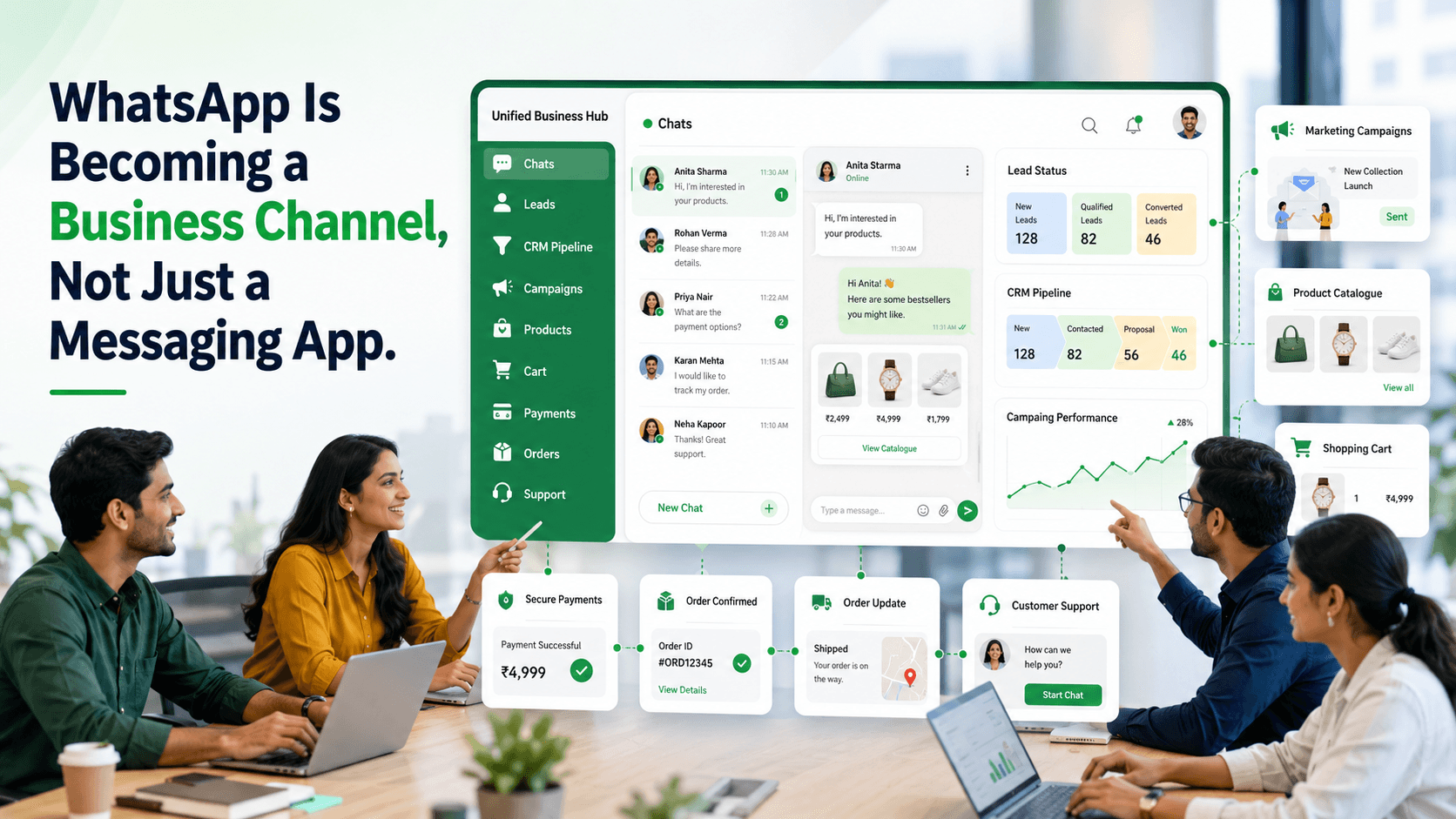
A visual CRM pipeline can help businesses move customers through stages such as new enquiry, contacted, requirement collected, quotation shared, follow-up required, payment pending and won.
Teams Can Work From One Shared Inbox
When customer conversations are managed through personal WhatsApp accounts, important information becomes scattered across different employees and devices.
A shared multi-agent inbox allows authorised team members to:
- Access customer conversations
- Assign chats to responsible employees
- Avoid duplicate replies
- Transfer conversations
- Add private internal notes
- Review previous messages
- Monitor pending conversations
Customers receive one continuous experience while the team coordinates internally.
WhatsApp Can Support Marketing Campaigns
Businesses can use WhatsApp to send relevant updates to customers who have provided appropriate consent.
Campaigns may include:
- New product announcements
- Festival offers
- Appointment reminders
- Restock alerts
- Event invitations
- Reorder reminders
- Birthday or anniversary offers
- Service-renewal reminders
Campaigns should be segmented using customer interests, purchase history, location, sales stage or communication preferences.
Sending every message to every contact can feel like spam and damage customer trust.
Customers Can Shop Through Conversations
WhatsApp can support the complete shopping journey instead of redirecting customers through multiple disconnected systems.
A conversational E-Shop can allow customers to:
- Browse product categories
- View product images and prices
- Select variants
- Add items to a cart
- Confirm delivery details
- Choose a payment method
- Place an order
- Receive payment confirmation
- Track order progress
Customers can ask questions during the purchase and receive human assistance whenever required.
Payments Can Be Connected to the Conversation
After a customer accepts a quotation or confirms an order, the business can send an approved payment option directly within the conversation.
The payment request should clearly display:
- Order or service reference
- Payable amount
- Payment purpose
- Available payment method
- Payment deadline, when applicable
Once payment is completed, the customer can receive confirmation and the business can update the order or lead status automatically.
Automation Can Save Time
Businesses repeatedly answer similar questions and perform the same administrative tasks. WhatsApp automation can help with:
- Greeting new customers
- Capturing basic requirements
- Sharing approved information
- Assigning conversations
- Creating follow-up reminders
- Sending appointment confirmations
- Providing payment updates
- Sending order-status notifications
- Requesting feedback
Automation should make conversations faster and more organised without making customers feel trapped inside rigid responses.
AI and Human Support Can Work Together
AI-powered responses can help businesses handle common questions and provide faster initial assistance. However, customers should be transferred to a person when the situation requires judgement or empathy.
Human involvement is especially important for:
- Complex recommendations
- High-value purchases
- Negotiations
- Custom requirements
- Payment concerns
- Complaints
- Returns and refunds
- Sensitive conversations
A smooth handover should preserve the customer’s context so they do not have to repeat everything.
WhatsApp Can Support the Entire Customer Journey
A connected WhatsApp journey may look like this:
- Customer discovers the business through Instagram, Google or an advertisement
- Customer starts a WhatsApp conversation
- The contact is captured automatically
- The conversation is assigned to the right employee
- Customer requirements are collected
- Relevant products or services are recommended
- A quotation, appointment or order is created
- Payment is completed
- Status updates are sent automatically
- The business requests feedback
- Relevant follow-ups encourage repeat business
Instead of using WhatsApp only for replies, the business uses it as a structured channel for marketing, sales and customer service.
Businesses Must Respect Customer Preferences
Using WhatsApp as a business channel requires responsible communication.
Businesses should:
- Obtain appropriate consent
- Send relevant messages
- Respect communication preferences
- Provide clear opt-out options
- Avoid excessive promotions
- Protect customer information
- Limit access to authorised employees
- Follow applicable privacy and messaging requirements
Trust is more valuable than message volume.
How Voixt.ai Turns WhatsApp Into a Business Channel
Voixt.ai brings the tools required to manage customer journeys through WhatsApp into one organised platform, including:
- Shared multi-agent WhatsApp inboxes
- Automatic contact capture
- Conversation assignments
- Visual CRM pipelines
- Contact tags and filters
- Follow-up reminders
- No-code automation workflows
- AI-powered responses
- AI-to-human handovers
- Targeted campaign management
- WhatsApp E-Shop
- Orders and payments
- Automated order updates
- Private internal notes
Businesses can manage customer conversations, sales activities, campaigns, orders, payments and support without relying on disconnected tools and personal WhatsApp accounts.
Final Thoughts
WhatsApp is becoming more than a place where businesses answer customer questions. It can support discovery, lead management, marketing, sales, payments and customer service through one continuous conversation.
The opportunity is not simply to send more messages. It is to create a structured customer journey that remains convenient, relevant and personal.
Voixt.ai helps businesses turn WhatsApp into an organised business channel where every conversation can lead to a clear next action.