
Why WhatsApp Can Become the Digital Storefront for Local Businesses
Discover how local businesses can use WhatsApp to showcase products, answer questions, accept orders, collect payments and build lasting customer relationships.
On this page16 sections
- What Is a Digital Storefront?
- Why WhatsApp Works for Local Businesses
- Product Discovery Becomes Conversational
- A Catalogue Makes Products Easier to Explore
- Conversations Build Confidence
- Orders and Payments Can Happen in One Journey
- Automation Keeps the Storefront Responsive
- Human Assistance Remains Essential
- A Shared Inbox Helps Teams Work Together
- Every Conversation Can Become a Sales Opportunity
- WhatsApp Can Connect Online and Offline Shopping
- Repeat Business Becomes Easier
- Local Businesses Can Compete Through Service
- Customer Data Must Be Managed Responsibly
- How Voixt.ai Helps Build a WhatsApp Storefront
- Final Thoughts
For many local businesses, the storefront is no longer limited to a physical location. Customers may discover a business through social media, Google or a recommendation, but their first direct interaction often happens on WhatsApp.
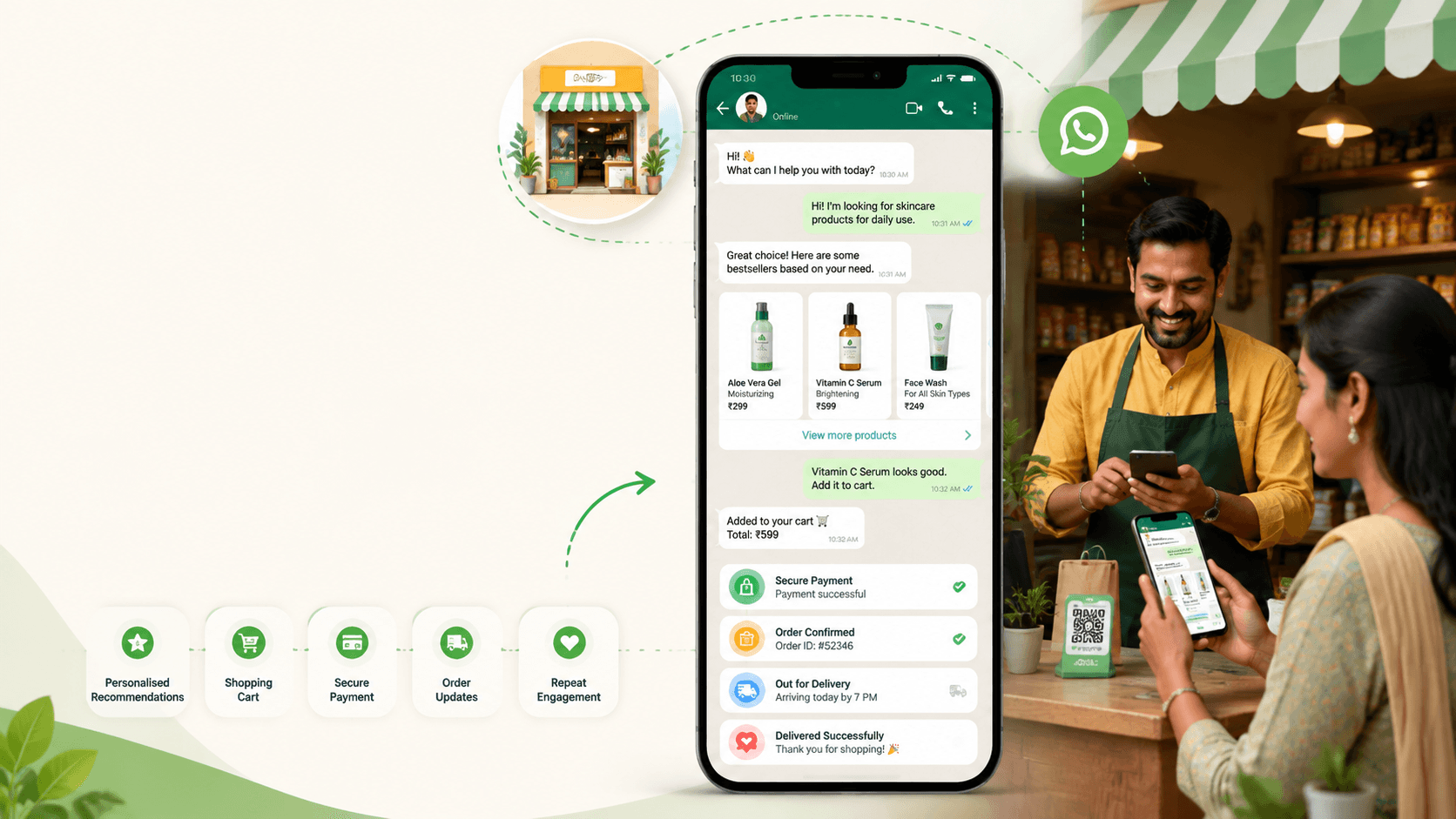
They ask whether a product is available, request a price, compare options or check delivery details. When these conversations are organised properly, WhatsApp can become more than a messaging channel. It can function as a digital storefront where customers discover, evaluate and purchase products.
What Is a Digital Storefront?
A digital storefront is the online experience through which customers explore a business and decide whether to buy. It may include product information, recommendations, ordering, payments and customer support.
Traditional digital storefronts are usually websites or mobile applications. However, local customers may prefer the familiarity and convenience of WhatsApp, especially when they need quick answers or personalised guidance.
Instead of asking customers to learn a new platform, businesses can bring the shopping experience into a conversation they already understand.
Why WhatsApp Works for Local Businesses
Local businesses often compete through relationships, product knowledge and responsive service. WhatsApp supports these strengths by making communication direct and personal.
Customers can use it to:
- Ask whether a product is available
- Request images, prices or specifications
- Compare different options
- Receive personalised recommendations
- Confirm store timings or locations
- Place an order
- Choose pickup or local delivery
- Complete a payment
- Receive order updates
- Ask for help after purchasing
The entire journey can continue inside one familiar conversation instead of being divided across multiple channels.
Product Discovery Becomes Conversational
A physical shopkeeper understands customer requirements by asking questions. A similar experience can happen through WhatsApp.
For example, a customer looking for a gift may share their budget, the occasion and the recipient’s preferences. The business can then recommend a small selection of suitable products instead of asking the customer to browse an entire catalogue.
This approach is useful for clothing stores, jewellery shops, electronics retailers, beauty businesses, home-decor stores and other businesses where customers may need guidance before buying.
A Catalogue Makes Products Easier to Explore
Businesses can create a structured catalogue or WhatsApp E-Shop that allows customers to view:
- Product categories
- Images
- Prices
- Descriptions
- Available variants
- Sizes or colours
- Stock information
- Related products
A catalogue gives customers the convenience of browsing while the conversation provides access to assistance. Together, they create an experience that combines self-service with personal support.
Conversations Build Confidence
Customers may hesitate to purchase from a local business online when they cannot verify product details, delivery availability or return conditions.
A responsive WhatsApp conversation can answer these questions immediately. Businesses can share real product images, explain differences, confirm availability and provide clear delivery information.
This human interaction can build confidence, particularly for higher-value, customised or preference-based purchases.
Orders and Payments Can Happen in One Journey
Once a customer selects a product, the business should make purchasing simple. A connected WhatsApp journey may allow the customer to:
- Select a product
- Confirm the preferred variant
- Share delivery or pickup details
- Review the order
- Receive a payment link
- Complete the payment
- Receive confirmation
- Track the order
Reducing unnecessary steps helps prevent customers from abandoning the purchase after showing interest.
Automation Keeps the Storefront Responsive
A local business may receive enquiries outside working hours or several messages at the same time. Automation can provide immediate assistance with predictable requests.
Businesses can automate:
- Welcome messages
- Frequently asked questions
- Product-category selection
- Store hours and location details
- Basic product information
- Order capture
- Payment links
- Payment confirmations
- Pickup notifications
- Delivery updates
- Feedback requests
- Reorder reminders
Automation should simplify routine interactions while giving customers a clear way to speak with a person when needed.
Human Assistance Remains Essential
Not every purchase can be handled through a fixed automated flow. Customers may need help with product selection, customisation, negotiation, availability or a problem with an order.
A smooth handover allows a team member to enter the conversation with the customer’s earlier messages and requirements already available. The customer does not need to repeat everything, and the employee can provide more relevant assistance.
The most effective digital storefront combines fast automation with accessible human support.
A Shared Inbox Helps Teams Work Together
When business conversations remain inside personal WhatsApp accounts, customer information can become scattered. Enquiries may be missed, two employees may reply to the same person or a follow-up may never happen.
A shared multi-agent inbox allows authorised employees to manage conversations together. Businesses can assign chats, add private notes, see conversation history and understand who is responsible for the next action.
This creates a more consistent customer experience, even when several team members handle sales and support.
Every Conversation Can Become a Sales Opportunity
A customer who asks a question may not purchase immediately. Without a follow-up process, that opportunity can disappear inside the chat list.
Businesses can organise enquiries using stages such as:
- New enquiry
- Requirement identified
- Product recommended
- Awaiting customer response
- Payment pending
- Order confirmed
- Completed
- Follow-up required
A simple CRM pipeline makes it easier to see what is happening with each customer and which conversations need attention.
WhatsApp Can Connect Online and Offline Shopping
A WhatsApp storefront does not need to replace the physical shop. It can support the customer before, during and after an in-store visit.
For example, customers may:
- Ask about availability before travelling
- Reserve a product for store pickup
- request additional options after visiting
- Complete payment remotely
- Receive a digital receipt
- Ask post-purchase questions
- Receive future product updates
This creates a connected experience across physical and digital channels.
Repeat Business Becomes Easier
A traditional website may treat every visitor as a new session. A conversation can preserve useful context about previous interests, purchases and support requests.
With appropriate consent, businesses can use this context to send relevant communication such as:
- New-arrival announcements
- Back-in-stock alerts
- Reorder reminders
- Service reminders
- Loyalty rewards
- Local delivery updates
- Offers based on previous interests
Messages should be targeted and useful. Sending frequent promotions to every contact can cause customers to mute, block or report the business.
Local Businesses Can Compete Through Service
Large online marketplaces may compete through extensive catalogues and aggressive pricing. Local businesses can differentiate themselves through speed, trust, flexibility and personal attention.
WhatsApp allows them to provide:
- Recommendations from knowledgeable employees
- Communication in local languages
- Faster answers about availability
- Flexible pickup and delivery options
- Personal assistance after the sale
- Stronger relationships with repeat customers
These advantages can help a smaller business deliver an online experience that feels more relevant than an anonymous marketplace transaction.
Customer Data Must Be Managed Responsibly
Using WhatsApp as a digital storefront involves handling customer information. Businesses should collect only what they need and protect it appropriately.
They should also:
- Obtain suitable consent before promotional communication
- Respect customer opt-out requests
- Limit access to authorised employees
- Avoid sharing sensitive information unnecessarily
- Maintain accurate order and payment records
- Follow applicable privacy and messaging requirements
Trust is part of the storefront experience. Customers should feel confident about both the purchase and the way their information is handled.
How Voixt.ai Helps Build a WhatsApp Storefront
Voixt.ai helps local businesses bring customer conversations, sales and support into one organised platform through:
- Shared multi-agent WhatsApp inboxes
- Automatic contact capture
- Conversation assignments
- Customer tags and filters
- Visual CRM pipelines
- No-code automation workflows
- AI-powered responses
- AI-to-human handovers
- Follow-up reminders
- Targeted campaign management
- WhatsApp E-Shop
- Orders and payments
- Automated order updates
- Private internal notes
Businesses can manage product discovery, enquiries, follow-ups, purchases and customer support without relying on disconnected tools or scattered personal accounts.
Final Thoughts
For local businesses, a digital storefront does not always need to begin with a complex website or mobile application. It can begin with a helpful WhatsApp conversation.
By combining product browsing, personalised assistance, ordering, payments, updates and follow-ups, WhatsApp can support the complete customer journey while preserving the human service that makes local businesses valuable.
Voixt.ai helps businesses turn these conversations into an organised digital storefront where customers can discover products, make purchases and receive ongoing support.