
Why Conversational Commerce Makes Sense for Indian Small Businesses
Learn why conversational commerce helps Indian small businesses manage enquiries, recommend products, accept payments and build customer relationships through WhatsApp.
On this page15 sections
- What Is Conversational Commerce?
- WhatsApp Is Already Familiar
- It Matches How Indian Customers Buy
- It Supports Local Languages
- It Reduces the Need for Complex Technology
- Product Discovery Becomes Personal
- Small Businesses Can Preserve Their Personal Advantage
- Customers Can Order and Pay Through WhatsApp
- Automation Helps Small Teams
- A Shared Inbox Improves Teamwork
- Follow-Ups Become More Reliable
- Campaigns Can Be More Relevant
- Responsible Communication Builds Trust
- How Voixt.ai Supports Indian Small Businesses
- Final Thoughts
Indian small businesses have always grown through conversations. Customers ask questions, request recommendations, negotiate details and build trust before purchasing.
Conversational commerce brings this familiar buying experience into digital channels such as WhatsApp. It allows businesses to combine personal service with online convenience without requiring customers to learn another platform.
What Is Conversational Commerce?
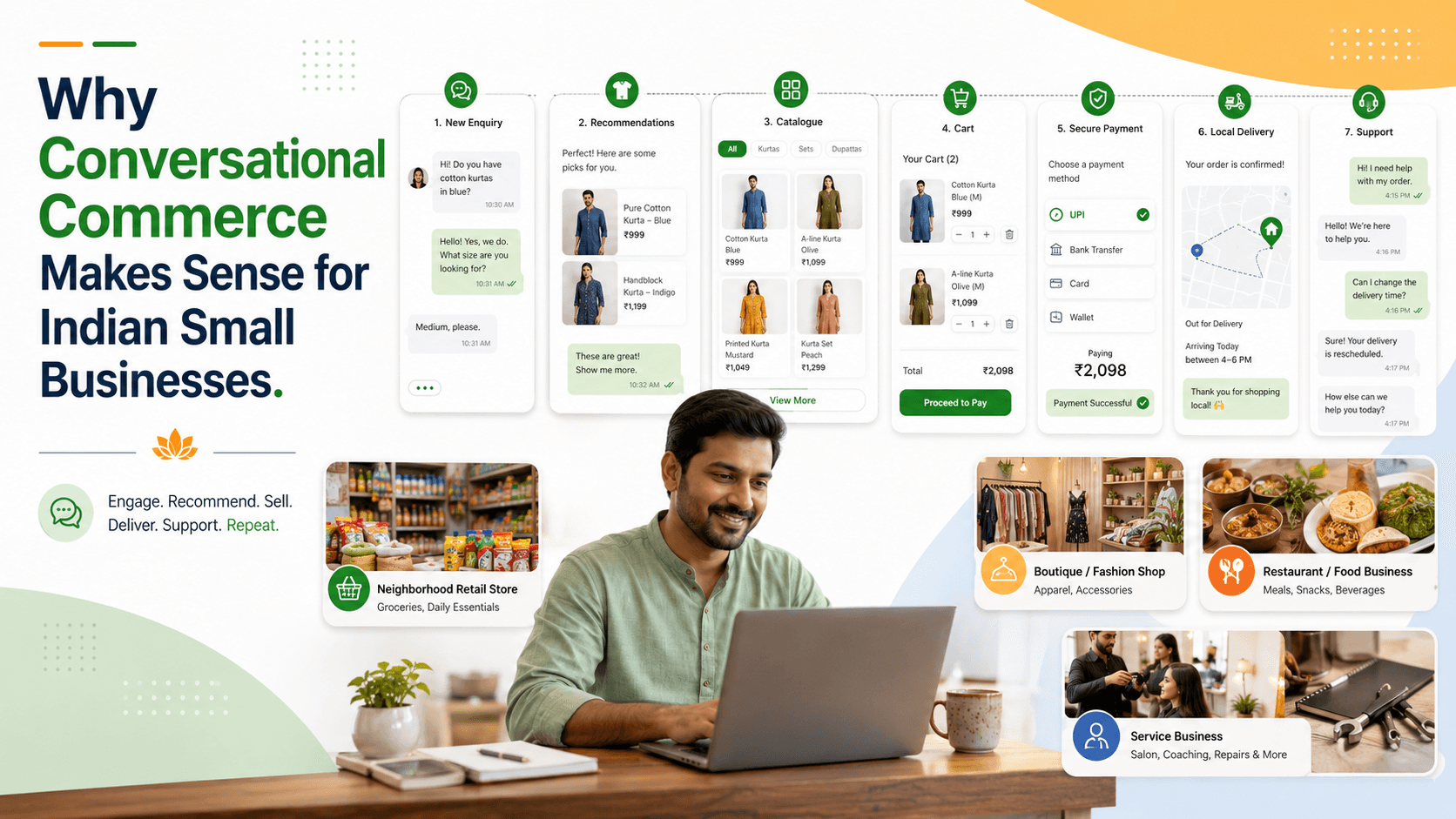
Conversational commerce allows customers to discover products, ask questions, receive recommendations, place orders, make payments and get support through a messaging conversation.
A typical WhatsApp customer journey may include:
- Customer sends an enquiry
- Business identifies the requirement
- Relevant products or services are recommended
- Customer confirms the selection
- Order or appointment details are collected
- Payment is completed
- Status updates are sent
- Human support remains available
The entire journey feels like a helpful conversation rather than a complicated online form.
WhatsApp Is Already Familiar
Small businesses do not need to convince customers to download an unfamiliar application. Customers already know how to send messages, share locations, open links and receive updates on WhatsApp.
They can begin with a simple question such as:
- Is this product available?
- What is the price?
- Do you deliver to my area?
- Can I book an appointment?
- Which option is suitable for me?
- When will my order arrive?
This familiarity reduces friction at the beginning of the buying journey.
It Matches How Indian Customers Buy
Many Indian customers prefer to ask questions before purchasing, particularly when buying from a local business or choosing a high-value product or service.
They may want to discuss:
- Product quality
- Size or colour
- Delivery availability
- Payment options
- Customisation
- Service details
- Exchange policies
- Local pickup
Conversational commerce allows businesses to answer these questions while guiding customers towards the next step.
It Supports Local Languages
Indian businesses often serve customers who are more comfortable communicating in regional languages or a mix of languages.
WhatsApp conversations allow teams to respond in the customer’s preferred language. This can make the buying experience more accessible and personal.
Approved response templates and AI-powered assistance can help teams respond consistently while preserving human review.
It Reduces the Need for Complex Technology
Building and maintaining a custom e-commerce application can require significant investment. Small businesses may also struggle to attract customers to download and regularly use it.
Conversational commerce allows businesses to create a digital sales channel using WhatsApp while managing products, customer data, orders and payments through an organised platform behind the conversation.
Product Discovery Becomes Personal
A large online catalogue can overwhelm customers. A conversation can ask a few relevant questions and display suitable options.
For example, a clothing retailer can ask about size, budget and occasion. A jewellery store can ask about preferred metal, style and purpose. A service business can ask about location, urgency and preferred date.
The customer receives focused recommendations instead of searching through every available option.
Small Businesses Can Preserve Their Personal Advantage
Large marketplaces compete through scale, selection and convenience. Small businesses can compete through trust, product knowledge and personalised service.
Conversational commerce helps them offer:
- Direct access to a knowledgeable employee
- Relevant recommendations
- Local-language assistance
- Flexible delivery options
- Store pickup
- Quick problem resolution
- Personal follow-ups
These advantages become available online instead of remaining limited to physical stores.
Customers Can Order and Pay Through WhatsApp
A WhatsApp E-Shop can allow customers to:
- Browse product categories
- View product images and prices
- Select variants
- Add products to a cart
- Confirm delivery details
- Choose a payment method
- Place an order
- Receive payment confirmation
- Track order progress
Service businesses can also share quotations, confirm appointments and collect payments through the same conversation.
Automation Helps Small Teams
Small businesses often have limited employees handling sales, operations and customer support. Automation can reduce repetitive work by:
- Acknowledging new enquiries
- Collecting basic requirements
- Sharing approved information
- Assigning conversations
- Sending appointment reminders
- Confirming payments
- Providing order updates
- Creating follow-up reminders
- Requesting feedback
Automation should save time while making it easy for customers to reach a person.
A Shared Inbox Improves Teamwork
When customer conversations remain on personal phones, businesses can lose visibility and continuity.
A shared multi-agent WhatsApp inbox allows teams to:
- Assign each conversation
- Prevent duplicate replies
- Review customer history
- Add private internal notes
- Transfer enquiries
- Monitor pending conversations
- Continue work when an employee is unavailable
The customer experiences one continuous conversation while the team works together behind it.
Follow-Ups Become More Reliable
Many customers do not purchase during the first interaction. They may need time to compare options, discuss the decision or wait for a preferred product.
Businesses can create follow-up reminders for situations such as:
- Quotation shared
- Product back in stock
- Payment incomplete
- Appointment approaching
- Customer requested a later callback
- Preferred variant available
- Reorder expected
Relevant follow-ups can recover opportunities without pressuring customers.
Campaigns Can Be More Relevant
Businesses can segment customers using tags and filters based on:
- Product interest
- Location
- Previous purchases
- Sales stage
- Customer type
- Order frequency
- Communication preference
This allows them to send relevant festival offers, new arrivals, restock alerts and repeat-purchase reminders instead of broadcasting every message to everyone.
Responsible Communication Builds Trust
A customer who sends an enquiry does not automatically want frequent promotional messages.
Businesses should obtain appropriate consent, respect opt-out requests, protect customer information and follow applicable privacy and messaging requirements.
Conversational commerce works best when messages remain useful, timely and relevant.
How Voixt.ai Supports Indian Small Businesses
Voixt.ai helps Indian small businesses create organised conversational-commerce journeys through:
- Shared multi-agent WhatsApp inboxes
- Automatic contact capture
- Conversation assignments
- Contact tags and filters
- Visual CRM pipelines
- Follow-up reminders
- No-code automation workflows
- AI-powered responses
- AI-to-human handovers
- Targeted campaign management
- WhatsApp E-Shop
- Orders and payments
- Automated order updates
- Private internal notes
Businesses can manage customer conversations, sales, campaigns, orders, payments and support from one connected platform.
Final Thoughts
Conversational commerce makes sense for Indian small businesses because it combines familiar buying behaviour with digital convenience.
Customers can ask questions, receive recommendations, place orders, make payments and get support through a channel they already use. Businesses can preserve their personal service while improving organisation and scalability.
Voixt.ai helps small businesses turn everyday WhatsApp conversations into structured customer journeys that support sales and long-term relationships.