
Why Important Customer Conversations Get Lost in Personal WhatsApp Accounts
Learn why customer conversations disappear inside employees’ personal WhatsApp accounts and how a shared business inbox preserves ownership, context, and follow-ups.
On this page32 sections
- Why Important Customer Conversations Get Lost in Personal WhatsApp Accounts
- Customer Information Becomes Fragmented
- The Customer Relationship Depends on One Person
- Important Conversations Disappear During Leave
- Conversations Are Lost When Employees Leave
- Follow-Ups Depend on Memory
- Customers Must Repeat Their Requirements
- Different Employees Give Different Answers
- Duplicate Conversations Are Created
- Managers Cannot See Workload or Risk
- Customer Data Is Mixed With Personal Communication
- Business Continuity Depends on Personal Devices
- Personal Numbers Blur Working Boundaries
- Campaign Replies Become Difficult to Manage
- The Business Cannot Measure Performance Accurately
- Use a Shared Business Inbox
- Assign Every Conversation
- Maintain One Customer Record
- Use Internal Notes for Team Context
- Track Conversations Through a Pipeline
- Create Visible Follow-Up Reminders
- Preserve Context During Handover
- Define Shift and Leave Handover Rules
- Create a Clear Offboarding Process
- Introduce a Business Number Carefully
- Keep the Experience Personal
- Use Permissions and Access Controls
- Build an Escalation Process
- Measure Whether Conversations Are Still Being Lost
- Common Mistakes to Avoid
- How Voixt.ai Keeps Customer Conversations Organised
- Final Thoughts
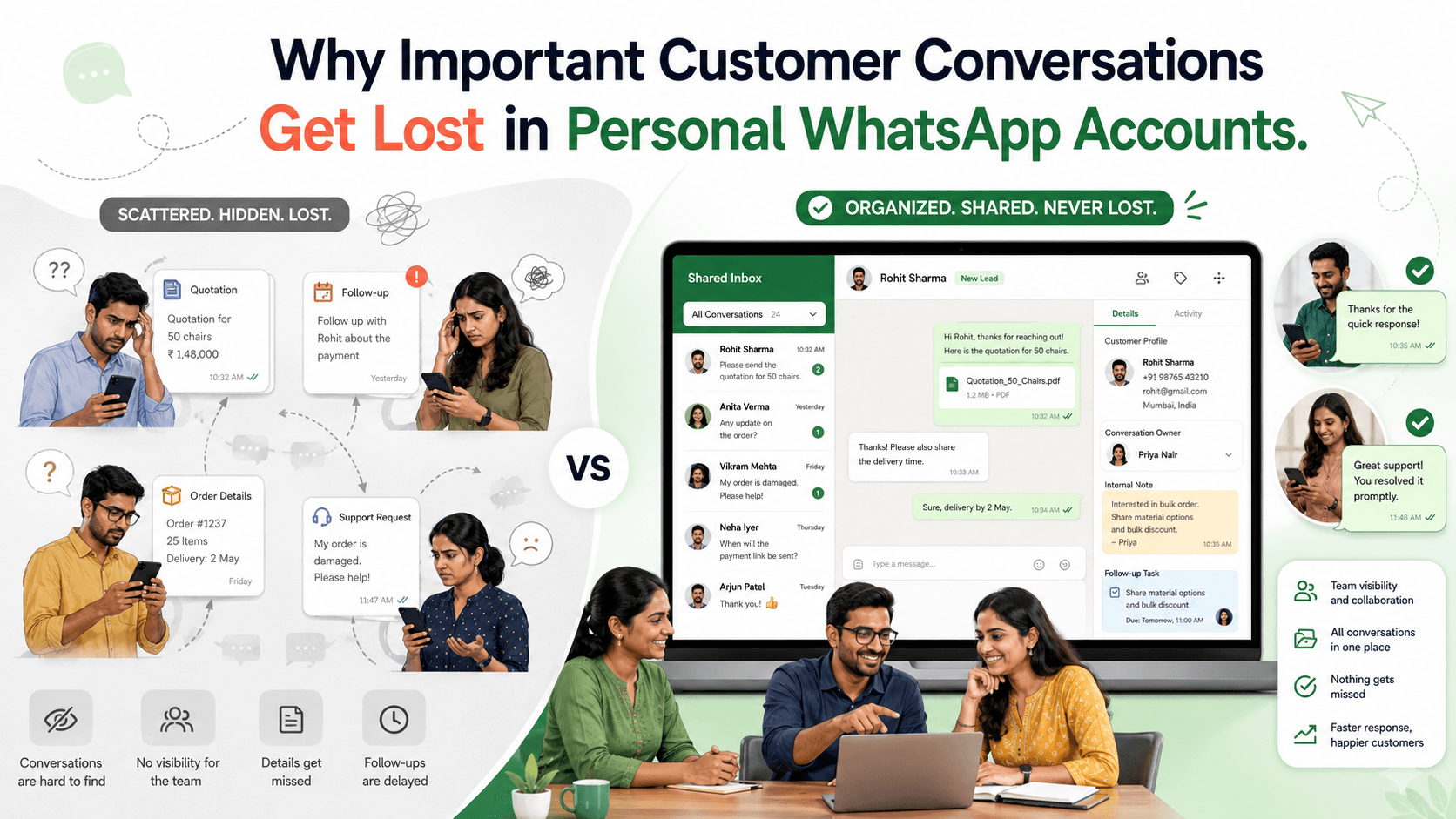
Why Important Customer Conversations Get Lost in Personal WhatsApp Accounts
Many customer relationships begin informally.
A salesperson shares a personal WhatsApp number. A customer sends a product question. The employee responds quickly, develops the opportunity, and continues handling future orders through the same account.
This may work while the business is small and the employee is available.
Problems begin when the employee takes leave, changes roles, loses the phone, leaves the company, or receives more messages than they can manage.
The conversation history, customer preferences, quotations, promises, and follow-up dates may remain inside one personal account that nobody else can access.
The business still has the customer, but it does not have the conversation.
Customer Information Becomes Fragmented
When employees use personal WhatsApp accounts, customer information is distributed across several devices.
One employee may hold:
- The original enquiry
- Product preferences
- Budget information
- Quotations
- Negotiated terms
- Delivery promises
- Payment discussions
- Follow-up dates
Another employee may have a separate conversation with the same customer about support or fulfilment.
The business has no complete record of the relationship.
This fragmentation makes it difficult to understand what happened, what was promised, and what should happen next.
The Customer Relationship Depends on One Person
Personal accounts create individual ownership instead of business ownership.
If the employee is unavailable, the customer may receive no response.
Other team members cannot easily see:
- Why the customer contacted the business
- Which products were discussed
- What price was quoted
- Whether a follow-up was promised
- Whether payment was requested
- Whether an issue remains unresolved
The customer may be told:
Please wait until Arjun returns on Monday. He has the previous conversation.
From the customer’s perspective, they contacted the business—not one employee’s phone.
Important Conversations Disappear During Leave
An employee may have active conversations when they take planned or unexpected leave.
These may include:
- Customers ready to purchase
- Quotations awaiting approval
- Payments awaiting verification
- Delivery problems
- Appointment changes
- Complaints
- Promised callbacks
If the conversations remain inside a personal account, the team may not know that these actions exist.
Even when the employee forwards a few screenshots, the team receives only part of the context.
Conversations Are Lost When Employees Leave
Employee offboarding becomes risky when customer communication lives inside personal accounts.
The business may not know:
- Which customers the employee handled
- Which enquiries remain active
- Which prices were quoted
- Which follow-ups are due
- Which customers expect a response
- Which files or product images were shared
- Which disputes remain unresolved
Customers may continue messaging the former employee because that is the only number they know.
The business must then rebuild the relationship without the original conversation history.
Follow-Ups Depend on Memory
Employees using personal WhatsApp often manage follow-ups through:
- Unread-message markers
- Starred messages
- Personal calendar entries
- Notes applications
- Spreadsheets
- Memory
These systems are difficult for other employees to see or support.
A follow-up may be missed when:
- The chat moves down the list
- The customer does not respond immediately
- A busy campaign generates new messages
- The employee changes phones
- Another task becomes urgent
- The employee is absent
A promised action needs a visible owner and due date—not only a mental reminder.
Customers Must Repeat Their Requirements
When a conversation moves from one personal account to another, context is often lost.
A customer may have already explained:
- Product required
- Preferred variant
- Quantity
- Budget
- Location
- Delivery date
- Previous problem
The new employee may begin with:
How can I help you?
The customer then repeats the entire enquiry.
This wastes time and signals that the business does not maintain an organised record.
Different Employees Give Different Answers
Personal accounts make it easier for employees to use different information sources.
One employee may quote the current price, while another uses an older catalogue.
Inconsistencies may involve:
- Price
- Discount
- Stock availability
- Delivery date
- Payment method
- Return policy
- Product specifications
- Appointment availability
Because conversations are private to each employee, the business may not discover the conflict until the customer complains.
Duplicate Conversations Are Created
The same customer may message several employees to receive a faster answer.
Each employee treats the person as a separate enquiry because they cannot see the other conversations.
This can result in:
- Duplicate quotations
- Repeated questions
- Different prices
- Multiple payment links
- Conflicting delivery promises
- Two employees following up
The business spends more time while the customer receives a less coordinated experience.
Managers Cannot See Workload or Risk
When customer communication happens across personal accounts, managers cannot reliably answer:
- How many new enquiries arrived today?
- How many customers are waiting?
- Which conversations are urgent?
- Who has too many active chats?
- Which quotations need follow-up?
- Which complaints remain unresolved?
- How quickly are employees responding?
- Which campaigns generate sales?
Without visibility, managers react to complaints instead of preventing problems.
They may assume that an employee has little work because the business system shows no conversations, while the employee is managing dozens of customers privately.
Customer Data Is Mixed With Personal Communication
Personal accounts combine business and private conversations on the same device.
This creates practical concerns involving:
- Customer information stored outside business systems
- Business files mixed with personal media
- Notifications visible to other device users
- Personal backups containing customer messages
- Limited control over access
- Difficulty applying company retention practices
- Unclear separation after employment ends
Businesses should define appropriate communication, privacy, access, and device policies based on their legal and operational requirements.
Only collect and retain information required for a legitimate customer or business purpose.
Business Continuity Depends on Personal Devices
A customer conversation may become inaccessible when an employee:
- Loses their phone
- Changes their number
- Replaces a device
- Experiences an account problem
- Has no internet access
- Is unavailable outside working hours
A business process should not depend entirely on one person’s device remaining accessible.
Customer communication needs a controlled business workspace with appropriate continuity procedures.
Personal Numbers Blur Working Boundaries
Customers may contact employees at any time because they have a personal number.
Employees may feel expected to answer:
- During leave
- Late at night
- On weekends
- After changing roles
- After leaving the business
This creates inconsistent expectations for customers and employees.
A business number can provide defined operating hours, automatic acknowledgements, team coverage, and escalation rules without requiring one person to remain permanently available.
Campaign Replies Become Difficult to Manage
Some businesses ask employees to send promotional messages from personal accounts.
Replies then remain distributed across the team.
The business may not know:
- Which customers responded
- Which products generated interest
- Which employee owns each opportunity
- Which customers opted out
- Which sales were completed
- Which follow-ups remain due
Consent and communication preferences may also be recorded inconsistently.
WhatsApp requires businesses to obtain appropriate opt-in permission before initiating messages and to respect requests to stop communication. WhatsApp Business Messaging Policy
Preference changes should apply consistently across the business—not only on one employee’s phone.
The Business Cannot Measure Performance Accurately
Personal accounts make reliable reporting difficult.
The business may not be able to measure:
- Enquiry volume
- First-response time
- Resolution time
- Conversion rate
- Revenue by campaign
- Follow-ups completed
- Unanswered conversations
- Complaint frequency
- Employee workload
- Customer opt-outs
Without these measurements, the team cannot identify where customer conversations are being lost.
Use a Shared Business Inbox
A shared WhatsApp inbox allows authorised employees to manage one business communication channel together.
The team can see:
- New conversations
- Conversation history
- Assigned owner
- Customer record
- Internal notes
- Current status
- Follow-up date
- Sales or support stage
Shared access should not mean that everyone replies to everything.
Every active conversation still needs one responsible owner.
Assign Every Conversation
Assignment creates accountability.
A conversation record might show:
- Owner: Meera
- Team: Furniture sales
- Stage: Quotation sent
- Status: Waiting for customer
- Next action: Follow up on Friday
Assignments can be based on:
- Branch
- Product category
- Customer location
- Language
- Enquiry type
- Existing account owner
- Employee availability
- Priority
If the owner becomes unavailable, the conversation can be reassigned with its context preserved.
Maintain One Customer Record
A central customer record should connect conversations and relevant business information.
It may include:
- Name
- Phone number
- First-contact source
- Product interests
- Purchase history
- Location
- Assigned employee
- Current customer stage
- Follow-up date
- Communication preferences
- Relevant internal notes
Avoid creating duplicate records when the same customer contacts another department or employee.
The goal is one organised view of the relationship—not several disconnected phone chats.
Use Internal Notes for Team Context
Private internal notes help employees share information without exposing operational details to customers.
For example:
Customer prefers the walnut finish and needs delivery before 30 August. Quoted ₹18,500, including delivery. Follow up after confirming warehouse availability.
A useful note should record:
- Verified requirement
- Decision or quotation
- Action taken
- Outstanding action
- Owner
- Due time when relevant
Notes should be factual, concise, and appropriate for a business record.
Track Conversations Through a Pipeline
Important conversations should not remain as unstructured chats.
A sales pipeline might include:
- New enquiry
- Requirement identified
- Product shared
- Quotation sent
- Follow-up scheduled
- Awaiting decision
- Awaiting payment
- Order confirmed
- Completed
- Lost or not interested
A support pipeline might include:
- Issue received
- Information collected
- Assigned
- Investigation in progress
- Waiting for internal action
- Waiting for customer
- Resolved
- Closed
Each active stage should have an owner and next action.
Create Visible Follow-Up Reminders
When an employee promises an update, create a shared reminder.
For example:
Confirm stock with the warehouse and update Rahul by 4:00 p.m. today.
The reminder should remain visible if the employee is absent or the conversation changes owner.
Do not rely on unread status as a follow-up system. A read message may still require significant work.
Preserve Context During Handover
A proper handover should include:
- Customer requirement
- Products or services discussed
- Quotation or order details
- Previous actions
- Promises made
- Outstanding issue
- Next action
- Due time
- Reason for transfer
For example:
Transfer to delivery support. Order VH-4821 was expected yesterday but has not arrived. Tracking has not changed for two days. Customer expects an update by 5:00 p.m.
Notify the customer when appropriate:
Priya from our delivery-support team has joined the conversation. She can see your order details and the previous messages.
The new owner should continue from the existing context rather than restarting the conversation.
Define Shift and Leave Handover Rules
Before an employee becomes unavailable, review:
- Active conversations
- Quotations awaiting decisions
- Promised callbacks
- Payment issues
- Delivery concerns
- Complaints
- Scheduled follow-ups
Every unfinished conversation should be:
- Reassigned
- Placed in a visible team queue
- Scheduled for follow-up
- Escalated when urgent
This should be a routine process—not an emergency task performed only when someone suddenly leaves.
Create a Clear Offboarding Process
When an employee leaves the business, confirm:
- All active conversations are reassigned
- Customer records are complete
- Follow-ups are transferred
- Access is removed appropriately
- Customers know the correct business contact
- Important files and quotations remain available
- Personal devices no longer serve as business communication channels
Do not wait until the employee’s final day to identify the customers they manage.
Introduce a Business Number Carefully
Moving customers from personal accounts to a shared business number requires planning.
A practical transition can include:
- Identify active customer conversations
- Record current requirements and open actions
- Create or update central customer records
- Assign each conversation to an employee
- Communicate the official business number
- Continue the conversation with context
- Redirect future business messages
- Monitor whether customers continue using personal numbers
A transition message might say:
Hi Meera, we’re moving customer conversations to our official WhatsApp number so our team can support you consistently. Your current product enquiry and quotation details have been transferred. Please continue the conversation here: [Official Business Contact].
Do not ask customers to repeat all their information after the move.
Keep the Experience Personal
A shared inbox does not require generic or impersonal communication.
Employees can still:
- Introduce themselves
- Use natural language
- Refer to previous context
- Provide tailored recommendations
- Maintain ongoing customer relationships
- Take ownership of follow-ups
The difference is that the relationship remains visible and supportable by the business.
The customer receives personal service without depending entirely on one personal account.
Use Permissions and Access Controls
Not every employee needs access to every conversation or customer detail.
Access can be organised by:
- Team
- Branch
- Role
- Customer type
- Support responsibility
- Management level
Businesses should review access regularly and remove it when roles change.
Sensitive information should be visible only to employees who require it for legitimate work.
Build an Escalation Process
Important conversations should be escalated when they involve:
- Serious complaints
- Payment disputes
- Security concerns
- High-value orders
- Policy exceptions
- Delayed resolutions
- Unusual risk
The escalation should preserve the complete conversation and identify one new owner.
Do not simply forward screenshots without explaining what has happened and what decision is required.
Measure Whether Conversations Are Still Being Lost
Track:
- Unassigned conversations
- Oldest unanswered message
- Overdue follow-ups
- Conversations without owners
- Duplicate customer records
- Transfers without notes
- Customers contacting personal numbers
- Unresolved complaints
- Employee response times
- Opportunities without next actions
Review actual conversation samples to identify missing context and incomplete handovers.
Common Mistakes to Avoid
Allowing Personal Accounts to Remain the Primary Channel
Create one official customer communication process.
Giving Everyone Access Without Ownership
Assign one responsible employee to every active conversation.
Moving Customers Without Preserving Context
Transfer requirements, quotations, promises, and follow-ups before changing channels.
Using Read Status as a Task List
Create visible statuses and reminders for unfinished work.
Keeping Customer Data in Separate Spreadsheets
Maintain one organised customer record linked to the conversation.
Ignoring Leave and Offboarding
Reassign conversations before employees become unavailable.
Removing Personal Service
Use a shared inbox to preserve context and continuity—not to replace genuine employee relationships.
Failing to Apply Opt-Outs Across the Team
Update communication preferences centrally and consistently.
How Voixt.ai Keeps Customer Conversations Organised
Voixt.ai helps businesses move customer communication from disconnected personal accounts into one organised WhatsApp workspace.
Teams can use:
- Shared multi-agent WhatsApp inboxes so authorised employees can manage one business number together
- Conversation assignments so every active enquiry has one responsible owner
- Automatic contact capture to maintain structured customer records
- Private internal notes for quotations, promises, handovers, and relevant customer context
- Contact tags and filters for product interests, branches, priorities, stages, and preferences
- Visual CRM pipelines to track sales and support conversations through defined stages
- Follow-up reminders so promised actions remain visible across shifts and absences
- No-code automation workflows for routing, assignment, escalation, and status updates
- AI-powered responses to help employees reply efficiently using approved information
- AI-to-human handovers that preserve the previous conversation
- Campaign management for targeted communication and centrally managed preferences
This gives the business continuity and visibility while allowing employees to provide personal customer service.
Final Thoughts
Important customer conversations get lost in personal WhatsApp accounts because the context, ownership, and follow-up process remain attached to one employee and one device.
The risk appears during leave, shift changes, high-volume periods, role changes, and employee departures.
Move customer communication into a shared business workspace. Maintain one customer record, assign every active conversation, preserve context through internal notes, and create visible follow-up reminders.
Customers should be able to continue receiving informed support even when their usual employee is unavailable.
Voixt.ai helps businesses create that continuity by connecting shared WhatsApp communication with customer records, assignments, pipelines, automation, and team collaboration.