
Do Small Businesses Really Need a Website to Sell Online?
Learn whether your small business needs a website to sell online and how WhatsApp, social media, marketplaces, and payment links can support sales.
On this page12 sections
- Do Small Businesses Really Need a Website to Sell Online?
- The Short Answer
- When You Can Sell Without a Website
- Benefits of Starting Without a Website
- Limitations of Selling Without a Website
- When a Website Becomes Important
- Websites and WhatsApp Work Better Together
- What Is the Minimum Website a Small Business Needs?
- How to Sell Online Without a Website
- Common Mistakes to Avoid
- How Voixt.ai Helps
- Final Thoughts
Do Small Businesses Really Need a Website to Sell Online?
A small business does not always need a website to start selling online.
Many businesses successfully display products, receive enquiries, accept payments, and manage orders through WhatsApp, social media, online marketplaces, and payment links. These channels can provide a practical starting point for businesses with limited budgets, small catalogues, or sales processes that require personal conversations.
However, selling without a website also has limitations. The right choice depends on what the business sells, how customers discover it, and how much information they need before purchasing.
The Short Answer
You can begin selling online without a website by using:
- WhatsApp Business
- Instagram and Facebook
- Google Business Profile
- Online marketplaces
- Digital catalogues
- Payment links
- Booking platforms
- Local business directories
These tools may be sufficient when customers prefer to ask questions before placing an order.
A website becomes more important when the business needs stronger credibility, search visibility, detailed product information, online ordering, or greater control over the customer journey.
When You Can Sell Without a Website
Selling without a website can work well when the business has a simple offer and customers already know how to contact it.
Examples include:
- Home-based food businesses
- Tutors and consultants
- Beauty professionals
- Repair services
- Local retailers
- Handmade-product sellers
- Property agents
- Event professionals
- Appointment-based businesses
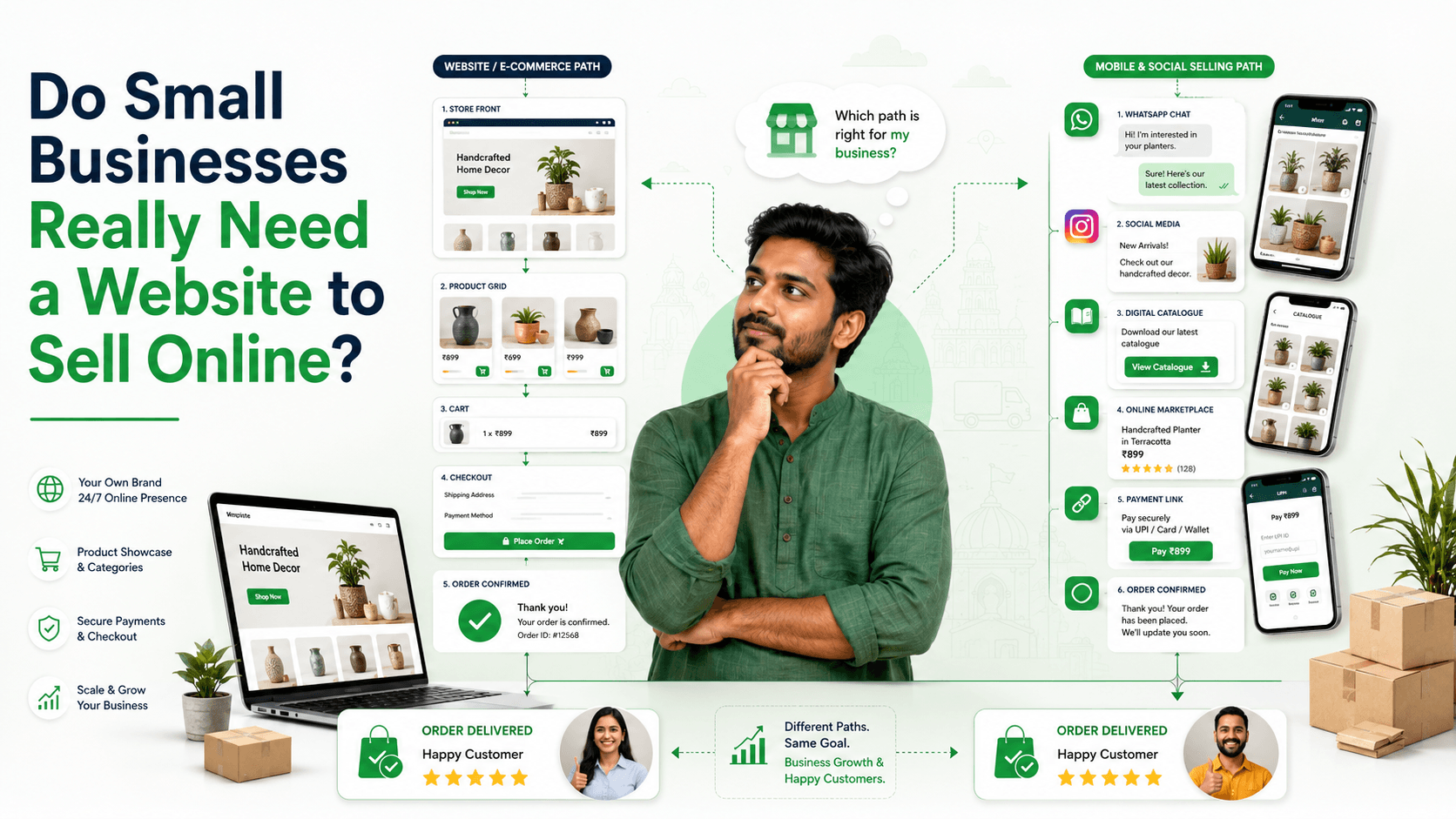
A typical buying journey may look like this:
- A customer discovers the business through Instagram.
- The customer sends a WhatsApp message.
- The business confirms the price and availability.
- The customer shares delivery information.
- The business sends a payment link.
- The order The order is confirmed through WhatsApp.
For businesses receiving a manageable number of enquiries, this process may be enough to begin selling.
Benefits of Starting Without a Website
Lower Initial Cost
Building a website may involve expenses for design, development, hosting, maintenance, product photography, copywriting, and payment processing.
Starting with WhatsApp or social media allows a business to test demand before making a larger investment.
Faster Launch
A WhatsApp catalogue, social media profile, or marketplace listing can usually be created faster than a complete online store.
This allows the business to start receiving customer feedback and learning which products generate interest.
Personal Customer Communication
Some products and services require discussion before purchase.
Customers may need help with:
- Selecting the correct option
- Confirming availability
- Understanding pricing
- Choosing a size or colour
- Checking delivery
- Requesting customisation
- Comparing packages
- Scheduling an appointment
WhatsApp allows businesses to answer these questions directly and guide customers towards the next step.
Easier Demand Testing
Before investing in a website, a business can test:
- Which products attract enquiries
- What prices customers accept
- Which advertisements perform well
- What questions customers ask
- Which locations generate demand
- Why potential customers do not purchase
- Which payment methods they prefer
These insights can later guide the content and structure of the website.
Limitations of Selling Without a Website
Customers May Question Credibility
Some customers expect an established business to have a professional website.
A website can provide:
- Business information
- Product or service details
- Customer reviews
- Contact information
- Policies
- Certifications
- Case studies
- Frequently asked questions
- A consistent brand identity
Without this information, customers may require additional reassurance before making a payment.
Information Can Be Difficult to Find
Important details can become buried inside social media posts or long message threads.
Customers may repeatedly ask:
- What is the price?
- What is included?
- Do you deliver to my location?
- What are your opening hours?
- What is your return policy?
- Which packages are available?
- How can I book?
- Which payment methods do you accept?
A website can organise this information and make it available at any time.
Manual Selling Becomes Difficult to Scale
Direct conversations are useful, but they require employee time.
As enquiry volumes increase, businesses may experience:
- Slow responses
- Missed enquiries
- Duplicate replies
- Forgotten follow-ups
- Inconsistent prices
- Unassigned conversations
- Incorrect order information
- Lost customer details
CRM and automation tools can reduce these problems, but a website may still be useful for customers who want to purchase independently.
The Business Has Less Control
Social media platforms and marketplaces control how listings appear and which features are available.
Policy changes, account restrictions, algorithm updates, or technical issues can affect the business’s visibility and sales.
A website provides greater control over branding, content, product presentation, and the customer journey.
Search Visibility May Be Limited
Potential customers often search online before contacting a business.
A useful website can appear in relevant search results and help customers understand the offer before starting a conversation.
Without a website, the business may depend heavily on advertisements, social media, referrals, marketplaces, and local listings.
When a Website Becomes Important
Customers Search for Your Services Online
A website can help customers discover the business when they search for services such as:
- Interior designer in Pune
- Wedding photographer in Jaipur
- Custom furniture in Bengaluru
- Accountant for small businesses
- Dental clinic near me
Relevant service pages can answer common questions and direct customers to WhatsApp, a booking form, or a telephone call.
You Sell Many Products
A large catalogue can become difficult to manage through messages and social media posts.
An online store allows customers to:
- Browse categories
- Search for products
- Compare options
- Check prices
- View availability
- Add products to a basket
- Pay online
- Track orders
WhatsApp can then be used for recommendations, questions, and customer support.
Customers Need Detailed Information
A website is valuable when customers need specifications, comparisons, demonstrations, case studies, policies, or detailed explanations before purchasing.
They can review the information at their convenience and contact the business when they are ready.
You Want to Build a Recognisable Brand
A website gives the business one consistent place to communicate its:
- Brand identity
- Story
- Expertise
- Products and services
- Customer results
- Contact information
- Policies
- Unique value
This is especially important for expensive products and professional services where customers need confidence before making a decision.
You Want Customers to Purchase Independently
If customers do not require personal assistance, a website can automate much of the buying process.
It can accept orders outside business hours and reduce the number of routine conversations employees must manage.
Websites and WhatsApp Work Better Together
Small businesses do not need to choose between a website and WhatsApp.
The two channels can support different stages of the customer journey.
A website can help customers:
- Discover the business
- Understand the offer
- Browse products
- Review pricing
- Read policies
- Compare options
- Build confidence
WhatsApp can help customers:
- Ask questions
- Confirm availability
- Request recommendations
- Discuss custom requirements
- Receive quotations
- Schedule appointments
- Complete payments
- Receive support
For example, a customer may discover a service through a search engine, review the details on the website, and then select a “Chat on WhatsApp” button to discuss their requirements.
The customer receives useful information from the website while WhatsApp provides the personal assistance needed to complete the sale.
What Is the Minimum Website a Small Business Needs?
A small business does not necessarily need a large or complicated website.
A simple website may include:
- A home page
- Product or service information
- Pricing or starting prices
- Information about the business
- Customer reviews
- Frequently asked questions
- Contact details
- A WhatsApp button
- Relevant policies
Every page should guide the customer towards one clear action.
Depending on the business, that action could be:
- Book a consultation.
- Ask about availability.
- Add the product to your basket.
- Request a quotation.
- Schedule an appointment.
- Send a WhatsApp message.
The website should simplify the buying process rather than introduce unnecessary steps.
How to Sell Online Without a Website
Create a Complete Business Profile
Make sure customers can easily find:
- Business name
- Description
- Contact information
- Location
- Opening hours
- Products or services
- Starting prices
- Delivery areas
- Payment methods
Keep this information consistent across WhatsApp, social media, marketplaces, and business listings.
Use a Digital Catalogue
A useful catalogue should include:
- Clear product names
- High-quality images
- Prices
- Available variations
- Important specifications
- Stock information
- Delivery details
- Ordering instructions
Customers should not need to search through months of social media posts to find basic information.
Define the Buying Process
Customers should understand exactly how to place an order.
For example:
- Select a product.
- Confirm the required quantity.
- Share the delivery location.
- Receive the final price.
- Complete the payment.
- Receive order confirmation.
A consistent process reduces confusion and helps employees provide reliable service.
Provide Secure Payment Options
Clearly communicate:
- The total amount
- Taxes
- Delivery charges
- The payment deadline
- Refund conditions
- The order-confirmation process
Never ask customers to share sensitive payment credentials through WhatsApp messages.
Track Every Enquiry
Potential customers should not remain only inside an unorganised inbox.
Record:
- Customer name
- Contact details
- Product or service
- Enquiry source
- Customer requirements
- Assigned employee
- Lead stage
- Next action
- Follow-up date
- Final outcome
This becomes increasingly important as conversation volume grows.
Follow Up Carefully
If a customer asks a question and disappears, schedule a relevant follow-up.
Instead of sending:
Any update?
Send:
Hi Riya, I’m following up on the custom gift boxes you asked about. The price includes printing and delivery for orders above 50 units. Would you like me to prepare a quotation for your required quantity?
The follow-up should refer to the original enquiry, add useful information, and ask one clear question.
Common Mistakes to Avoid
Building a Website Without a Sales Process
A website will not automatically produce sales.
The business still needs a plan for attracting visitors, responding to enquiries, processing orders, and following up with potential customers.
Hiding Important Information
Customers may leave if they cannot find pricing, delivery areas, appointment availability, or contact options.
Provide enough information to help them decide whether to continue.
Ignoring Mobile Users
Many customers will visit the website using a mobile device.
Pages should load quickly, text should be readable, buttons should be easy to select, and the primary action should remain visible.
Sending Every Customer to WhatsApp
Some customers prefer to purchase without speaking to anyone.
If the product is straightforward, forcing every customer into a conversation can create unnecessary delays.
Offer self-service purchasing when appropriate and personal assistance when required.
Failing to Track WhatsApp Leads
Adding a WhatsApp button is not enough if the business cannot manage the resulting conversations.
Every enquiry should have an owner, a current status, and a clear next action.
How Voixt.ai Helps
Voixt.ai helps small businesses sell through WhatsApp whether or not they currently have a website.
Its capabilities include:
- Shared multi-agent WhatsApp inboxes
- Automatic contact capture
- Visual CRM pipelines
- Conversation assignments
- Contact tags and filters
- Follow-up reminders
- No-code automation workflows
- AI-powered responses
- Private internal notes
- AI-to-human handovers
- Campaign and contact management
Businesses can connect website enquiries, advertisements, social media campaigns, and direct WhatsApp messages to a structured sales process.
This helps ensure that every customer receives a timely response and that valuable enquiries do not disappear inside personal phones or busy inboxes.
Final Thoughts
Small businesses do not always need a website to begin selling online.
WhatsApp, social media, marketplaces, digital catalogues, and payment links can provide an effective starting point, especially for businesses with small catalogues or relationship-based sales processes.
A website becomes increasingly valuable when the business needs search visibility, stronger credibility, detailed information, self-service purchasing, or greater control over the customer experience.
The most practical approach is to begin with the simplest system that supports sales and add a website when it solves a clear business need.
Start using Voixt.ai to organise WhatsApp enquiries, track potential customers, automate follow-ups, and turn online conversations into sales.