
How Coaching Classes Can Manage Student Enquiries and Reminders
Learn how coaching classes can organise student enquiries, assign conversations, automate reminders and follow up with prospective students through WhatsApp without making communication feel impersonal.
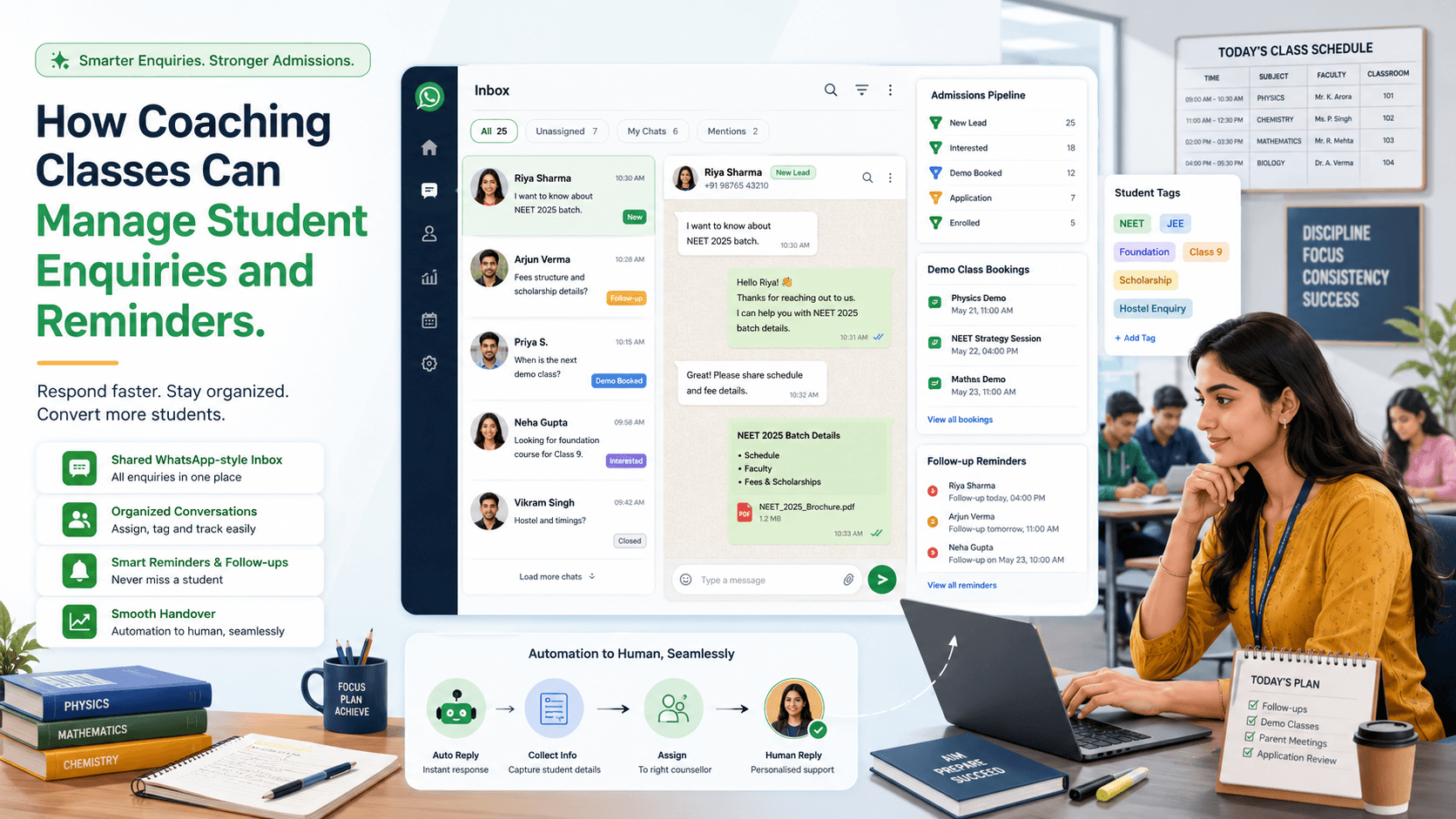
{ "title": "How Coaching Classes Can Manage Student Enquiries and Reminders", "slug": "how-coaching-classes-manage-student-enquiries-reminders", "excerpt": "Learn how coaching classes can organise student enquiries, assign conversations, automate reminders and follow up with prospective students through WhatsApp without making communication feel impersonal.", "content": "Coaching classes often receive most of their student enquiries through WhatsApp. A parent may ask about fees, a student may request the timetable, and another person may want to know whether seats are still available—all within the same few minutes.\n\nWhatsApp makes these conversations convenient, but managing them becomes difficult as enquiry volumes grow. Messages get buried, two counsellors may reply to the same student, follow-ups are forgotten, and important reminders have to be sent manually.\n\nThe solution is not simply to send more messages. Coaching classes need a clear system for capturing enquiries, organising conversations, following up at the right time and sending relevant reminders.\n\nThis guide explains how coaching institutes, tuition centres, test-preparation academies and independent tutors can create that system using WhatsApp.\n\n## Why Coaching Classes Receive So Many Enquiries on WhatsApp\n\nStudents and parents usually want answers before they are ready to enrol. They may have discovered the coaching class through an advertisement, social media post, referral, seminar, school event or local search.\n\nInstead of completing a long form or making a phone call, they send a WhatsApp message because it feels quick and informal.\n\nCommon questions include:\n\n- Which courses are available?\n- What are the batch timings?\n- How much is the fee?\n- Is there a trial or demo class?\n- Who are the teachers?\n- When does the next batch begin?\n- Is study material included?\n- Are online classes available?\n- What results have previous students achieved?\n- Is there a branch near my location?\n\nThese questions may appear simple, but every conversation represents a potential admission. If the response is slow, incomplete or confusing, the student can easily contact another institute.\n\n## The Problems With Managing Enquiries Manually\n\nA small coaching class may initially manage enquiries through the owner’s or receptionist’s WhatsApp account. That approach can work when there are only a few conversations each day.\n\nIt becomes unreliable when the institute grows.\n\n### Enquiries get buried\n\nA new student’s message can quickly disappear beneath group messages, internal discussions and ongoing conversations. Unless somebody remembers to return to it, the enquiry may never receive a proper response.\n\n### Follow-ups depend on memory\n\nMany students do not enrol during the first conversation. They may need to speak with their parents, compare options, attend a demo class or wait for exam results.\n\nIf the counsellor does not record when to follow up, the opportunity is easily lost.\n\n### Multiple employees create confusion\n\nWhen several counsellors share responsibility for enquiries without a clear assignment system, two people may reply to the same student. In other cases, everyone assumes somebody else is handling the conversation, so nobody responds.\n\n### Information becomes inconsistent\n\nOne counsellor may quote an old fee, another may share the wrong batch timing, and someone else may promise a discount that has not been approved.\n\nThis inconsistency reduces trust, especially when students compare replies or visit the centre later.\n\n### Reminders consume staff time\n\nTeams may manually send demo-class reminders, fee reminders, timetable updates and test notifications. Repeating the same work for every student takes time and increases the chance of mistakes.\n\n### Management lacks visibility\n\nThe owner may know how many messages arrived but not how many became demo bookings, applications or paid admissions. Reading every chat is not a practical way to understand performance.\n\n## Create a Clear Process for Every New Enquiry\n\nEvery enquiry should move through a defined process. The exact stages can vary, but a simple admissions pipeline might include:\n\n1. New enquiry\n2. Contacted\n3. Qualified\n4. Demo class booked\n5. Demo attended\n6. Follow-up required\n7. Admission confirmed\n8. Not interested or lost\n\nThis structure gives the team a shared understanding of what needs to happen next.\n\nA WhatsApp conversation should not remain an unorganised chat. It should become a trackable admission opportunity with an owner, a status and a next action.\n\n## Capture the Right Details Early\n\nCounsellors need enough information to recommend the correct course, but asking too many questions at once can make the conversation feel like an application form.\n\nStart with a few essential details:\n\n- Student’s name\n- Parent’s name, when relevant\n- Class, grade or academic level\n- Subject or examination of interest\n- Preferred location or branch\n- Online or classroom preference\n- Preferred batch timing\n- Expected joining date\n- Source of the enquiry\n\nThe questions should feel conversational.\n\nFor example:\n\n“Thanks for contacting BrightPath Academy. Could you tell me which class or entrance examination you are preparing for? I’ll share the most relevant batch details.”\n\nOnce the student responds, the counsellor can ask the next useful question instead of sending a long questionnaire.\n\n## Identify Where Each Enquiry Came From\n\nKnowing the source helps coaching classes understand which marketing activities produce serious enquiries.\n\nAn enquiry may come from:\n\n- Google or local search\n- Facebook or Instagram advertising\n- YouTube\n- A school seminar\n- A student referral\n- A banner or newspaper advertisement\n- A landing page\n- A branch visit\n- An education fair\n\nUse campaign-specific links, pre-filled WhatsApp messages or enquiry-source tags where possible. A message such as “I’m interested in the Class 10 Science batch” gives the counsellor useful context immediately.\n\nWithout source tracking, the institute may continue spending money on campaigns that generate messages but very few admissions.\n\n## Use a Shared WhatsApp Inbox\n\nWhen coaching classes depend on personal WhatsApp accounts, conversations become tied to individual employees. If a counsellor is absent or leaves the organisation, their colleagues may not know what was promised to a student.\n\nA shared team inbox allows authorised staff members to manage student conversations from one place.\n\nIt can help the institute:\n\n- Give multiple counsellors access without passing a phone around\n- Assign each enquiry to a specific employee\n- See whether somebody has already replied\n- Leave internal notes for colleagues\n- Review the conversation history\n- Transfer enquiries between counsellors or branches\n- Prevent duplicate replies\n- Monitor pending conversations\n\nStudents still experience one continuous WhatsApp conversation, while the institute gains coordination behind the scenes.\n\n## Assign One Owner to Every Enquiry\n\nEvery active enquiry should have one clearly identified owner. That person is responsible for responding, recording important details and completing the next follow-up.\n\nAssignment rules can be based on:\n\n- Course or subject\n- Student’s grade\n- Branch or location\n- Language preference\n- Online or classroom programme\n- Counsellor availability\n- Enquiry source\n\nFor example, enquiries about engineering entrance preparation can go to one admissions specialist, while enquiries about school tuition go to another.\n\nOwnership does not prevent teamwork. It simply ensures accountability.\n\n## Respond Quickly Without Sounding Robotic\n\nStudents expect a prompt acknowledgement, particularly after clicking an advertisement or submitting an enquiry form. However, a fast response should not become a cold, generic message.\n\nAn automatic acknowledgement can confirm that the enquiry has been received:\n\n“Hi, thank you for contacting BrightPath Academy. We’ve received your enquiry. A course counsellor will reply shortly. Meanwhile, please share the class or examination you’re preparing for.”\n\nThis message is useful because it sets expectations and collects relevant information. It should not pretend to be a complete admissions conversation.\n\nOnce a counsellor joins, the conversation should become personal and specific to the student’s needs.\n\n## Build a Reliable Follow-Up System\n\nMany admissions are lost because coaching classes follow up inconsistently. Some counsellors message too often, while others forget to follow up at all.\n\nEvery follow-up should have a reason.\n\nUseful follow-up triggers include:\n\n- The student requested time to discuss the course with a parent\n- A demo class is approaching\n- The student attended a demo but has not enrolled\n- A new batch is about to begin\n- The student asked to be contacted after an examination\n- Requested documents have not been submitted\n- A payment link was shared but admission is incomplete\n- The student wanted a batch timing that has now become available\n\nInstead of recording “follow up later,” set a specific date and purpose.\n\nFor example:\n\n“Follow up on 18 August to ask whether the student wants to join the weekend mathematics batch after attending the demo.”\n\nThis gives the counsellor meaningful context when the reminder appears.\n\n## Send Reminders That Are Actually Useful\n\nReminders should help students take an expected action. They should not become repeated promotional messages.\n\n### Demo-class reminders\n\nSend the student the date, time, venue or joining link, teacher’s name and anything they should bring.\n\nExample:\n\n“Hi Riya, this is a reminder for your Class 12 Chemistry demo tomorrow at 5:00 p.m. at our Andheri centre. Please arrive 10 minutes early. Reply here if you need directions.”\n\nA second reminder shortly before the class may be appropriate when it contains practical information.\n\n### Batch-start reminders\n\nStudents who have enrolled should receive confirmation of the start date, timetable, classroom details and study-material instructions.\n\nExample:\n\n“Your NEET Foundation batch begins on Monday, 24 August, at 4:30 p.m. Your classroom is Room 3. Please bring a notebook and your admission receipt on the first day.”\n\n### Fee reminders\n\nFee reminders should clearly state the relevant instalment, due date and approved payment method. Avoid language that embarrasses or pressures the student.\n\nExample:\n\n“Hi Arjun, a quick reminder that the second instalment for your JEE programme is due on 10 September. Please use the payment link shared by our accounts team or contact us if you need assistance.”\n\nDo not include unnecessarily sensitive financial details in messages, and follow applicable payment and privacy requirements.\n\n### Test and assignment reminders\n\nSend only the information students need: subject, date, time, syllabus, submission deadline and access link where relevant.\n\n### Counselling-session reminders\n\nFor scheduled calls or in-person counselling, include the appointment time, counsellor’s name and rescheduling instructions.\n\n## Segment Students Before Sending Messages\n\nThe same message is rarely relevant to everyone in a coaching institute.\n\nA Class 8 student should not receive updates meant for medical entrance candidates. A person who has already enrolled should not continue receiving “last chance to enrol” messages.\n\nUseful segments include:\n\n- Course or examination\n- Grade or academic level\n- Branch\n- Batch\n- Online or classroom students\n- New enquiries\n- Demo booked\n- Demo attended\n- Enrolled students\n- Former students\n- Students with pending documents\n- Students with upcoming fee instalments\n\nSegmentation makes messages more relevant and reduces unnecessary communication.\n\nBefore sending any campaign, ask:\n\n1. Who needs this information?\n2. Why is it useful to them now?\n3. What action should they take?\n4. Should enrolled students or uninterested leads be excluded?\n\n## Automate Repetitive Work, Not Important Decisions\n\nAutomation is valuable when a task follows a predictable rule. It can acknowledge enquiries, assign conversations, create reminders and send confirmed logistical updates.\n\nSuitable tasks for automation include:\n\n- Acknowledging new enquiries\n- Asking for basic course information\n- Assigning leads according to course or branch\n- Sending demo-class confirmations\n- Sending scheduled reminders\n- Creating follow-up tasks\n- Sharing location details or approved brochures\n- Updating the admissions pipeline after defined actions\n- Alerting a counsellor when a student asks for human assistance\n\nConversations that usually need a person include:\n\n- Helping a student choose between programmes\n- Addressing concerns about teaching quality\n- Discussing a student’s learning challenges\n- Handling scholarship or discount requests\n- Resolving complaints\n- Discussing exceptional payment arrangements\n- Managing uncertainty from parents\n- Closing a serious admission opportunity\n\nThe best system uses automation to prepare and organise the conversation, then gives counsellors enough context to respond thoughtfully.\n\n## Create Approved Answers for Common Questions\n\nCounsellors should not have to type the same information repeatedly. Prepare accurate, approved response templates for common questions such as:\n\n- Course fees\n- Batch timings\n- Faculty information\n- Class duration\n- Demo-class availability\n- Study materials\n- Test schedules\n- Online-class requirements\n- Branch addresses\n- Admission documents\n- Refund or cancellation policies\n\nTemplates should save time without forcing every conversation into identical wording. Counsellors can personalise the opening, remove irrelevant information and add context based on the student’s needs.\n\nReview templates whenever fees, schedules or policies change. Outdated saved replies can create more problems than they solve.\n\n## Keep Internal Coordination Outside the Student Chat\n\nCounsellors often need help from teachers, accounts staff or branch managers. They should not discuss internal matters in the student-facing conversation.\n\nPrivate internal notes can record details such as:\n\n- “Parent wants a callback after 7:00 p.m.”\n- “Confirm scholarship approval with the branch manager.”\n- “Student prefers the Hindi-English bilingual batch.”\n- “Accounts team is checking the payment reference.”\n- “Do not send another promotional message; student requested a follow-up next month.”\n\nThese notes help employees coordinate without exposing internal discussions to the student.\n\n## Prevent Excessive Messaging\n\nMore reminders do not necessarily produce more admissions or better attendance. Too many messages can make the institute appear disorganised or aggressive.\n\nAvoid:\n\n- Sending the same promotion to every contact\n- Following up daily without a clear reason\n- Continuing to message students who declined\n- Sending offers unrelated to the student’s course\n- Using artificial urgency repeatedly\n- Sending messages at unreasonable hours\n- Adding students to groups without appropriate permission\n\nMaintain clear communication preferences and follow applicable consent, privacy and messaging requirements. Make it easy for people to indicate that they no longer want promotional updates.\n\nOperational messages should also remain proportionate. A student may appreciate a reminder about tomorrow’s test but not five reminders about the same test.\n\n## Measure the Admission Process\n\nCoaching-class owners should be able to understand performance without reading every WhatsApp conversation.\n\nUseful metrics include:\n\n- Number of new enquiries\n- First-response time\n- Enquiries assigned to each counsellor\n- Enquiries awaiting a response\n- Demo classes booked\n- Demo attendance rate\n- Follow-ups due or overdue\n- Enquiry-to-demo conversion rate\n- Demo-to-admission conversion rate\n- Total confirmed admissions\n- Admissions by branch, course or source\n- Common reasons for lost admissions\n\nThese figures show where the process needs improvement.\n\nFor example, a campaign may generate many enquiries but few qualified students. Another campaign may generate fewer messages but a much higher admission rate. The second campaign may be more valuable even if its enquiry count looks smaller.\n\n## A Simple WhatsApp Enquiry Workflow\n\nA practical workflow could look like this:\n\n### Step 1: Receive the enquiry\n\nThe student sends a message from an advertisement, website, referral link or direct contact.\n\n### Step 2: Acknowledge it\n\nAn automatic reply confirms receipt and asks one relevant qualifying question.\n\n### Step 3: Capture and assign\n\nThe student’s details are recorded, and the enquiry is assigned to the correct counsellor based on course, branch or another rule.\n\n### Step 4: Qualify the student\n\nThe counsellor identifies the academic requirement, preferred format, timing and expected joining date.\n\n### Step 5: Recommend the next step\n\nDepending on the student’s needs, the counsellor shares a suitable course, arranges a call or books a demo class.\n\n### Step 6: Send confirmation and reminders\n\nThe student receives the correct date, time, location or online-class link.\n\n### Step 7: Record the outcome\n\nAfter the demo or counselling session, the counsellor updates the enquiry status and schedules a specific follow-up.\n\n### Step 8: Complete the admission\n\nOnce payment and documentation are complete, the student moves into an enrolled-student segment and stops receiving prospect-focused campaigns.\n\n### Step 9: Continue relevant communication\n\nThe institute can send batch updates, test reminders and necessary academic information based on the student’s enrolled programme.\n\n## Example: From Instagram Enquiry to Confirmed Admission\n\nSuppose a student sees an Instagram advertisement for a Class 10 mathematics batch and sends a WhatsApp message.\n\nThe system acknowledges the message and asks whether the student prefers weekday or weekend classes. Based on the answer and location, the enquiry is assigned to the relevant branch counsellor.\n\nThe counsellor reviews the source and the student’s response before joining the conversation. They recommend the Saturday demo class and book the student’s place.\n\nThe student receives a confirmation immediately and a practical reminder before the class. After attendance, the system creates a follow-up task for the counsellor.\n\nThe counsellor contacts the parent, answers questions about the timetable and confirms the admission. The contact is then moved from “Demo Attended” to “Enrolled,” preventing further prospecting messages.\n\nThe WhatsApp conversation remains personal, but the process around it is organised and measurable.\n\n## Common Mistakes Coaching Classes Should Avoid\n\n### Treating every message as an isolated chat\n\nWithout a status and next action, the team cannot reliably move an enquiry towards admission.\n\n### Asking too many questions immediately\n\nCollect information gradually and explain why it is needed.\n\n### Sharing a brochure without guidance\n\nA large PDF does not replace a useful recommendation. Tell the student which programme is most relevant and why.\n\n### Sending reminders from personal numbers\n\nThis can scatter communication across employees and make continuity difficult.\n\n### Failing to update enrolled students\n\nOnce a student joins, remove them from lead-nurturing campaigns and place them in the correct batch segment.\n\n### Automating the entire admissions conversation\n\nStudents and parents often need reassurance, explanation and judgement that a rigid automated flow cannot provide.\n\n### Focusing only on response speed\n\nA quick but inaccurate reply is not good service. Track response quality, follow-up completion and conversions as well.\n\n## How Voixt.ai Helps Coaching Classes Manage WhatsApp\n\nVoixt.ai can give coaching classes a structured system for handling student enquiries and reminders without losing the conversational nature of WhatsApp.\n\nWith Voixt.ai, institutes can use:\n\n- Shared multi-agent WhatsApp inboxes so counsellors can work together from one organised workspace\n- Automatic contact capture to reduce manual data entry when new students message\n- Conversation assignments so every enquiry has a clearly responsible counsellor\n- Visual CRM pipelines to track students from new enquiry to demo, follow-up and confirmed admission\n- Contact tags and filters for courses, batches, branches, grades and admission stages\n- Follow-up reminders so counsellors know which students need attention each day\n- No-code automation workflows for acknowledgements, assignments, demo confirmations and scheduled reminders\n- AI-powered responses to help teams answer common questions efficiently while retaining human review\n- Private internal notes for coordination between counsellors, teachers, accounts teams and branch managers\n- AI-to-human handovers when a student needs personalised guidance\n- Campaign management for sending relevant updates to carefully selected student segments\n\nInstead of searching through individual chats, owners and admissions managers can see how enquiries are progressing and where action is required.\n\n## Final Thoughts\n\nWhatsApp can be an effective admissions channel for coaching classes, but only when conversations are supported by a reliable process.\n\nEvery student enquiry should have an owner, a status and a clear next action. Reminders should be timely and useful, campaigns should be segmented, and automation should handle repetitive coordination rather than replace meaningful counselling.\n\nWith a shared inbox, structured admission pipeline and consistent follow-up system, coaching classes can respond faster, reduce missed enquiries and give students and parents a more professional experience.\n\nVoixt.ai helps coaching institutes bring these activities together so their teams can manage more enquiries without losing the personal attention that influences enrolment.\n\nWant to organise student enquiries and automate useful WhatsApp reminders? Explore Voixt.ai and build a more reliable admissions process for your coaching class.", "metaTitle": "Manage Coaching Class Enquiries and Reminders on WhatsApp", "metaDescription": "Learn how coaching classes can organise WhatsApp student enquiries, automate reminders, manage follow-ups and improve the admissions process.", "keywords": [ "WhatsApp for coaching classes", "student enquiry management", "coaching class admission software", "WhatsApp reminders for students", "education lead management", "coaching institute CRM", "student follow-up system", "WhatsApp automation for education", "admission enquiry management", "Voixt.ai" ] }