
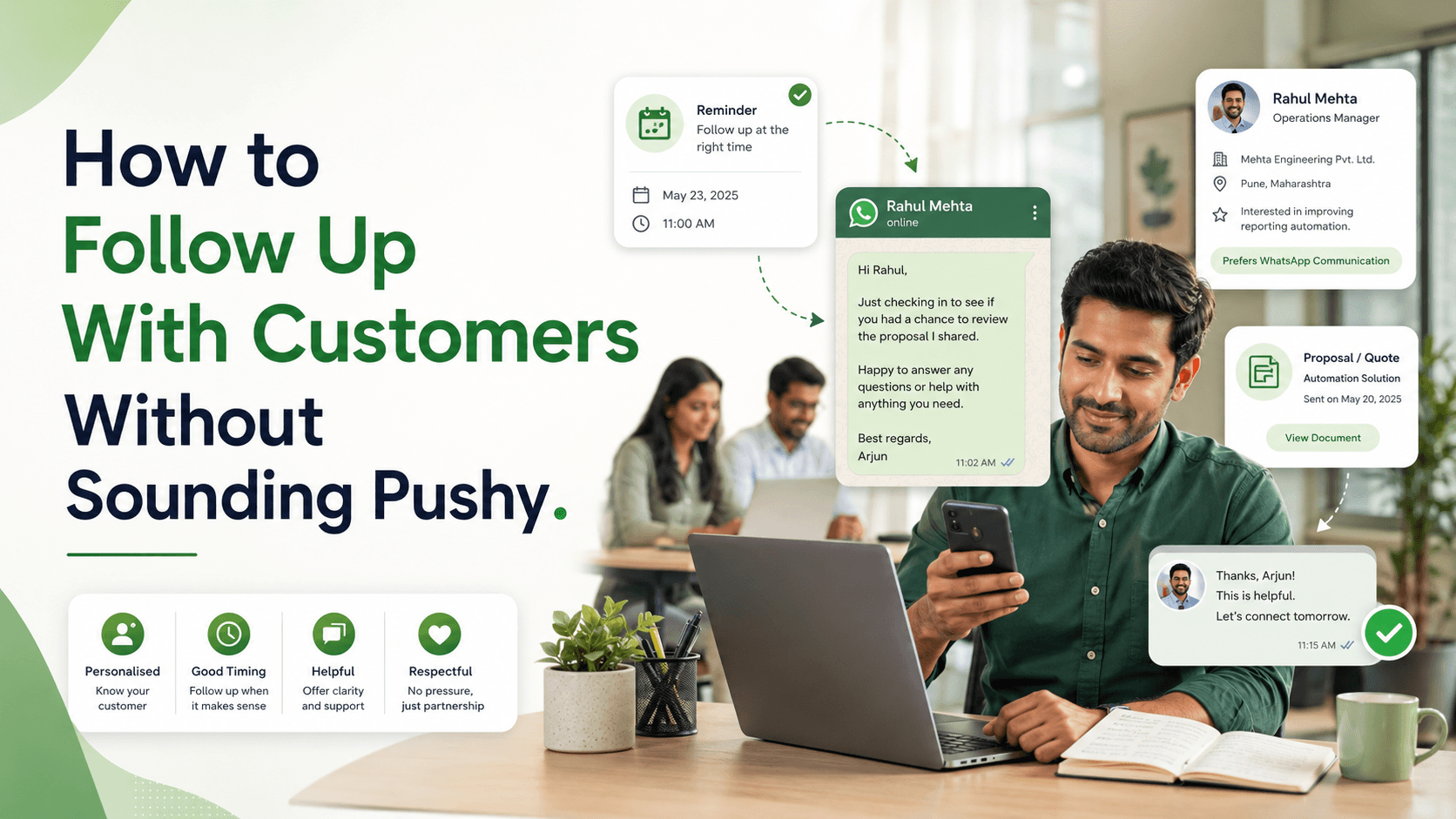
How to Follow Up With Customers Without Sounding Pushy
Learn how to follow up with customers using timely, helpful, and personalised WhatsApp messages that encourage responses without creating pressure.
On this page17 sections
- How to Follow Up With Customers Without Sounding Pushy
- 1. Agree on the Follow-Up
- 2. Allow Enough Time
- 3. Add Value to Every Message
- 4. Personalise the Message
- 5. Keep the Message Short
- 6. Ask One Clear Question
- 7. Use a Helpful Tone
- 8. Create Genuine Urgency
- 9. Address the Likely Barrier
- 10. Use a Limited Follow-Up Sequence
- 11. Track Follow-Ups in the CRM
- 12. Use Automation Carefully
- Follow-Up Message Examples
- Customer Follow-Up Checklist
- How Voixt.ai Helps
- Final Thoughts
How to Follow Up With Customers Without Sounding Pushy
Following up is an essential part of sales and customer service.
Customers may need time to compare options, discuss a purchase, arrange payment, review a quotation, or receive internal approval. A delayed response does not always mean they are uninterested.
However, repeated messages such as “Any update?” can make customers feel pressured. Effective follow-ups should help customers make decisions rather than simply remind them to reply.
Here is how businesses can follow up without sounding pushy.
1. Agree on the Follow-Up
The best time to arrange a follow-up is during the original conversation.
Instead of ending with:
Let me know.
Ask:
I’ll send the quotation today. Would it be helpful if I followed up on Thursday afternoon?
This gives the customer control and creates a clear expectation.
Record:
- The follow-up date
- The reason for following up
- The responsible employee
- Information promised to the customer
- The customer’s preferred communication time
An agreed follow-up feels helpful because the customer expects it.
2. Allow Enough Time
Following up too quickly can create unnecessary pressure.
The appropriate timing depends on the situation:
- Product enquiry: one or two days
- Quotation: two or three business days
- Meeting or demonstration: within one business day
- Payment reminder: based on the agreed due date
- Support issue: according to its urgency
- Long-term purchase: based on the customer’s expected timeline
If a customer says they need a week, do not contact them the following day unless there is an important update.
Respecting the customer’s timeline demonstrates professionalism.
3. Add Value to Every Message
A follow-up should give the customer a reason to respond.
Avoid:
Hi, any update?
Use:
Hi Arjun, I’m following up on the office furniture quotation. I’ve added an alternative chair that keeps the total within the budget you shared. Would you like me to send the revised quotation?
Useful follow-ups may include:
- An updated quotation
- A relevant product comparison
- A lower-cost alternative
- New availability information
- A delivery update
- An answer to an earlier question
- A case study
- A demonstration
- A genuine deadline
- A suitable payment option
A valuable message feels like assistance rather than pressure.
4. Personalise the Message
Generic messages are easy to ignore.
Use the customer’s name and refer to the actual conversation:
Hi Meera, I’m following up on your enquiry about the six-user WhatsApp management plan. You mentioned that conversation assignment was your main requirement. Would you like a short demonstration of how it works?
Personalisation should be based on relevant information, including:
- Product or service discussed
- Customer requirement
- Budget
- Preferred option
- Previous concern
- Promised next step
- Purchase timeline
Avoid inserting a customer’s name into an otherwise generic message and treating it as personalisation.
5. Keep the Message Short
Customers should understand the purpose of the follow-up immediately.
A useful message usually contains:
- A polite greeting
- The reason for contacting them
- One helpful detail
- One clear question
For example:
Hi Kavya, I’m following up on the website proposal sent Tuesday. The development slot we discussed is still available for next month. Would you like me to reserve it while you review the proposal?
Long paragraphs can make a simple follow-up feel demanding.
6. Ask One Clear Question
A follow-up should make replying easy.
Avoid sending several questions together:
Did you review the quotation? Is the price suitable? Do you need changes? When can we call? Are you ready to proceed?
Ask one question:
Would you like me to revise the quotation based on your updated budget?
Other useful questions include:
- Would you like a comparison of the two options?
- Is there any information you need before deciding?
- Would another date be more convenient?
- Should I send the payment link?
- Would you prefer a shorter demonstration?
- Has your requirement changed?
One clear question reduces effort and encourages a response.
7. Use a Helpful Tone
The message should sound calm, respectful, and easy to decline.
Use phrases such as:
- I wanted to check whether you need any additional information.
- I’m following up as agreed.
- Would it be helpful if I shared another option?
- Please let me know if your requirement has changed.
- No problem if the timing is not right.
- I can close the enquiry for now if you prefer.
Avoid language that creates unnecessary pressure:
- Why have you not replied?
- I need your answer today.
- This is my third reminder.
- Please respond immediately.
- Are you interested or not?
- I have been waiting for your response.
A respectful tone protects the relationship even when the customer does not purchase.
8. Create Genuine Urgency
Urgency is appropriate when it is accurate and relevant.
Examples include:
- A quotation expiry date
- Limited product availability
- A delivery deadline
- A booking deadline
- A scheduled price change
- A genuine promotional end date
For example:
Hi Rohan, the quotation remains valid until Friday because supplier pricing changes next week. Would you like me to reserve the current price?
Do not create false scarcity or repeatedly claim that an offer is about to expire. Artificial pressure damages trust.
9. Address the Likely Barrier
Customers often stop responding because something is preventing the decision.
Possible barriers include:
- Price
- Missing information
- Internal approval
- Delivery concerns
- Unclear value
- Lack of trust
- Competing priorities
- Product availability
- Changed requirements
A useful follow-up makes it safe to explain the concern:
Hi Nisha, I wanted to check whether the proposal matches your requirements. If the scope or budget needs adjustment, I can prepare another option.
This approach invites an honest response without assuming the customer is ready to purchase.
10. Use a Limited Follow-Up Sequence
Sending messages indefinitely can damage the customer relationship.
A simple sequence may include three follow-ups.
First follow-up
Remind the customer of the conversation and offer help:
Hi Aman, I’m following up on the quotation sent Monday. Would you like me to explain any part of the package?
Second follow-up
Add something useful:
Hi Aman, I’ve prepared a smaller package that includes the features you prioritised while reducing the monthly cost. Would you like me to send it?
Final follow-up
Close the conversation respectfully:
Hi Aman, I’ll close this enquiry for now so we do not keep messaging you. You can reply here anytime if you would like to continue.
Stop following up when the customer declines, opts out, or asks not to receive further messages.
11. Track Follow-Ups in the CRM
Follow-ups should not depend on memory or personal notes.
Every active lead should have:
- A current pipeline stage
- An assigned owner
- A next action
- A follow-up date
- A follow-up reason
- Relevant conversation history
- Internal notes
- A final outcome
Voixt.ai connects WhatsApp conversations with contact records, assignments, and visual CRM pipelines. This helps teams see which customers require attention and prevents duplicate or forgotten follow-ups.
12. Use Automation Carefully
Automation can help businesses send timely follow-ups at scale.
It can:
- Create follow-up tasks
- Remind assigned employees
- Send appointment confirmations
- Request missing information
- Share quotation reminders
- Move leads through CRM stages
- Stop sequences when customers respond
- Transfer conversations to employees
Automation should consider the customer’s actions.
If a customer responds, completes payment, changes their requirement, or asks to stop, the automated sequence should end or adjust immediately.
Complex questions, objections, negotiations, and sensitive concerns should be transferred to a person with the complete conversation history.
Follow-Up Message Examples
After sending a quotation
Hi Pooja, I’m following up on the quotation sent yesterday. Would you like any changes to the package before reviewing it with your team?
After a product enquiry
Hi Dev, the model you asked about is now available in blue and black. Would you like photos of both options?
After a demonstration
Hi Sneha, thank you for joining the demonstration. You mentioned that automatic lead assignment was important. Would you like a sample workflow based on your team structure?
After no response
Hi Rahul, I wanted to check whether you still need help with your enquiry. No problem if your plans have changed—just let me know, and I’ll update our records.
Final follow-up
Hi Rahul, I’ll close this enquiry for now so we do not keep messaging you. You are welcome to reply here anytime if you would like to continue.
Customer Follow-Up Checklist
Before sending a follow-up, confirm that:
- Enough time has passed.
- The customer has not already responded elsewhere.
- The message refers to the correct enquiry.
- It includes something useful.
- It is short and personalised.
- It asks one clear question.
- The tone is respectful.
- Any urgency is genuine.
- The customer can decline easily.
- The CRM record is updated.
- Automated messages will stop after a response or opt-out.
How Voixt.ai Helps
Voixt.ai helps businesses manage customer follow-ups through:
- Shared multi-agent WhatsApp inboxes
- Contact records and conversation history
- Visual CRM pipelines
- Conversation assignments
- Follow-up reminders
- No-code automation workflows
- Contact tags and filters
- Private internal notes
- AI-powered responses
- AI-to-human handovers
These capabilities help teams follow up at the right time with the correct context, without relying on spreadsheets or memory.
Final Thoughts
A good follow-up does not pressure customers. It helps them take the next step.
Businesses should respect the customer’s timeline, personalise each message, add useful information, ask one clear question, and stop after a reasonable number of attempts.
Start using Voixt.ai to organise, personalise, and track customer follow-ups without making conversations feel pushy.