
How to Know Which Customers Need a Follow-Up Today
Learn how to build a daily WhatsApp follow-up list using customer stages, due dates, priorities, ownership, conversation context, and automated reminders.
On this page30 sections
- How to Know Which Customers Need a Follow-Up Today
- Why Follow-Ups Get Missed
- An Unread Message Is Not a Follow-Up System
- Every Follow-Up Needs Five Details
- Which Customers Usually Need Follow-Up?
- 1. Customers Who Requested a Specific Date
- 2. Customers Waiting for Promised Information
- 3. Customers Who Received a Quotation
- 4. Customers Waiting for Stock
- 5. Customers With Pending Payments
- 6. Customers With Open Support Issues
- 7. Customers Who Asked to Be Contacted Later
- 8. Customers With Upcoming Appointments or Renewals
- 9. High-Intent Customers Who Went Quiet
- Prioritise Today’s Follow-Up List
- Use Customer Stages to Identify Follow-Ups
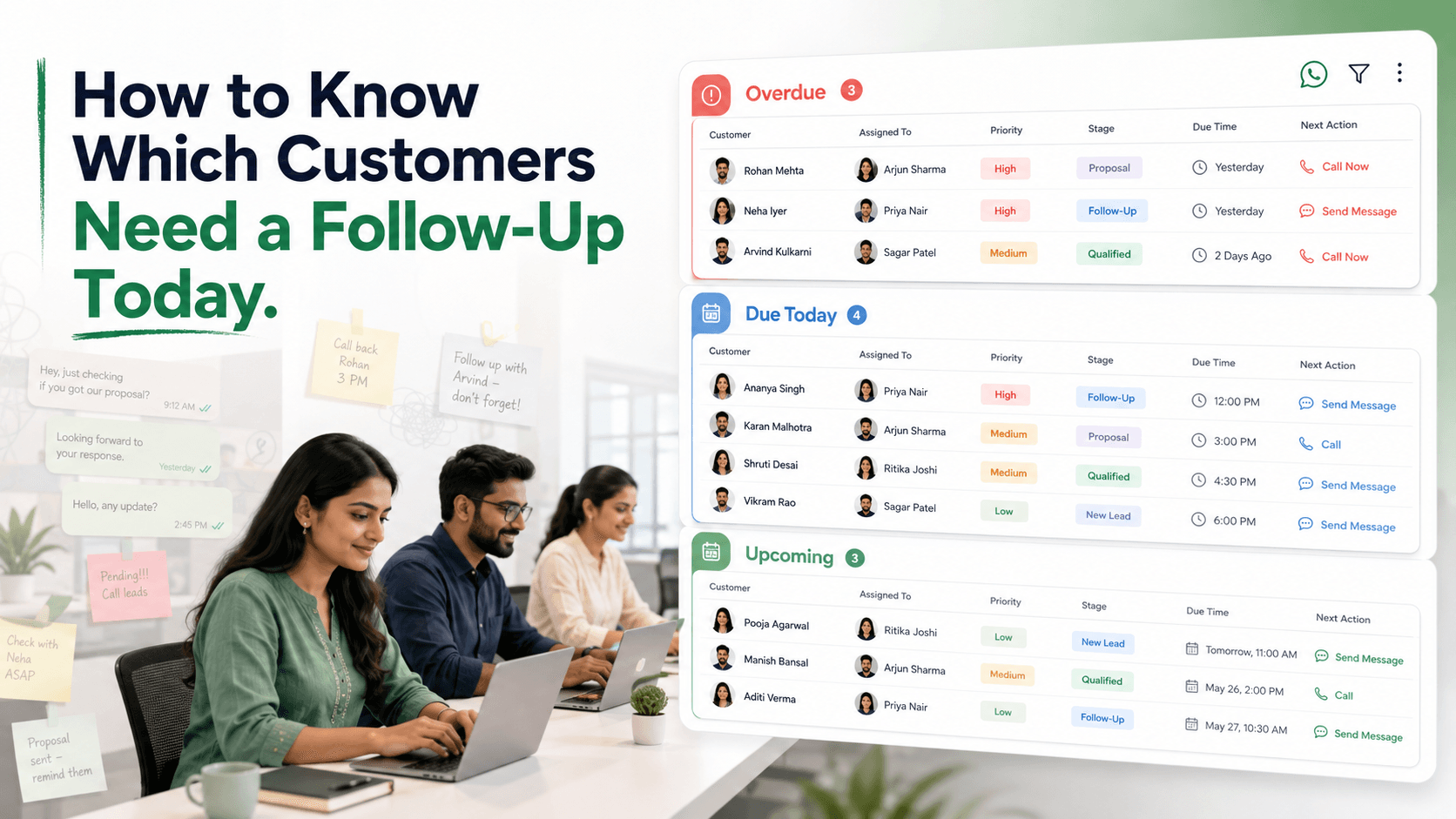
- Create a Daily Follow-Up View
- Review Overdue Follow-Ups First
- Assign One Owner
- Preserve Conversation Context
- Follow Up With New Value
- Know When Not to Follow Up
- Automate Reminders, Not Every Message
- Build Follow-Up Rules Around Events
- Create a Daily Team Routine
- Record the Outcome
- Measure Follow-Up Performance
- Common Mistakes to Avoid
- How Voixt.ai Organises Daily Follow-Ups
- Final Thoughts
How to Know Which Customers Need a Follow-Up Today
A customer asks for a quotation. Another wants a product when it returns to stock. A third says, “Contact me next week.” An employee promises to confirm a delivery date by the end of the day.
All four conversations require follow-up, but they should not depend on memory, unread-message markers, or personal notes.
A reliable follow-up process should tell the team:
- Which customers need attention today
- Why each follow-up is due
- Who is responsible
- What happened previously
- What action should happen next
- Which conversations are already overdue
The goal is not to contact every customer repeatedly. It is to complete promised actions and continue relevant conversations at the appropriate time.
Why Follow-Ups Get Missed
Follow-ups are often managed informally.
Employees may rely on:
- Unread chats
- Starred messages
- Personal calendars
- Notes applications
- Spreadsheets
- Memory
- Messages sent to themselves
These methods can work temporarily, but they become unreliable when message volume grows or several employees share customer responsibility.
A follow-up may disappear when:
- New messages push the conversation down the list
- The employee marks the message as read
- The customer replies after several days
- The owner takes leave
- The conversation changes employees
- The spreadsheet is not updated
- A promised internal action takes longer than expected
- Nobody records a specific due date
Follow-up management needs structure.
An Unread Message Is Not a Follow-Up System
Unread status shows whether someone opened a conversation. It does not show whether the required work is complete.
A conversation may be read but still require:
- A quotation
- Stock confirmation
- Delivery investigation
- Manager approval
- Payment verification
- Appointment rescheduling
- A promised callback
Another conversation may remain unread even though it requires no response.
Use clear statuses, owners, and due dates instead of treating the inbox as a task list.
Every Follow-Up Needs Five Details
A useful follow-up record should include:
- Customer — Who needs attention?
- Owner — Which employee is responsible?
- Reason — Why is the follow-up required?
- Due date and time — When should it happen?
- Next action — What must the employee do?
For example:
Customer: Meera Shah Owner: Arjun Due: Today at 4:00 p.m. Reason: Waiting for size M stock confirmation Next action: Check with Indiranagar store and send availability update
“Follow up later” is not specific enough.
Which Customers Usually Need Follow-Up?
1. Customers Who Requested a Specific Date
If a customer says:
Contact me on Friday.
Record Friday as the due date.
Do not send messages before the requested time merely because the salesperson wants an earlier answer.
A customer-selected follow-up is one of the strongest reasons to contact them.
2. Customers Waiting for Promised Information
Employees often say:
- I’ll confirm availability
- I’ll check with the warehouse
- I’ll send the quotation
- I’ll ask my manager
- I’ll update you after speaking with the courier
Every promise should create a follow-up task immediately.
For example:
Update Rahul by 5:00 p.m. after confirming delivery availability with the fulfilment team.
Even if there is no final answer by the promised time, send an update:
Hi Rahul, I’m still waiting for confirmation from our delivery team. I’ll update you by 11:00 a.m. tomorrow. I’m sorry for the delay.
Create a new reminder for the revised commitment.
3. Customers Who Received a Quotation
A quotation often requires a follow-up, but the timing should reflect the purchase.
Consider:
- Quotation value
- Customer’s decision timeline
- Product availability
- Validity period
- Customer-requested date
- Whether clarification is pending
A useful follow-up adds context:
Hi Meera, I’m following up on quotation Q-1842 for the walnut study desk. Delivery to Baner is still available next week, and the quotation remains valid until Friday. Would you like any detail clarified?
Avoid:
Any update?
4. Customers Waiting for Stock
Create a follow-up when a requested product or variant becomes available.
Record:
- Product code
- Variant
- Quantity
- Customer location
- Maximum acceptable price when voluntarily provided
- Notification expiry
For example:
Hi Kavya, the brass table lamp you requested is back in stock for ₹3,499. Reply RESERVE if you would like us to hold one until tomorrow.
Do not contact the customer about unrelated stock merely because their requested product remains unavailable.
5. Customers With Pending Payments
A payment follow-up may be appropriate when:
- The customer confirmed the order
- A payment link was requested
- The payment deadline is genuine
- A transaction failed
- The customer asked for assistance
Before following up, verify:
- Current order status
- Payment status
- Final amount
- Link validity
- Whether the order was cancelled
- Whether the customer already paid through another method
For example:
Hi Arjun, payment for order VH-4821 is still pending. The confirmed amount is ₹4,850, and the reservation remains active until 6:00 p.m. today. Reply PAY for the approved payment option or HELP if you have already completed it.
Do not rely only on screenshots when verifying payment.
6. Customers With Open Support Issues
Support follow-ups should be prioritised according to impact and urgency.
Examples include:
- Delayed delivery
- Damaged product
- Missing item
- Service interruption
- Refund delay
- Appointment problem
- Incorrect order
The team should follow up when:
- A promised update is due
- Another department completes an action
- New information becomes available
- The resolution deadline approaches
- The issue remains unresolved
A customer should not need to ask repeatedly for progress.
7. Customers Who Asked to Be Contacted Later
“Later” should become a specific date.
If a customer says:
Message me next month.
Ask or infer the minimum necessary clarification:
Certainly. Would you prefer the first or third week of next month?
Record the customer’s selection and avoid contacting them earlier about the same matter.
8. Customers With Upcoming Appointments or Renewals
Follow-up may be required for:
- Appointment confirmation
- Rescheduling request
- Service renewal
- Maintenance reminder
- Subscription expiry
- Reorder cycle
The message should include the relevant date and a clear action.
For example:
Reminder: Your consultation is scheduled for tomorrow at 3:30 p.m. Reply CONFIRM, RESCHEDULE, or CANCEL.
These reminders can often be automated when the customer expects them.
9. High-Intent Customers Who Went Quiet
A customer may show strong purchase intent and then stop responding.
Useful signals include:
- Requested a quotation
- Confirmed a product variant
- Asked for delivery availability
- Requested a payment link
- Asked the business to reserve an item
One respectful follow-up may be appropriate.
For example:
Hi Meera, I’m checking whether you still need the blue dress in size M. The reservation expires today at 6:00 p.m. No action is needed if you no longer want it.
Do not create false urgency or send repeated messages without new information.
Prioritise Today’s Follow-Up List
A team may have more due tasks than it can complete at once.
Use priority rules.
Urgent
- Safety or security concerns
- Suspected fraud
- Serious complaints
- Same-day appointment changes
- Time-sensitive service failures
- Promised updates already overdue
High priority
- Payment problems
- Missing or damaged orders
- Customers ready to purchase
- High-value quotations near expiry
- Existing customers with unresolved issues
Standard priority
- Routine quotation follow-ups
- Stock updates
- Product comparisons
- Reorder reminders
- General appointment confirmations
Low priority
- Long-term nurturing
- Non-urgent feedback
- Optional future offers
Priority should consider customer impact, promised deadlines, and business risk—not only potential revenue.
Use Customer Stages to Identify Follow-Ups
A CRM pipeline makes follow-up needs visible.
A sales pipeline might include:
- New enquiry
- Requirement identified
- Product shared
- Quotation sent
- Follow-up scheduled
- Awaiting decision
- Awaiting payment
- Order confirmed
- Completed
- Lost or not interested
Each stage can have a standard next-action rule.
For example:
| Stage | Possible follow-up rule |
|---|---|
| New enquiry | Assign and reply within business target |
| Product shared | Follow up on customer-selected date |
| Quotation sent | Review after agreed decision period |
| Awaiting payment | Verify status before reminder |
| Support issue open | Update by promised resolution time |
| Completed | Stop sales follow-up sequence |
Rules provide consistency, but employees should adjust them to the customer’s actual context.
Create a Daily Follow-Up View
A useful daily view should show:
- Due today
- Overdue
- Due this week
- Assigned employee
- Priority
- Customer stage
- Follow-up reason
- Last conversation date
- Next action
Employees should be able to filter the list by:
- Owner
- Team
- Branch
- Product category
- Support issue
- Priority
- Campaign
This creates one reliable work queue instead of several personal reminder systems.
Review Overdue Follow-Ups First
An overdue task may represent a broken customer promise.
Before sending the message, review:
- What was promised
- Why the deadline was missed
- Whether new information exists
- Whether another employee contacted the customer
- Whether the customer already completed the action
Acknowledge meaningful delays honestly:
Hi Meera, I’m sorry we did not update you by 4:00 p.m. as promised. The warehouse has now confirmed that size M will be available on Monday. Would you like us to notify you when it arrives?
Do not send a generic follow-up that ignores the missed commitment.
Assign One Owner
Every follow-up should belong to one employee.
Without ownership:
- Two employees may contact the same customer
- Each employee may assume the other will follow up
- Different information may be sent
- The task may remain incomplete
When ownership changes, transfer:
- Customer context
- Follow-up reason
- Promise made
- Current status
- Due time
- Next action
The new owner should not need to reconstruct the task from scattered messages.
Preserve Conversation Context
Before following up, the employee should review:
- Customer’s latest message
- Product or service discussed
- Quotation or order details
- Previous objections
- Promised action
- Communication preference
- Relevant internal notes
The message should continue the conversation.
Avoid:
Hi, are you interested?
Use:
Hi Rahul, I’ve confirmed that the compact desk you viewed is available in the walnut finish. Delivery to Baner is possible on Saturday. Would you like us to reserve it?
Follow Up With New Value
A useful follow-up should provide at least one of the following:
- Requested information
- Updated availability
- Relevant alternative
- Clarification
- Revised quotation
- Confirmed delivery date
- Appointment option
- Genuine deadline
- Resolution progress
If nothing has changed and the customer did not request another message, repeated follow-ups may create pressure rather than value.
Know When Not to Follow Up
Do not follow up when:
- The customer asked to stop communication
- The customer declined the offer
- The purchase was completed
- The issue was resolved
- The reminder is no longer relevant
- Another employee already contacted the customer
- The customer requested a later date
- The business has no new or useful information
- An unresolved complaint makes promotion inappropriate
Silence is not permission to increase message frequency.
WhatsApp requires businesses to obtain appropriate opt-in permission before initiating messages and to respect requests to stop communication. WhatsApp Business Messaging Policy
Automate Reminders, Not Every Message
Automation can identify due follow-ups and notify employees without automatically contacting the customer.
This is useful when the message requires judgement.
Automation can:
- Create a task when a quotation is sent
- Notify the owner when a due date arrives
- Escalate overdue tasks
- Update customer stages
- Stop reminders after purchase
- Reassign tasks when an employee is unavailable
- Create manager alerts for urgent issues
The employee can then review the context and send an appropriate response.
Fully automated messages are more suitable for predictable events such as appointment reminders, order updates, and customer-requested reorder schedules.
Build Follow-Up Rules Around Events
Useful triggers include:
- Quotation sent
- Customer requests contact on a date
- Payment remains pending
- Appointment approaches
- Product returns to stock
- Delivery issue remains unresolved
- Customer selects LATER
- Employee promises an update
Every trigger should define:
- Due time
- Owner
- Priority
- Required action
- Stop conditions
- Escalation rule
For example:
Trigger: Quotation sent Due: Customer-selected review date or three business days Owner: Assigned salesperson Stop: Purchase completed, customer declines, or customer opts out Escalate: High-value quotation overdue by one business day
Create a Daily Team Routine
A practical routine might include:
Start of day
- Review overdue tasks
- Review urgent support follow-ups
- Confirm employee availability
- Reassign tasks from absent employees
During the day
- Complete due tasks
- Create reminders immediately when promises are made
- Update customer stages
- Record outcomes
End of day
- Review incomplete promises
- Transfer work requiring another shift
- Reschedule tasks with valid reasons
- Escalate unresolved urgent issues
This routine makes follow-up management part of normal work rather than an occasional cleanup task.
Record the Outcome
After following up, record what happened.
Possible outcomes include:
- Customer responded
- Follow-up completed
- New date requested
- Quotation updated
- Payment completed
- Order confirmed
- Not interested
- No response
- Issue resolved
- Escalated
- Opted out
The outcome should update the customer stage and determine whether another action is required.
Do not leave completed tasks open or create endless follow-up sequences.
Measure Follow-Up Performance
Track:
- Follow-ups due
- Follow-ups completed on time
- Overdue tasks
- Average delay
- Response rate
- Conversion rate
- Revenue from follow-ups
- Support issues updated on time
- Appointments confirmed
- Tasks reassigned
- Opt-outs and complaints
- Follow-ups by employee, team, and stage
Quality matters as much as quantity.
A team that sends many generic reminders may perform worse than one that sends fewer, relevant messages.
Common Mistakes to Avoid
Using Memory as the System
Create a visible task with an owner and due date.
Treating Unread Chats as Follow-Ups
Use statuses and next actions instead.
Writing “Follow Up Later”
Record a specific date, time, reason, and action.
Contacting Every Customer on the Same Schedule
Adapt timing to the customer’s stage and request.
Sending Generic Messages
Continue the previous conversation and add useful information.
Ignoring Completed Purchases or Resolved Issues
Stop unnecessary follow-up sequences immediately.
Allowing Two Employees to Follow Up
Assign one owner and maintain shared visibility.
Measuring Only Message Count
Track timeliness, outcomes, satisfaction, and negative feedback.
How Voixt.ai Organises Daily Follow-Ups
Voixt.ai helps businesses identify which WhatsApp conversations need action and when.
Teams can use:
- Follow-up reminders with specific owners, due dates, and next actions
- Visual CRM pipelines to organise customers by sales or support stage
- Conversation assignments so every follow-up has one responsible employee
- Shared multi-agent WhatsApp inboxes so the team can see customer history and current ownership
- Automatic contact capture to maintain structured customer records
- Contact tags and filters for priority, product interest, location, stage, and follow-up status
- No-code automation workflows for creating tasks, updating stages, escalating overdue work, and stopping completed sequences
- AI-powered responses to help employees draft relevant follow-up messages efficiently
- AI-to-human handovers that preserve the previous conversation
- Private internal notes for promises, pending actions, and customer context
- Campaign management for targeted, permission-based communication and organised responses
This gives employees one daily view of overdue and upcoming customer actions instead of relying on scattered reminders and memory.
Final Thoughts
Knowing which customers need a follow-up today requires more than opening WhatsApp and scanning recent messages.
Every follow-up should have a customer, owner, reason, due date, and next action. Customer stages and priority rules should determine which tasks appear first.
Follow up when you have a promise to complete, requested information to provide, or a relevant next step. Stop when the customer declines, purchases, resolves the issue, changes the date, or asks not to receive further communication.
Voixt.ai helps businesses organise this process through shared conversations, assignments, pipelines, reminders, and automation so important customer actions do not depend on memory.