
How Retailers Can Use WhatsApp for New Arrivals Without Annoying Customers
Learn how retailers can promote new arrivals on WhatsApp using customer consent, relevant segments, curated products, appropriate timing, and respectful follow-ups.
On this page24 sections
- How Retailers Can Use WhatsApp for New Arrivals Without Annoying Customers
- Start With Permission
- 1. Ask Customers What They Want to Receive
- 2. Segment Customers Using Relevant Context
- 3. Build Exclusions Before Sending
- 4. Send a Curated Selection
- 5. Keep Product Information Complete
- 6. Explain Why the Product Is Relevant
- 7. Use Appropriate Timing
- 8. Control Campaign Frequency
- 9. Use One Clear Call to Action
- 10. Prepare Employees Before Launching
- 11. Assign Every Interested Customer
- 12. Track New-Arrival Enquiries Through a Pipeline
- 13. Follow Up With New Information
- 14. Use Reservations Honestly
- 15. Confirm the Order Before Payment
- 16. Share a Secure Payment Option
- 17. Stop Promotional Follow-Ups After Purchase
- New-Arrival Message Examples
- Measure More Than Message Delivery
- Common Mistakes Retailers Should Avoid
- How Voixt.ai Helps Retailers Promote New Arrivals
- Final Thoughts
How Retailers Can Use WhatsApp for New Arrivals Without Annoying Customers
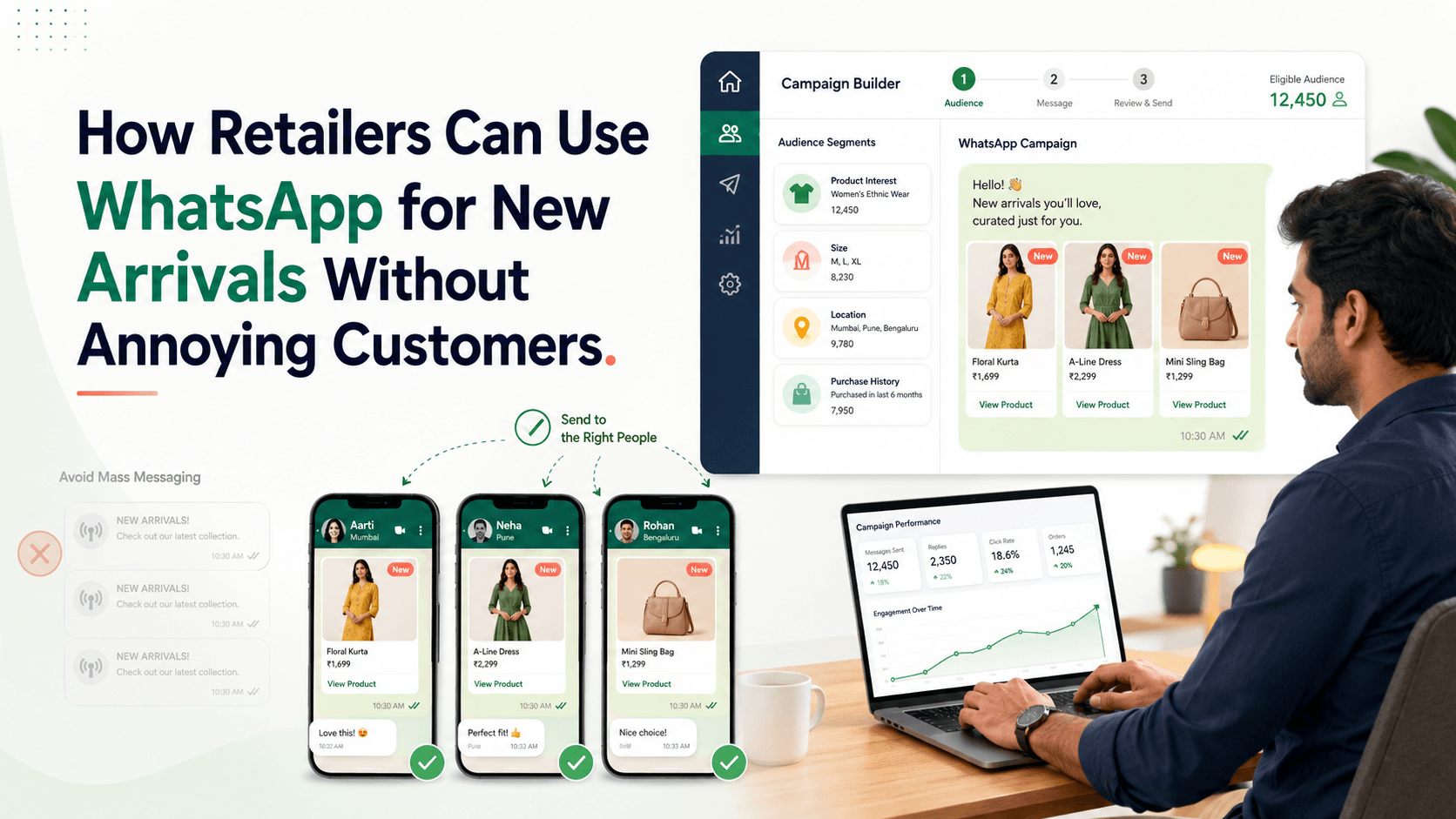
New-arrival messages can help customers discover products they genuinely want. They can also become irritating when every customer receives every product launch, several images arrive without context, or the retailer sends repeated reminders after receiving no response.
The difference is relevance.
A useful new-arrival message reaches customers who are likely to care about the collection, explains why it may interest them, arrives at an appropriate time, and gives them a simple way to respond or change their communication preferences.
Here is how retailers can promote new arrivals on WhatsApp without overwhelming their customers.
Start With Permission
Retailers should not assume that every customer who shared a phone number wants promotional messages.
WhatsApp’s Business Messaging Policy states that businesses must receive the person’s phone number and opt-in permission before sending subsequent messages or calls. Businesses must also respect requests to stop communication. WhatsApp Business Messaging Policy
A clear opt-in might say:
Receive new-arrival updates and up to four promotional messages per month from UrbanStyle on WhatsApp. Reply STOP at any time to unsubscribe.
Explain:
- Which business will send messages
- What types of messages the customer will receive
- Approximate frequency
- How the customer can update preferences or opt out
Maintain consent records and follow applicable privacy and marketing requirements.
1. Ask Customers What They Want to Receive
Customers are more likely to value new-arrival messages when they can choose the categories that interest them.
A retailer might ask customers to select:
- Women’s clothing
- Men’s clothing
- Children’s products
- Footwear
- Jewellery
- Home décor
- Furniture
- Electronics
- Beauty products
- Premium collections
- Sale announcements
For example:
Which updates would you like to receive? Reply WOMEN, MEN, KIDS, or HOME. You can change your preferences at any time.
This creates more useful segments than placing everyone on one general list.
2. Segment Customers Using Relevant Context
Product preferences are only one form of segmentation.
Retailers can also organise audiences using:
- Previous purchases
- Products previously discussed
- Preferred size or variant
- Typical budget
- Store location
- Delivery area
- Online or in-store preference
- Loyalty status
- Previous campaign response
- Last purchase date
For example, a furniture retailer should send a new compact-desk collection to customers who previously enquired about home-office furniture—not to everyone who purchased any item from the store.
Use information customers knowingly provided through purchases, enquiries, preferences, or legitimate interactions. Avoid sensitive inferences or hidden profiling.
3. Build Exclusions Before Sending
Good targeting requires deciding who should not receive the campaign.
Exclude customers who:
- Asked to stop promotional messages
- Already purchased from the new collection
- Recently received a similar message
- Declined the product category
- Live outside the eligible delivery area
- Are not interested in the category
- Have an unresolved complaint
- Are waiting for a different product
Exclusion rules prevent irrelevant communication and repeated promotions.
4. Send a Curated Selection
Do not send twenty or thirty product images in the first message.
A large image dump forces customers to scroll through the conversation, match products with prices, and remember which item they liked.
Send a small selection or invite customers to request the relevant collection.
For example:
Hi Meera, our new pastel kurta collection has arrived in sizes S to XXL, starting at ₹1,299. Since you previously preferred lightweight everyday styles, we selected five suitable options. Reply STYLES to view them.
This message is useful because it explains:
- What has arrived
- Why it may be relevant
- The price range
- Available sizes
- What the customer should do next
5. Keep Product Information Complete
A product image without useful details creates more work for customers and employees.
Each product should include:
- Product name or code
- Price
- Available variants
- Key features
- Material or specifications
- Stock status
- Delivery or pickup information
- Relevant terms
For example:
Product: Linen Shirt LS-204 Price: ₹1,899 Colours: White, blue, and olive Sizes: M to XXL Availability: In stock Delivery: Two to four business days
Consistent product codes also prevent confusing replies such as “How much is the third blue one?”
6. Explain Why the Product Is Relevant
A message feels more personal when the retailer connects the new arrival to a known customer preference.
Compare:
New collection available. Shop now.
With:
Hi Arjun, our new compact work desks have arrived. Since you previously asked for models below 120 cm wide, we selected three options that may fit your space.
The second message uses relevant context without becoming intrusive.
Do not claim a product is perfect for the customer when the business does not have enough information to make that judgement.
7. Use Appropriate Timing
A relevant message can still be annoying when it arrives too often or at an unreasonable time.
Consider:
- Customer’s local time
- Store operating hours
- Product availability
- Delivery timelines
- Previous campaign date
- Seasonal relevance
- Customer purchase cycle
Send campaigns when employees are available to handle replies.
Avoid announcing a collection before accurate prices, stock details, and fulfilment information are ready.
8. Control Campaign Frequency
There is no perfect frequency for every retailer.
A fast-fashion business may have more frequent launches than a furniture or jewellery store. Customer expectations should determine the schedule.
Monitor:
- Replies
- Catalogue requests
- Purchases
- Opt-outs
- Blocks
- Complaints
- Falling engagement
Do not respond to declining engagement by sending more messages. Improve targeting, content, and timing first.
Let customers choose fewer updates when possible.
9. Use One Clear Call to Action
Tell customers exactly what to do next.
Useful actions include:
- Reply CATALOGUE
- Reply SIZE
- Reply RESERVE
- Reply VISIT
- Book a styling appointment
- Ask for delivery availability
- Speak with an employee
Avoid including several links and competing instructions in one message.
For example:
Reply CATALOGUE to view the new collection or STOP to opt out of promotional messages.
A simple action makes the campaign easier to understand and measure.
10. Prepare Employees Before Launching
A successful new-arrival campaign may generate many replies at once.
Before sending, confirm:
- Which employees will handle replies
- How conversations will be assigned
- Whether stock information is current
- Whether prices are approved
- Which sizes and variants are available
- How reservations work
- Which delivery dates can be promised
- How opt-outs will be recorded
Do not send a large campaign when nobody is available to respond.
11. Assign Every Interested Customer
Every campaign reply should have one responsible employee.
Without clear assignment:
- Two employees may reply to the same customer
- Questions may remain unanswered
- Different prices may be quoted
- Follow-ups may be forgotten
- Customers may have to repeat their requirements
Assignment can be based on branch, product category, customer language, location, or employee availability.
12. Track New-Arrival Enquiries Through a Pipeline
A campaign response should become a trackable sales opportunity.
A simple pipeline might include:
- Campaign reply received
- Preference identified
- Products shared
- Availability confirmed
- Awaiting decision
- Follow-up scheduled
- Awaiting payment
- Order confirmed
- Completed
- Lost or not interested
Each active enquiry should have an owner, status, and next action.
This prevents interested customers from disappearing after product photos are shared.
13. Follow Up With New Information
Avoid generic follow-ups such as:
Did you check the collection?
Add value instead:
Hi Kavya, I’m following up on the linen dresses you viewed. The blue style is now available in size M, and I found another option within your ₹3,000 budget. Would you like to see it?
Useful follow-ups can provide:
- Updated availability
- A relevant alternative
- Size information
- Delivery details
- A product comparison
- A genuine reservation deadline
If nothing has changed and the customer did not request another message, repeated follow-ups may feel like pressure.
14. Use Reservations Honestly
A short reservation can help customers who need time to decide.
State:
- Exact product and variant
- Reservation expiry
- Whether payment is required
- What happens when the period ends
For example:
We can reserve the blue dress in size M until tomorrow at 6:00 p.m. No payment is required until you confirm.
Do not use false scarcity or claim that an item is reserved when no reliable inventory process exists.
15. Confirm the Order Before Payment
Before requesting payment, send a complete order summary:
Order summary
Product: Blue linen dress LD-108 Size: M Quantity: 1 Price: ₹2,899 Delivery: ₹100 Total: ₹2,999 Estimated delivery: 24–26 August
Please reply CONFIRM if these details are correct.
This allows the customer to correct the size, colour, quantity, address, or fulfilment method.
16. Share a Secure Payment Option
After confirmation, provide an approved payment method supported by the retailer.
Never ask customers to share passwords, card PINs, or one-time passwords through chat.
Verify payments through the authorised payment system instead of relying only on screenshots. After verification, send an order number, receipt, and fulfilment timeline.
17. Stop Promotional Follow-Ups After Purchase
Once a customer purchases the promoted product, remove them from the remaining campaign sequence.
They should receive relevant order updates—not reminders to buy the same item again.
After fulfilment, the retailer may recommend complementary products when appropriate and permitted, but the recommendation should not delay or complicate the original purchase.
New-Arrival Message Examples
Clothing store
Hi Meera, our new cotton kurta collection has arrived in sizes S to XXL, starting at ₹1,299. We selected five lightweight styles based on your previous preference. Reply STYLES to view them or STOP to opt out.
Furniture store
Hi Arjun, our new compact study tables are now available. Three models are under ₹8,000 and suitable for smaller rooms. Reply TABLES to view dimensions, prices, and delivery availability.
Beauty retailer
Hi Ananya, two new shades have been added to the lip-colour range you purchased previously. Reply SHADES to view them and check current availability.
Home décor store
Hi Kavya, our new handmade lamp collection has arrived at the Indiranagar store. Reply LAMPS to view the collection or VISIT to book a store appointment.
Measure More Than Message Delivery
Track:
- Reply rate
- Catalogue requests
- Product enquiries
- Store visits
- Reservations
- Orders
- Revenue
- Conversion by segment
- Average order value
- Opt-outs
- Blocks and complaints
- Products requested but unavailable
- Follow-ups completed
A smaller campaign sent to the right customers can outperform a large campaign sent to everyone.
Common Mistakes Retailers Should Avoid
Sending every launch to every customer
Use product, location, purchase, and preference segments.
Sending too many images
Share a curated selection or let customers request the catalogue.
Omitting price and availability
Provide enough information for customers to decide whether to respond.
Repeating the same campaign
Use follow-ups only when they add value or communicate a genuine deadline.
Launching before stock is ready
Confirm prices, variants, fulfilment, and employee capacity first.
Ignoring opt-outs
Update customer preferences immediately.
Forgetting campaign replies
Assign each conversation and schedule necessary follow-ups.
How Voixt.ai Helps Retailers Promote New Arrivals
Voixt.ai helps retailers build relevant customer segments, organise campaigns, and manage the conversations created by new-arrival messages.
Teams can use:
- Contact tags and filters for product interests, locations, sizes, purchases, and customer stages
- Campaign management to organise new-arrival communication and responses
- Shared multi-agent WhatsApp inboxes so employees can handle replies together
- Automatic contact capture to maintain organised customer records
- Conversation assignments so every enquiry has an owner
- Visual CRM pipelines to track customers from campaign response to completed purchase
- Follow-up reminders so interested customers are not forgotten
- No-code automation workflows for tagging, routing, reservations, and order updates
- AI-powered responses to help answer common product questions
- Private internal notes for sharing customer and stock context
- AI-to-human handovers when customers need personalised recommendations
This allows retailers to promote new products without turning WhatsApp into a stream of irrelevant messages.
Final Thoughts
Customers do not necessarily dislike new-arrival messages. They dislike messages that arrive without permission, ignore their interests, waste their time, or continue after they have shown no interest.
Retailers should focus on customer preferences, curated selections, accurate product information, appropriate frequency, and useful follow-ups.
Voixt.ai helps businesses organise this process so new-arrival campaigns can generate sales while preserving customer trust.