
WhatsApp Catalog vs Online Store: What's the Difference?
Compare a WhatsApp catalog with an online store, including product discovery, checkout, payments, automation, customer conversations, costs, limitations, and the best option for your business.
On this page21 sections
- WhatsApp Catalog vs Online Store: What's the Difference?
- What Is a WhatsApp Catalog?
- What Is an Online Store?
- WhatsApp Catalog vs Online Store: Quick Comparison
- 1. Product Discovery
- 2. Customer Conversations
- 3. Catalogue Size and Navigation
- 4. Checkout and Payments
- 5. Personalisation
- 6. Speed of Setup
- 7. Operating Costs
- 8. Team Management
- 9. Inventory and Availability
- 10. Branding and Customer Trust
- When a WhatsApp Catalog May Be Enough
- When an Online Store Is More Suitable
- Can a Business Use Both?
- Questions to Ask Before Choosing
- Common Mistakes to Avoid
- How Voixt.ai Supports WhatsApp-Led Selling
- Final Thoughts
WhatsApp Catalog vs Online Store: What's the Difference?
A WhatsApp catalog and an online store can both help customers discover and purchase products, but they serve different purposes.
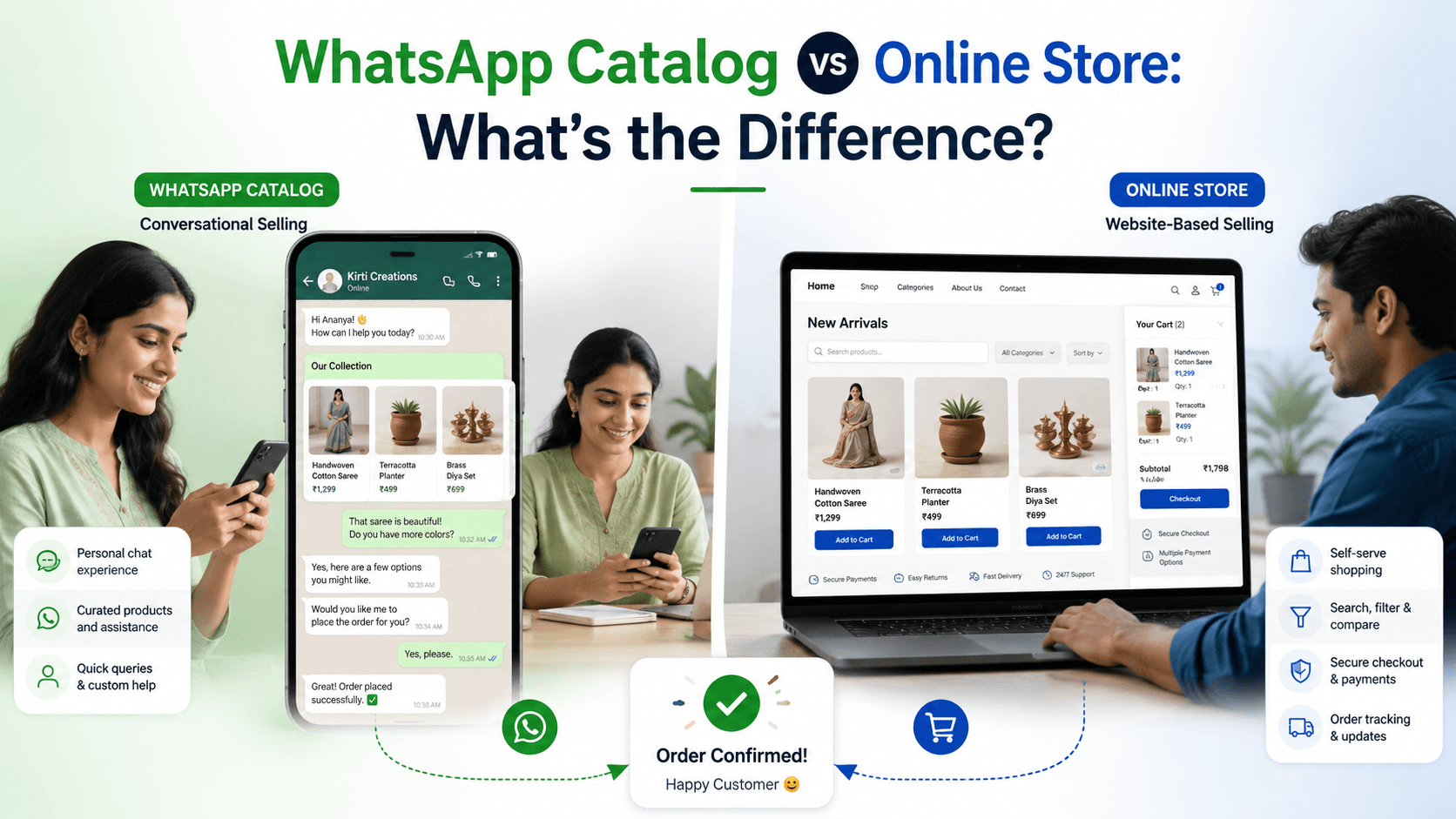
A WhatsApp catalog places product information inside a messaging experience. Customers can browse products and then continue the purchase through a conversation. An online store provides a dedicated website where customers can usually search, compare, add products to a cart, pay, and manage an order with less employee involvement.
Neither option is automatically better. The right choice depends on the size of the catalogue, order volume, customer behaviour, budget, and amount of personal assistance required.
What Is a WhatsApp Catalog?
A WhatsApp catalog is a mobile storefront that allows a business to display products or services inside WhatsApp. According to the official WhatsApp Business feature page, businesses can organise related items into collections, share links to the complete catalogue or individual products, and let customers send selected catalogue items as one cart message. Availability can depend on the business’s setup and location. WhatsApp Business App Features
A catalogue item can contain information such as:
- Product name
- Images
- Price
- Description
- Product code
- Link
- Relevant variants or details
The catalogue helps customers understand what the business sells without requiring employees to send every product photo manually.
The conversation remains central. Customers can browse, ask questions, confirm availability, request recommendations, and discuss delivery before purchasing.
What Is an Online Store?
An online store is a dedicated ecommerce website or hosted storefront where customers can browse and purchase products.
A typical online store may include:
- Product categories
- Search and filters
- Product pages
- Shopping cart
- Online checkout
- Payment gateway
- Shipping calculations
- Customer accounts
- Inventory information
- Discount codes
- Order tracking
- Returns workflows
- Analytics and integrations
The customer can often complete the purchase independently without waiting for an employee to respond.
WhatsApp Catalog vs Online Store: Quick Comparison
| Area | WhatsApp Catalog | Online Store |
|---|---|---|
| Primary experience | Product discovery through messaging | Product discovery and checkout through a website |
| Customer assistance | Conversation-led | Usually self-service, with optional support |
| Setup | Generally simpler | Usually requires more configuration |
| Product range | Better for focused catalogues | Better for large, structured catalogues |
| Search and filters | More limited | Usually more advanced |
| Checkout | Often completed through chat or a linked payment process | Usually built into the store |
| Personalisation | Employee recommends products directly | Recommendations depend on store features and data |
| Order management | Requires an organised conversation and CRM process | Often included or integrated |
| Search visibility | Limited outside the messaging ecosystem | Can support search-engine discovery |
| Branding control | Limited | Extensive design and branding control |
| Maintenance | Product and conversation management | Website, products, checkout, integrations, and security |
| Best suited for | Conversational and assisted selling | Self-service and higher-volume ecommerce |
1. Product Discovery
A WhatsApp catalog works well when customers already know the business or arrive through Instagram, Facebook, a QR code, advertisement, referral, or direct link.
WhatsApp officially lists QR codes, short links, social profile actions, and click-to-message advertising among the available ways businesses can encourage customers to start conversations. WhatsApp Business App Features
An online store has broader discovery potential because its pages can be linked from different platforms and may appear in search results when properly configured.
Choose a WhatsApp-led approach when most customers arrive through conversations. Consider an online store when search visibility and independent product browsing are important.
2. Customer Conversations
A WhatsApp catalog is naturally suited to products that require questions before purchase.
Customers may need help with:
- Size
- Colour
- Compatibility
- Customisation
- Availability
- Delivery
- Installation
- Product suitability
- Bulk quantities
An employee can understand the requirement and recommend a suitable option.
An online store is designed for customers who are comfortable reading product information and deciding independently. Live chat or WhatsApp can still be added for customers who need assistance.
3. Catalogue Size and Navigation
A WhatsApp catalog can work well for a manageable number of products, focused collections, and frequently requested items.
As the catalogue grows, customers may need more advanced ways to browse. An online store can offer:
- Search
- Categories
- Filters
- Sorting
- Product comparisons
- Related items
- Detailed specifications
A business selling thousands of products will usually need more structured navigation than a conversation-first catalogue can provide.
4. Checkout and Payments
A WhatsApp catalogue helps the customer select products, but the business still needs a clear process for confirming availability, charges, payment, and fulfilment.
A WhatsApp-led order may involve:
- Customer selects a product.
- Employee confirms the variant and stock.
- Business sends an order summary.
- Customer confirms the details.
- Business shares an approved payment option.
- Payment is verified.
- Customer receives fulfilment updates.
An online store generally provides a structured checkout where customers enter delivery information, select shipping and payment options, and place the order themselves.
The exact payment options available through WhatsApp or an ecommerce platform can vary by provider, configuration, and location.
Never request passwords, card PINs, or one-time passwords through chat. Payments should be verified through an authorised payment system rather than relying only on screenshots.
5. Personalisation
WhatsApp allows employees to personalise recommendations through conversation.
For example:
You mentioned that you need a compact dining table below ₹20,000. These three options are the closest match. The first is easiest to maintain, while the second provides additional storage.
An online store can personalise recommendations through customer accounts, browsing data, purchase history, and ecommerce tools. However, these features may require additional setup and integrations.
WhatsApp personalisation is human and conversational. Online-store personalisation is usually system-driven and scalable.
6. Speed of Setup
A WhatsApp catalog can provide a practical starting point for a small business because it does not require a complete website design, checkout configuration, hosting setup, or extensive development.
The business still needs to prepare:
- Product photographs
- Prices
- Descriptions
- Product codes
- Availability information
- Order procedures
- Payment methods
- Delivery policies
An online store usually requires more initial work, including store design, product structure, payment setup, shipping rules, policies, testing, and ongoing maintenance.
7. Operating Costs
The cost of either option depends on the tools and services selected.
A WhatsApp-led process may involve costs for:
- Business messaging tools
- Team inbox software
- Automation
- CRM functionality
- Payment processing
- Advertising
An online store may involve:
- Platform subscription
- Domain
- Hosting
- Development
- Design
- Applications or plugins
- Payment processing
- Maintenance
- Security and backups
Compare the complete operational cost rather than looking only at the initial setup price.
8. Team Management
As WhatsApp enquiry volume grows, one phone is not enough to manage the sales process reliably.
Businesses need:
- Shared access for authorised employees
- Conversation assignments
- Complete customer history
- Internal notes
- Follow-up reminders
- Sales stages
- Order status tracking
- Performance visibility
An online store records orders automatically, but customer questions may still arrive through WhatsApp, email, social media, and support channels. These conversations also require ownership and tracking.
9. Inventory and Availability
A WhatsApp catalogue must be kept current. Customers become frustrated when they select a product and later learn that it is unavailable or incorrectly priced.
An online store can provide more advanced inventory capabilities, particularly when connected to point-of-sale, warehouse, or accounting systems.
Regardless of the channel, businesses should confirm current availability before accepting payment when inventory information is uncertain.
10. Branding and Customer Trust
An online store gives a business more control over:
- Design
- Domain name
- Navigation
- Product storytelling
- Policies
- Reviews
- Educational content
- Brand presentation
A WhatsApp catalogue offers less design control but provides the familiarity and convenience of a direct conversation.
Trust depends on more than the channel. Businesses should provide accurate information, clear policies, secure payment methods, reliable fulfilment, and responsive support.
When a WhatsApp Catalog May Be Enough
A WhatsApp catalogue may be suitable when:
- The product range is manageable
- Customers usually ask questions before buying
- Orders are local or relationship-driven
- Products require recommendations
- The business is testing online demand
- Employees are available to assist customers
- Purchases involve customisation
Examples may include boutiques, bakeries, local furniture stores, home businesses, jewellery sellers, appointment-based services, and specialised retailers.
When an Online Store Is More Suitable
An online store may be better when:
- The catalogue is large
- Customers expect self-service checkout
- Search and filtering are important
- Order volume is high
- The business sells across many locations
- Shipping rules are complex
- Inventory requires deeper integration
- Search-engine visibility matters
- Employees cannot manually assist with every order
Can a Business Use Both?
Yes. Many businesses benefit from a combined approach.
The online store can handle structured browsing and self-service checkout, while WhatsApp can support:
- Product questions
- Recommendations
- High-value enquiries
- Custom orders
- Abandoned purchase follow-ups
- Delivery assistance
- Repeat purchases
- Customer support
A customer may discover a product on the website, ask a question through WhatsApp, and return to the store to complete payment. Another customer may browse a WhatsApp catalogue and receive a secure checkout link.
The two channels can complement each other when customer information and order context remain connected.
Questions to Ask Before Choosing
Consider:
- How many products do you sell?
- How often do customers need advice?
- Can the team respond quickly?
- Do customers expect self-service checkout?
- How complex are delivery and inventory rules?
- Where do customers discover the business?
- What budget is available for setup and maintenance?
- How will enquiries, payments, and follow-ups be tracked?
- Does the business need search-engine visibility?
- Will order volume increase significantly?
The answers may indicate that the business needs a WhatsApp catalogue, an online store, or both.
Common Mistakes to Avoid
Treating a catalogue as a complete order system
The business still needs processes for stock confirmation, payment, fulfilment, and support.
Sending the complete catalogue to every customer
Use the conversation to recommend relevant products.
Building an online store without maintaining it
Outdated prices, broken checkout steps, and incorrect stock information damage trust.
Keeping customer conversations separate from order records
Employees should be able to see what was discussed and promised.
Choosing based only on setup cost
Consider order volume, staff time, integrations, customer experience, and future growth.
How Voixt.ai Supports WhatsApp-Led Selling
Voixt.ai helps businesses organise the customer conversations that take place around product discovery and purchasing.
Teams can use:
- Shared multi-agent WhatsApp inboxes to manage conversations together
- Automatic contact capture to create organised customer records
- Conversation assignments so every enquiry has an owner
- Visual CRM pipelines to track customers from enquiry to purchase
- Contact tags and filters for products, interests, locations, and sales stages
- Follow-up reminders so potential sales are not forgotten
- No-code automation workflows for acknowledgements, routing, and order updates
- AI-powered responses to help answer common product questions
- Private internal notes for team coordination
- AI-to-human handovers when customers need personal assistance
- Campaign management for relevant new-arrival, restock, and repeat-purchase messages
Voixt.ai can complement a WhatsApp catalogue or an online store by keeping customer conversations, sales opportunities, and follow-ups organised.
Final Thoughts
A WhatsApp catalogue is designed for conversational selling. An online store is designed primarily for structured browsing and self-service purchasing.
Small businesses with focused product ranges and advice-driven sales may begin with a WhatsApp catalogue. Businesses with large catalogues, complex operations, or high self-service order volumes may benefit from an online store.
Many businesses do not have to choose only one. They can use an online store for scalable transactions and WhatsApp for personal assistance, follow-ups, and customer relationships.