
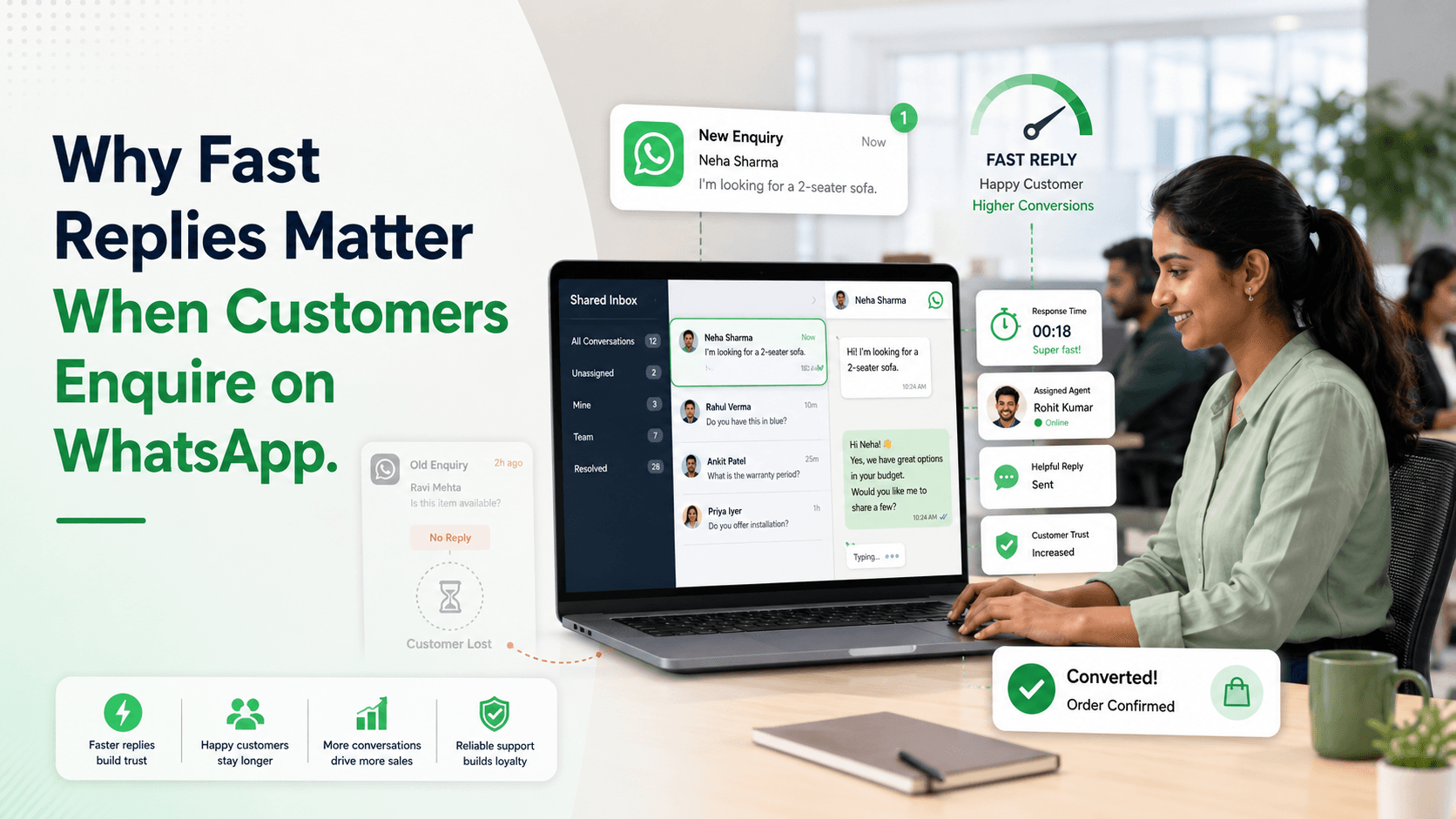
Why Fast Replies Matter When Customers Enquire on WhatsApp
Learn why fast WhatsApp replies improve customer experience, increase conversions, build trust, and help businesses prevent valuable enquiries from being lost.
On this page15 sections
- Why Fast Replies Matter When Customers Enquire on WhatsApp
- 1. Customers Expect WhatsApp to Be Fast
- 2. Customer Interest Is Highest at the Time of Enquiry
- 3. Slow Replies Send Customers to Competitors
- 4. Fast Replies Build Trust
- 5. Fast Responses Improve Conversion Opportunities
- 6. Immediate Acknowledgement Prevents Uncertainty
- 7. Faster Routing Creates Faster Answers
- 8. Context Makes Fast Replies More Useful
- 9. Automation Supports Teams During Busy Periods
- 10. Response Speed Should Be Measured
- Example of a Fast WhatsApp Enquiry Workflow
- Fast-Reply Checklist
- How Voixt.ai Helps
- Final Thoughts
Why Fast Replies Matter When Customers Enquire on WhatsApp
Customers use WhatsApp because they expect communication to be quick and convenient.
When someone asks about a product, service, price, appointment, or delivery, they are usually interested at that moment. A fast and helpful reply keeps that interest active. A delayed response gives the customer time to lose interest, contact a competitor, or abandon the purchase.
Fast replies do more than improve response time. They build trust, increase conversions, and create a better customer experience.
1. Customers Expect WhatsApp to Be Fast
WhatsApp feels more immediate than email or a website contact form. Customers often use it when they want a quick answer.
They may ask:
- Is this product available?
- What is the price?
- Can you deliver today?
- Do you provide this service in my location?
- Can I book an appointment?
- Which package is suitable for me?
If the business takes several hours to respond, the experience no longer feels convenient.
A quick acknowledgement shows the customer that the enquiry has been received and will be handled.
Hi! Thanks for contacting BrightHome Interiors. We’ve received your enquiry, and a team member will respond within 10 minutes.
The response should set an accurate expectation rather than promise a speed the team cannot maintain.
2. Customer Interest Is Highest at the Time of Enquiry
A customer who sends a message is actively considering the business.
They may have just:
- Seen an advertisement
- Visited the website
- Viewed a product catalogue
- Received a recommendation
- Compared several options
- Decided to make a purchase
This is the best time to continue the conversation.
For example:
Hi Priya, the dining table shown in the advertisement is available for ₹18,500, including six chairs. Would you like to see the available colours?
This reply answers the question and offers one simple next step while the customer is still interested.
3. Slow Replies Send Customers to Competitors
Customers frequently contact more than one business before making a decision.
The first business to provide a clear and useful response has an advantage. It can understand the requirement, recommend an option, answer concerns, and guide the customer toward the next step.
A competitor may secure the purchase even if its product is not cheaper, simply because it responded first and made the process easier.
Businesses should therefore monitor:
- New conversations
- Unassigned enquiries
- Unread messages
- After-hours enquiries
- Conversations waiting for an employee
- High-intent messages
- Missed follow-ups
Every genuine enquiry should have an owner and a clear status.
4. Fast Replies Build Trust
Customers notice how a business communicates before they make a purchase.
A quick, organised response suggests that the business is attentive and reliable. It gives customers confidence that future questions, delivery updates, or support requests will also be handled properly.
However, speed alone is not enough.
A fast but unhelpful reply such as:
Check our website.
may still frustrate the customer.
A better response would be:
Hi Arjun, our plans start at ₹1,349 per month. The most suitable option depends on your team size and automation requirements. How many people need access?
The goal is to respond quickly while providing relevant information.
5. Fast Responses Improve Conversion Opportunities
Every delay creates another opportunity for the customer to leave.
A timely reply allows the business to:
- Identify the customer’s requirement
- Confirm availability
- Share pricing
- Explain what is included
- Recommend a suitable option
- Answer objections
- Arrange a demonstration
- Schedule an appointment
- Send a quotation
- Provide a payment link
The faster these actions happen, the easier it is to maintain momentum.
For example:
The blue model is currently available for ₹3,200 and can be delivered tomorrow. Would you like me to reserve one?
This response turns a simple enquiry into a clear purchase opportunity.
6. Immediate Acknowledgement Prevents Uncertainty
Businesses cannot always provide a complete answer immediately. The relevant employee may be unavailable, or the enquiry may require additional information.
In these situations, an automated acknowledgement can reassure the customer.
During business hours:
Hi! Thanks for contacting us. We’ve received your message and will respond within 15 minutes. Please share the product name or photo so we can assist you faster.
Outside business hours:
Hi! Our team is currently offline and will respond after 9:00 AM tomorrow. Meanwhile, please share your name and requirement so we can direct your enquiry to the correct person.
An acknowledgement should:
- Confirm that the message was received
- Identify the business
- State the expected response time
- Collect only essential information
- Provide access to human support when available
It should not pretend that a complete response has been provided.
7. Faster Routing Creates Faster Answers
An enquiry may still be delayed after receiving an automated greeting if it is not assigned correctly.
Businesses should route conversations according to factors such as:
- Product or service
- Department
- Customer location
- Preferred language
- Campaign source
- Existing customer status
- Agent availability
- Enquiry urgency
- Purchase intent
A customer asking about payment should reach the billing team. A high-value sales enquiry should reach an appropriate sales representative. A complaint should not remain in a general enquiry queue.
Correct routing reduces unnecessary transfers and repeated questions.
8. Context Makes Fast Replies More Useful
Employees respond faster when they can see the customer’s context.
The conversation should show:
- Customer name and contact details
- Previous messages
- Advertisement or campaign source
- Product viewed
- Earlier purchases
- Assigned employee
- CRM stage
- Internal notes
- Previous quotations
- Scheduled follow-ups
Without this information, employees may ask customers to repeat themselves.
Instead of:
Which product are you asking about?
the business can respond:
Hi Meera, the skincare package from the Instagram advertisement is ₹2,499 and includes all four products shown. Would you like the ingredient details?
A contextual reply feels faster, more personal, and more professional.
9. Automation Supports Teams During Busy Periods
Automation can help businesses maintain quick response times when message volume is high.
It can:
- Send instant acknowledgements
- Identify customer intent
- Answer common questions
- Collect basic information
- Create CRM records
- Apply contact tags
- Assign conversations
- Prioritise urgent enquiries
- Schedule follow-ups
- Notify responsible employees
Automation should not trap customers in an unhelpful sequence.
Provide a clear handover option:
Type AGENT at any time to speak with our team.
Complex requirements, complaints, negotiations, payment problems, and repeated failed responses should be transferred to an employee with the complete conversation history.
10. Response Speed Should Be Measured
Businesses cannot improve response times without tracking them.
Useful metrics include:
- Average first-response time
- Percentage of enquiries answered within the target time
- Assignment time
- Average resolution time
- Number of unanswered conversations
- After-hours response time
- Conversion rate by response time
- Customer satisfaction
- Agent workload
- Missed follow-ups
These measurements help identify whether delays are caused by staffing, routing, unclear ownership, or disconnected systems.
Response targets should be realistic and based on business hours, enquiry type, and urgency.
Example of a Fast WhatsApp Enquiry Workflow
Customer
Price please.
Automated response
Hi! Thanks for your interest in Voixt.ai. Plans start at ₹1,349 per month. How many team members need access?
Customer
Five people.
Qualification
Thank you. Do you need only a shared WhatsApp inbox, or would you also like automation and CRM tracking?
Customer
We need both.
Agent response
Hi, I’m Ananya from Voixt.ai. Based on your team size and requirements, I can recommend the most suitable package. Would tomorrow at 11:00 AM work for a short demonstration?
The enquiry is then captured in the CRM, assigned to an employee, moved to the appropriate pipeline stage, and scheduled for follow-up.
The customer receives immediate assistance without losing access to a human representative.
Fast-Reply Checklist
For every WhatsApp enquiry, confirm that:
- The customer receives an immediate acknowledgement.
- The expected response time is accurate.
- The correct product or campaign is identified.
- The enquiry is assigned to one employee.
- The employee can see the conversation history.
- The response answers the customer’s question.
- Only necessary information is requested.
- One clear next step is proposed.
- After-hours enquiries are followed up.
- Automation provides a human handover option.
- Response time and outcome are recorded.
How Voixt.ai Helps
Voixt.ai helps businesses respond to WhatsApp enquiries faster through:
- AI-powered instant responses
- Shared multi-agent inboxes
- Automatic conversation capture
- No-code qualification workflows
- Conversation assignments
- Contact tags and filters
- Visual CRM pipelines
- Private internal notes
- Automated follow-ups
- AI-to-human handovers
- Campaign and contact management
These capabilities help teams organise incoming conversations, maintain customer context, and ensure that valuable enquiries do not remain unanswered.
Final Thoughts
Fast replies matter because customer interest is strongest when the enquiry is made.
Businesses that respond quickly can build trust, understand requirements, answer questions, and guide customers toward the next step before attention shifts elsewhere.
The best response is not merely immediate. It is relevant, helpful, personalised, and connected to a clear follow-up process.
Start using Voixt.ai to capture, assign, track, and respond to WhatsApp enquiries before valuable opportunities are lost.