
Why Sending the Same Message to Every Customer Doesn't Work
Learn why generic WhatsApp campaigns lose customer attention and how segmentation, personalisation, timing, customer stages, and preference management improve results.
On this page23 sections
- Why Sending the Same Message to Every Customer Doesn't Work
- Customers Have Different Needs
- Generic Messages Are Easy to Ignore
- 1. Different Customers Want Different Products
- 2. Location Changes Relevance
- 3. Customer Stage Changes the Message
- 4. Purchase History Provides Useful Context
- 5. Timing Differs Between Customers
- 6. Budget and Product Positioning Matter
- 7. Communication Preferences Are Different
- 8. Previous Responses Should Influence Future Messages
- Build Practical Customer Segments
- Use Exclusions Carefully
- Personalisation Is More Than a Name
- Keep Customer Data Accurate
- Prepare for Campaign Replies
- Connect Messages to a Sales Process
- Test Messages Before Sending
- Measure Segment Performance
- Examples of Better Segmented Messages
- Common Mistakes to Avoid
- How Voixt.ai Helps Businesses Send More Relevant Messages
- Final Thoughts
Why Sending the Same Message to Every Customer Doesn't Work
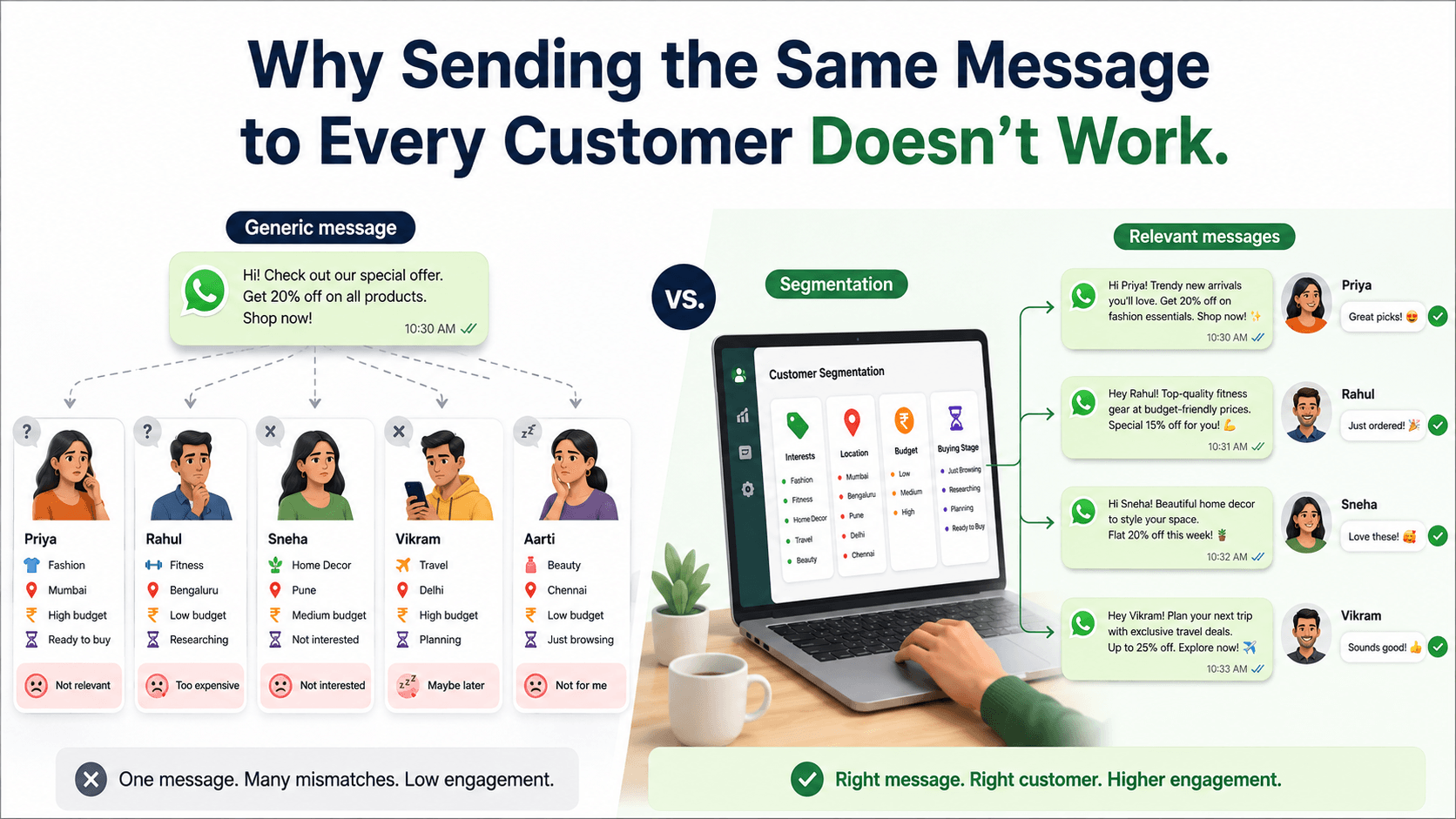
Customers do not all want the same products, have the same budgets, live in the same locations, or occupy the same stage of the buying journey.
Yet many businesses send one WhatsApp message to every contact in their database.
A generic campaign may promote products customers do not need, send purchase reminders to people who already bought, announce local events to customers in another city, or offer beginner services to experienced users.
The problem is not always the message itself. The problem is that the message reaches people for whom it has no relevance.
Effective WhatsApp communication begins by understanding who should receive a message, why it matters to them, and what they should do next.
Customers Have Different Needs
A business contact list may contain:
- New leads
- Existing customers
- Repeat buyers
- Inactive customers
- People waiting for a product
- Customers with open support issues
- Customers from different locations
- People interested in different categories
- High-value customers
- People who requested only transactional updates
Sending the same promotion to all these groups ignores the reason each person is connected to the business.
A new lead may need an introduction. A repeat buyer may need a reorder option. A customer with an unresolved complaint needs support—not another sales message.
Generic Messages Are Easy to Ignore
A broad message often says something like:
Hi! Check out our latest products and special offers. Shop now!
The customer may not know:
- Which products are relevant
- Why they received the message
- Whether the offer applies to them
- What has changed
- Why they should act now
- What they should do next
A specific message is more useful:
Hi Meera, the cotton kurtas you asked about are back in stock in sizes M and L. Prices start at ₹1,299. Reply STYLES to see the available colours.
The second message connects to a known customer interest and provides a clear action.
1. Different Customers Want Different Products
Product interest is one of the simplest ways to segment customers.
A retailer might organise contacts by:
- Women’s clothing
- Men’s clothing
- Children’s products
- Footwear
- Jewellery
- Home décor
- Furniture
- Electronics
- Beauty products
A customer who regularly purchases home décor should not receive every clothing launch. A person interested in budget office chairs may not want a campaign for premium sofas.
Record preferences through legitimate customer enquiries, purchases, and voluntary selections.
2. Location Changes Relevance
Many messages are useful only within a specific area.
Examples include:
- Store openings
- Branch events
- Local delivery offers
- Appointment availability
- Property listings
- Workshops
- Regional service coverage
A customer in Pune should not repeatedly receive event invitations for Bengaluru.
Location segmentation can use:
- City
- Delivery area
- Preferred branch
- Service territory
- Store visited
Use location only when it is necessary and appropriately collected.
3. Customer Stage Changes the Message
People need different communication at different stages.
| Customer stage | Useful message |
|---|---|
| New enquiry | Helpful introduction and qualification |
| Product viewed | Relevant details or comparison |
| Quotation sent | Contextual follow-up |
| Awaiting payment | Clear order summary and payment assistance |
| Existing customer | Order updates or relevant recommendations |
| Repeat buyer | Reorder option or loyalty benefit |
| Inactive customer | Respectful re-engagement message |
| Complaint open | Support and resolution update |
Sending an introductory promotion to an existing buyer appears careless. Sending a purchase reminder to someone who has already paid creates confusion.
A customer’s stage should update whenever the conversation or order progresses.
4. Purchase History Provides Useful Context
Previous purchases can help businesses send more relevant communication.
Examples include:
- Replenishment reminders
- Compatible accessories
- Maintenance messages
- Restock alerts
- New variants of a purchased product
- Renewal reminders
For example:
Hi Arjun, the replacement filter for the purifier you purchased last year is available for ₹650. Reply FILTER if you would like compatibility and delivery details.
Avoid recommending the same durable product immediately after purchase or exposing sensitive purchase information unnecessarily.
5. Timing Differs Between Customers
Customers do not all purchase on the same schedule.
A reorder reminder should consider:
- Previous purchase date
- Quantity purchased
- Typical usage cycle
- Customer-requested reminder date
- Product lifespan
- Service renewal date
If one customer reorders every month and another every three months, sending both the same monthly reminder will annoy one of them.
Timing is part of personalisation.
6. Budget and Product Positioning Matter
A customer who asked for an affordable option may not find repeated premium-product promotions useful.
Businesses can organise customers by broad, appropriate price preferences based on actual enquiries or purchases.
For example:
Hi Kavya, three new compact dining tables have arrived within the ₹15,000–₹20,000 range you requested. Reply TABLES to view them.
Do not make assumptions about a customer’s income or financial circumstances. Use the budget they voluntarily shared for a specific purchase.
7. Communication Preferences Are Different
Some customers may want:
- Order updates
- New-arrival messages
- Reorder reminders
- Appointment reminders
- Event invitations
- Offers
- Product recommendations
Others may want only essential transactional communication.
WhatsApp’s Business Messaging Policy requires businesses to obtain appropriate opt-in permission and respect requests to stop communication. WhatsApp Business Messaging Policy
Where practical, let customers choose message categories:
Which updates would you like to receive? Reply ARRIVALS, OFFERS, REORDERS, or ORDERS. You can update your preferences at any time.
A phone number should not automatically place someone into every campaign.
8. Previous Responses Should Influence Future Messages
Customer behaviour provides useful signals.
For example:
- A customer repeatedly requests new-arrival catalogues
- A customer postpones reorder reminders
- A customer ignores one category but responds to another
- A customer asks not to receive event messages
- A customer requests a restock alert
Use these signals to improve communication.
If a customer repeatedly selects LATER, increase the reminder interval. If they request only product availability messages, do not automatically add general promotions.
Build Practical Customer Segments
Segmentation does not need to begin with hundreds of groups.
Start with useful categories such as:
- New lead
- Existing customer
- Repeat buyer
- Product category
- Location
- Preferred branch
- Waiting for restock
- Reorder due
- Appointment booked
- Support issue open
- Promotional opt-in
Combine segments when necessary.
For example:
Customers in Mumbai + interested in women’s ethnic wear + opted into new-arrival updates + have not purchased from the new collection.
This produces a smaller but more relevant audience.
Use Exclusions Carefully
Campaign selection should include exclusion rules.
Exclude customers who:
- Already purchased the promoted item
- Asked to stop messages
- Recently received the same campaign
- Declined the category
- Live outside the eligible location
- Have an unresolved complaint
- Are at an inappropriate sales stage
- Do not meet the campaign conditions
Exclusions protect the customer experience and prevent waste.
Personalisation Is More Than a Name
A message can contain the customer’s name and still be irrelevant.
Compare:
Hi Meera, enjoy 10% off all furniture today.
With:
Hi Meera, the compact study table you asked about is back in stock. Delivery to Baner is available this week. Reply RESERVE if you would like us to hold one until tomorrow.
The second message is personalised through context, timing, and a useful next step.
Keep Customer Data Accurate
Segmentation fails when data is outdated.
Regularly update:
- Customer stage
- Product interest
- Location
- Purchase status
- Opt-in categories
- Opt-out status
- Last contact date
- Assigned employee
- Follow-up date
Remove duplicate records and avoid maintaining separate versions across phones and spreadsheets.
Only collect information that serves a legitimate customer or business purpose. Protect it appropriately and follow applicable privacy requirements.
Prepare for Campaign Replies
A targeted message can produce many high-intent responses.
Before sending, confirm:
- Which employees will reply
- How conversations will be assigned
- Whether stock is current
- Whether prices and conditions are approved
- Which next actions are available
- How opt-outs will be handled
- How interested customers will be tracked
Do not send a campaign if the team cannot support the conversations it creates.
Connect Messages to a Sales Process
A campaign should not end when the message is delivered.
Replies can move through a structured pipeline:
- Customer replied
- Requirement identified
- Product or service recommended
- Follow-up scheduled
- Awaiting decision
- Awaiting payment
- Purchase confirmed
- Not interested
- Opted out
Each active opportunity needs an owner and next action.
Test Messages Before Sending
Review:
- Audience segment
- Exclusion rules
- Customer names
- Product information
- Prices
- Offer dates
- Location conditions
- Links
- Reply keywords
- Opt-out instructions
Send a test to an internal contact before launching the full campaign.
Check how the message appears on a phone and whether the call to action is clear.
Measure Segment Performance
Track results by audience segment rather than viewing only overall campaign totals.
Useful metrics include:
- Reply rate
- Qualified enquiries
- Purchases
- Revenue
- Conversion rate
- Average order value
- Opt-outs
- Blocks and complaints
- Performance by location
- Performance by customer stage
- Performance by product interest
A smaller segment may generate fewer replies but a much higher conversion rate.
This information helps the business improve future targeting.
Examples of Better Segmented Messages
New lead
Hi Rahul, thanks for enquiring about our office furniture. Are you furnishing a home office or a larger team workspace? We’ll share the most relevant options.
Existing clothing customer
Hi Meera, our new cotton kurta collection has arrived in sizes S to XXL. Since you previously preferred lightweight styles, we selected five suitable options. Reply STYLES to view them.
Reorder customer
Hi Arjun, would you like to reorder your usual printer supplies? The current total is ₹2,350, with delivery available on Friday. Reply REORDER or CHANGE.
Restock customer
Hi Kavya, the lamp you requested is back in stock in the brass finish. Reply RESERVE if you would like us to hold one until tomorrow.
Customer with an open issue
Hi Ananya, we are still working on your delivery concern. Our support team will update you by 4:00 p.m. today.
The last customer should not receive a promotional campaign until the issue is appropriately handled.
Common Mistakes to Avoid
Creating Too Many Segments Immediately
Start with a few groups connected to clear customer needs.
Using Inaccurate Data
Review customer stages, purchases, locations, and preferences regularly.
Personalising With Sensitive Information
Use only appropriate customer context.
Forgetting Exclusions
Remove completed buyers, opt-outs, and unsuitable contacts.
Sending More Messages When Engagement Falls
Improve relevance, timing, and targeting first.
Treating Every Reply as a New Conversation
Keep customer history and previous context accessible.
Measuring Only Delivery Volume
Track conversions, revenue, preference changes, and negative feedback.
How Voixt.ai Helps Businesses Send More Relevant Messages
Voixt.ai helps businesses organise customer information and create more focused WhatsApp communication.
Teams can use:
- Contact tags and filters to build segments based on interests, purchases, locations, and customer stages
- Campaign management to organise targeted messages and responses
- Automatic contact capture to maintain structured customer records
- Shared multi-agent WhatsApp inboxes so employees can manage replies together
- Conversation assignments so every interested customer has an owner
- Visual CRM pipelines to track customers through the sales journey
- Follow-up reminders so opportunities are not forgotten
- No-code automation workflows for tagging, routing, preferences, and stage updates
- AI-powered responses to help employees answer common questions
- Private internal notes for sharing customer context
- AI-to-human handovers when personal assistance is required
This allows businesses to move away from one-message-for-everyone campaigns and create communication that reflects real customer needs.
Final Thoughts
Sending the same message to every customer may be convenient for the business, but it transfers the inconvenience to the customer.
Relevant communication requires appropriate permission, accurate customer information, practical segments, careful exclusions, and messages matched to the customer’s stage and interests.
The objective is not to make every campaign larger. It is to make every message more useful.
Voixt.ai helps businesses organise the customer context required to do that consistently.